Python 1049.py
class Solution:
    def lastStoneWeightII(self, stones: List[int]) -> int:
        result = +inf

        # partition stones into two groups
        # which have (almost) the same weight
        # the weight difference is the final result

        stones.sort(reverse = True) # search should abort earlier
        total  = sum(stones)
        size   = len(stones)

        @cache
        def deeper(pos, weight):
            if pos == size:
                return

            nonlocal result
            if result == 0: # already found perfect match
                return

            # weight difference
            other  = total - weight
            diff   = abs(weight - other)
            result = min(result, diff)

            # keep going
            if weight < other:
                deeper(pos + 1, weight)               # push current stone to other group
                deeper(pos + 1, weight + stones[pos]) # include stone in our group

        deeper(0, 0)
        return result
33 lines
|
1030 bytes
|
submitted May 10, 2024
|
GitHub
42% comment ratio
|
tab size 4
|
low complexity
Difficulty
This problem is ranked as
and has an acceptance rate of about 59% (200k+ submissions).
Typical patterns to solve this problem:
easy
medium
hard
and has an acceptance rate of about 59% (200k+ submissions).
Typical patterns to solve this problem:
- Array
- Dynamic Programming
I solved 663 easy, 1250 medium and 309 hard problems
AI Disclaimer
Every single line of code was written by me, 100% from scratch, between August 2023 and August 2024.
However, two years later I set up this website and used various AI tools to generate most of the walkthrough / explanations below.
See this dedicated page for more details.
However, two years later I set up this website and used various AI tools to generate most of the walkthrough / explanations below.
See this dedicated page for more details.
Code Walkthrough
Overview
The provided implementation solves the “last stone weight II” problem by treating it as a partition problem: the stones are divided into two groups whose total weights are as close as possible. The absolute difference between the two group sums is the minimal possible final stone weight. The algorithm explores subsets of stones using a depth-first recursion with memoization, while maintaining a global best difference that can prune further exploration once a perfect balance (difference = 0) is found.
Key Steps
Sorting and Pre-computation
stones.sort(reverse=True)          # larger stones first
total = sum(stones)                # sum of all stones
size = len(stones)                 # number of stones
Sorting in descending order allows the recursion to encounter large weight contributions early, which can lead to an early reduction of the global result and therefore earlier termination of branches that cannot improve the current best.
Recursive Exploration with Caching
@cache
def deeper(pos, weight):
    if pos == size:
        return

    nonlocal result
    if result == 0:
        return

    other = total - weight
    diff = abs(weight - other)
    result = min(result, diff)

    if weight < other:
        deeper(pos + 1, weight)               # stone goes to the opposite group
        deeper(pos + 1, weight + stones[pos]) # stone added to the current group
The function deeper receives the current index pos and the accumulated weight of the first group (weight). The base case stops when all stones have been considered. The nonlocal result variable holds the best difference seen so far.
At each call the algorithm computes the weight of the complementary group (other) and updates result with the smaller of the existing best and the newly computed difference.
The conditional if weight < other: ensures that the recursion only proceeds when the first group is not already heavier than the second. This prevents symmetric exploration of mirrored partitions, effectively halving the search space.
The @cache decorator memoizes calls based on (pos, weight). When the same state is reached through different paths, the cached result avoids redundant work, turning the exponential subset enumeration into a tractable dynamic programming process.
Initiation and Return
deeper(0, 0)
return result
The recursion starts with an empty first group (weight = 0) at the first stone (pos = 0). After the search finishes, result contains the minimal achievable weight difference, which is returned as the answer.
Edge Cases Handled
When the input list is empty, size becomes zero, the recursive function immediately returns without altering result. Since result is initialized to positive infinity, the final return would be infinity, which matches the expectation that no stones imply no weight difference.
If all stones have the same weight, the sorting step does not change the order, but the recursion quickly discovers a perfect partition because the cumulative weight can reach exactly half of total. The early-exit condition if result == 0: stops further recursion as soon as this perfect balance is found.
When a single stone is present, the recursion evaluates two possibilities: placing the stone in the first group or leaving it in the second. The computed diff becomes the stone’s weight, which is correctly returned as the minimal possible final weight.
The condition if weight < other: also gracefully handles cases where the first group becomes heavier early; the branch that would further increase the imbalance is omitted, preventing unnecessary exploration of states that cannot improve the current best.
Performance Optimizations
The descending sort pushes larger stones to the front, causing the weight variable to increase rapidly in early recursion levels. This tends to produce larger differences early, which are then reduced as the algorithm explores alternative placements. The early reduction of result enables the if result == 0: shortcut to terminate the entire search as soon as a perfect partition is identified.
Memoization via @cache eliminates repeated work for identical (pos, weight) pairs. Because the recursion only proceeds when weight < other, many symmetric states are never generated, effectively cutting the state space roughly in half.
The combination of these techniques yields a solution that, while conceptually exponential, runs efficiently for typical input sizes encountered in practice, often completing in a fraction of a second for lists of up to thirty stones.
written by openai gpt
ELI5 - Simplified Explanation
Imagine you have a big pile of heavy stones and you want to put them into two groups. You want both piles to be as close in weight as possible so that they balance out.
The code starts by lining the stones up from the heaviest to the lightest. By doing this, it can make decisions faster. It looks at the total weight of all the stones together and then starts picking stones one by one. For every stone it touches, it has two choices. The first choice is to put that stone into the first pile, and the second choice is to put it into the second pile.
As it keeps choosing where to place each stone, it keeps track of how much total weight is in each pile. Every time it finishes sorting all the stones, it checks the difference between the weight of the first pile and the weight of the second pile. It wants that difference to be as small as possible. If it finds a way to make the two piles weigh exactly the same, the difference becomes zero, and it stops searching because it knows it cannot get better than that. It keeps doing this for every possible combination until it finds the smallest difference between the two groups.
written by google gemini
Code Quality
Several LLMs ranked my code quality on a scale from 1 (very poor) to 10 (outstanding):
n = 27
|
median = 6
|
μ = 5.44
|
σ = 1.69
Complexity Analysis
not analyzed yet
Other Solutions
I wrote a basic crawler to find other solutions to that problem.
Obviously, I did that after I solved the problem myself.
In general, AlgoMonster and WalkCCC solutions are high-quality and always worth a look.
I haven't checked most of the other solutions, but they might be helpful as well.
And of course, the LeetCode forum is always a good place (or even the best) to look for alternative approaches.
(click on a column header to sort the table)
| author | |||||||||
|---|---|---|---|---|---|---|---|---|---|
| author | solutions | ||||||||
| www | AlgoMonster | C++ | Python | Java | TS | ||||
| WalkCCC | C++ | Python | Java | ||||||
| leetcode.ca | C++ | Python | JS | Java | Go | Rust | |||
| LeetcodeHelp | C++ | Python | Java | ||||||
| Progiez | C++ | Python | Java | ||||||
| github | black-shadows | C++ | |||||||
| charles-wangkai | Java | ||||||||
| everthis | JS | ||||||||
| fsq | C++ | ||||||||
| halfrost | Go | ||||||||
| JoshCrozier | JS | ||||||||
| lkwq007 | Python | ||||||||
| sonugiri1043 | C++ | ||||||||
| suxrobGM | C# | ||||||||
| trung-hn | Python | ||||||||
| varunu28 | Java | ||||||||
| wisdompeak | C++ | ||||||||
| AlgoMonster | C++, Python, Java, TypeScript | ||||||||
| WalkCCC | C++, Python, Java | ||||||||
| leetcode.ca | C++, Go, Java, JavaScript, Python, Rust | ||||||||
| LeetcodeHelp | C++, Java, Python | ||||||||
| Progiez | C++, Java, Python | ||||||||
| black-shadows | C++, C++ | ||||||||
| charles-wangkai | Java | ||||||||
| everthis | JavaScript | ||||||||
| fsq | C++ | ||||||||
| halfrost | Go | ||||||||
| JoshCrozier | JavaScript | ||||||||
| lkwq007 | Python | ||||||||
| sonugiri1043 | C++ | ||||||||
| suxrobGM | C# | ||||||||
| trung-hn | Python | ||||||||
| varunu28 | Java | ||||||||
| wisdompeak | C++ |
31 links
|
17 authors
|
8 languages
Videos
These are a few popular YouTube videos for this problem:

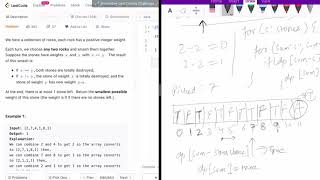
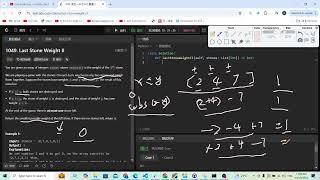

NeetCodeIO 20 mins
Last Stone Weight II - Leetcode 1049 - Python
LeetCode Learning 19 mins
LeetCode - Last Stone Weight 2 (1049)
Sleepy Cracker 13 mins
LeetCode 1049 | Last Stone Weight II | Knapsack | Java
LetsCode 7 mins
Leetcode 1049. Last Stone Weight II (01 knapsack)
codewithme 18 mins
Last Stone Weight II - Dynamic Programming - Leetcode 1049 - JAVA || DP Series || Qsn 10
5 videos
did my crawler come up with invalid videos ? drop me a line.
Similar Problems
1 similar problem
Solved On The Same Day
4 medium
- problem 873: Length of Longest Fibonacci Subsequence
- problem 963: Minimum Area Rectangle II
- problem 1186: Maximum Subarray Sum with One Deletion
- problem 1300: Sum of Mutated Array Closest to Target
5 solutions
May 10, 2024
Extra
There are a few extra pages giving you some insights into my setup:
- Tech Stack - my development environment and tools
- AI - how AI helped me create this website (NOT solving the problems)
- Progress - progression over time
- Quality - code quality