Python 0113.py
class Solution:
    def deeper(self, root, sumSoFar, target):
        if not root:
            return None

        sumSoFar += root.val

        if not root.left and not root.right:
            if sumSoFar == target:
                return [ [ root.val ] ]
            else:
                return None

        result = []
        paths = self.deeper(root.left, sumSoFar, target)
        if paths:
            for p in paths:
                result.append([ root.val ] + p)
        paths = self.deeper(root.right, sumSoFar, target)
        if paths:
            for p in paths:
                result.append([ root.val ] + p)

        return result


    def pathSum(self, root: Optional[TreeNode], targetSum: int) -> List[List[int]]:
        if not root:
            return []

        return self.deeper(root, 0, targetSum)
Difficulty
This problem is ranked as
and has an acceptance rate of about 63% (1+ million submissions).
Typical patterns to solve this problem:
easy
medium
hard
and has an acceptance rate of about 63% (1+ million submissions).
Typical patterns to solve this problem:
- Backtracking
- Binary Tree
- Depth First Search
- Tree
I solved 663 easy, 1250 medium and 309 hard problems
AI Disclaimer
Every single line of code was written by me, 100% from scratch, between August 2023 and August 2024.
However, two years later I set up this website and used various AI tools to generate most of the walkthrough / explanations below.
See this dedicated page for more details.
However, two years later I set up this website and used various AI tools to generate most of the walkthrough / explanations below.
See this dedicated page for more details.
Code Walkthrough
Overview
The provided implementation defines a class Solution that solves the classic “path sum” problem on a binary tree. The goal is to return every root-to-leaf path whose node values add up to a given target sum. The solution separates the traversal logic into a helper method deeper and a public entry point pathSum. The helper carries the cumulative sum while descending the tree, builds qualifying paths, and aggregates results from both sub-trees.
Key Steps
The algorithm proceeds through a depth-first search that tracks the running total of node values. The first critical operation is the base case that stops recursion when a null node is encountered.
if not root:
    return None
When a node is present, its value is added to the running total.
sumSoFar += root.valThe next decisive step checks whether the current node is a leaf. If it is, the method compares the accumulated sum with the target. A match yields a single-element path wrapped in a list; otherwise the call returns None.
if not root.left and not root.right:
    if sumSoFar == target:
        return [ [ root.val ] ]
    else:
        return None
If the node is not a leaf, the method recursively explores the left child, collects any returned paths, and prefixes each with the current node’s value.
paths = self.deeper(root.left, sumSoFar, target)
if paths:
    for p in paths:
        result.append([ root.val ] + p)
The same pattern is repeated for the right child, ensuring that paths from both sides are merged into a single result list.
paths = self.deeper(root.right, sumSoFar, target)
if paths:
    for p in paths:
        result.append([ root.val ] + p)
Finally, the helper returns the assembled list of qualifying paths.
return resultThe public method pathSum guards against an empty tree and initiates the recursion with a zeroed cumulative sum.
if not root:
    return []
return self.deeper(root, 0, targetSum)
Edge Cases Handled
The code explicitly handles the situation where the input tree is empty. By returning an empty list early, it avoids unnecessary recursion and conforms to the expected output format for a tree with no nodes.
When a leaf node is reached, the algorithm distinguishes between a successful match (cumulative sum equals the target) and a mismatch. In the mismatch case, it returns None, which later prevents the leaf’s value from being added to any result path. This distinction ensures that only complete root-to-leaf paths that satisfy the sum condition are reported.
The recursion also gracefully deals with sub-trees that contain no qualifying paths. The if paths: guard filters out None returns, so an empty branch does not contribute spurious entries to the final list.
Performance Optimizations
The implementation leverages in-place accumulation of the sum (sumSoFar += root.val) rather than constructing a new sum object for each recursive call. This reduces the overhead of creating additional integer objects during traversal.
Path construction uses list concatenation ([ root.val ] + p) only when a qualifying sub-path p is already known. By postponing concatenation until a valid path is identified, the algorithm avoids unnecessary list copying for branches that do not lead to a solution.
The helper returns None for dead ends instead of an empty list. This choice allows the caller to perform a simple truthy check (if paths:) rather than iterating over an empty collection, thereby saving iteration cost on branches that yield no results.
Collecting results in a local result list and returning it once per call minimizes the number of intermediate list objects. Each recursive level aggregates its own contributions before passing the combined list upward, which keeps the memory footprint proportional to the number of successful paths rather than the total number of nodes visited.
written by openai gpt
ELI5 - Simplified Explanation
Imagine a tree made of numbers where you start at the very top. The goal is to walk down all the different branches to reach the bottom. As you step on each number, you carry a little basket and put that number inside it, keeping a running total of how much the numbers add up to as you go.
When you reach the very end of a branch, you check your basket. If the total of the numbers you collected matches the magic target number, you keep that path as a success. If the total is different, you leave that path behind because it is not the one being looked for.
To do this, the computer acts like a curious explorer. It starts at the top and asks if it should go left or right. It keeps diving deeper into the tree, always counting as it explores. When it finds a path that works, it remembers those numbers. The computer looks at every single branch of the tree one by one until it has checked the entire garden of numbers to see which paths add up to the perfect sum.
written by google gemini
Code Quality
Several LLMs ranked my code quality on a scale from 1 (very poor) to 10 (outstanding):
n = 27
|
median = 7
|
μ = 6.37
|
σ = 1.57
Complexity Analysis
not analyzed yet
Other Solutions
I wrote a basic crawler to find other solutions to that problem.
Obviously, I did that after I solved the problem myself.
In general, AlgoMonster and WalkCCC solutions are high-quality and always worth a look.
I haven't checked most of the other solutions, but they might be helpful as well.
And of course, the LeetCode forum is always a good place (or even the best) to look for alternative approaches.
(click on a column header to sort the table)
| author | ||||||||||||
|---|---|---|---|---|---|---|---|---|---|---|---|---|
| author | solutions | |||||||||||
| www | AlgoMonster | C++ | Python | Java | TS | |||||||
| WalkCCC | C++ | Python | Java | |||||||||
| leetcode.ca | C++ | Python | JS | Java | Rust | Go | ||||||
| LeetcodeHelp | C++ | Python | Java | |||||||||
| MemoryLimitExceeded | C++ | Python | ||||||||||
| Progiez | C++ | Python | Java | |||||||||
| github | aylei | Rust | ||||||||||
| begeekmyfriend | C | |||||||||||
| BigEggStudy | C# | |||||||||||
| black-shadows | Python | |||||||||||
| charles-wangkai | Java | |||||||||||
| chenyanzhe | C++ | |||||||||||
| DimitrisJim | JS | |||||||||||
| everthis | JS | |||||||||||
| fartem | Ruby | |||||||||||
| fengvyi | C++ | |||||||||||
| fpdjsns | C++ | |||||||||||
| gaosq0604 | Python | |||||||||||
| Garvit244 | Python | |||||||||||
| halfrost | Go | |||||||||||
| JoshCrozier | JS | |||||||||||
| keineahnung2345 | C++ | |||||||||||
| lennylxx | C++ | |||||||||||
| linouk23 | C++ | |||||||||||
| lkwq007 | Python | |||||||||||
| luangong | C++ | |||||||||||
| MacJim | C++ | |||||||||||
| martianoff | Scala | |||||||||||
| qiyuangong | Python | |||||||||||
| ruoru | Rust | |||||||||||
| shreymehul | C# | |||||||||||
| sonugiri1043 | C++ | |||||||||||
| suxrobGM | C# | |||||||||||
| varunu28 | Java | |||||||||||
| vthwang | Java | |||||||||||
| XiaotaoGuo | C++ | |||||||||||
| zfang399 | C++ | |||||||||||
| AlgoMonster | C++, Python, Java, TypeScript | |||||||||||
| WalkCCC | C++, Python, Java | |||||||||||
| leetcode.ca | C++, Go, Java, JavaScript, Python, Rust | |||||||||||
| LeetcodeHelp | C++, Java, Python | |||||||||||
| MemoryLimitExceeded | Python, C++ | |||||||||||
| Progiez | C++, Java, Python | |||||||||||
| aylei | Rust | |||||||||||
| begeekmyfriend | C | |||||||||||
| BigEggStudy | C# | |||||||||||
| black-shadows | Python, Python | |||||||||||
| charles-wangkai | Java | |||||||||||
| chenyanzhe | C++ | |||||||||||
| DimitrisJim | JavaScript | |||||||||||
| everthis | JavaScript | |||||||||||
| fartem | Ruby | |||||||||||
| fengvyi | C++ | |||||||||||
| fpdjsns | C++ | |||||||||||
| gaosq0604 | Python | |||||||||||
| Garvit244 | Python | |||||||||||
| halfrost | Go | |||||||||||
| JoshCrozier | JavaScript | |||||||||||
| keineahnung2345 | C++ | |||||||||||
| lennylxx | C++ | |||||||||||
| linouk23 | C++ | |||||||||||
| lkwq007 | Python | |||||||||||
| luangong | C++ | |||||||||||
| MacJim | C++ | |||||||||||
| martianoff | Scala | |||||||||||
| qiyuangong | Python | |||||||||||
| ruoru | Rust | |||||||||||
| shreymehul | C# | |||||||||||
| sonugiri1043 | C++ | |||||||||||
| suxrobGM | C# | |||||||||||
| varunu28 | Java | |||||||||||
| vthwang | Java | |||||||||||
| XiaotaoGuo | C++ | |||||||||||
| zfang399 | C++ |
52 links
|
37 authors
|
11 languages
Videos
These are a few popular YouTube videos for this problem:







Naresh Gupta 10 mins
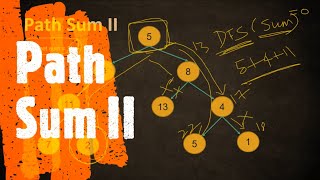
Path Sum II | Leetcode 113 | Tree DFS Backtracking | Facebook
Deepti Talesra 10 mins
Path Sum II - LeetCode 113 Python
Eric Programming 9 mins
[Java] Leetcode 113. Path Sum II [Binary Tree #13]
AlgoJS 8 mins
Path Sum II - LeetCode 113 - JavaScript
Coding Decoded 9 mins
Leetcode 113 Path Sum II | DP Coding Decoded SDE Sheet
AlgoJS 9 mins
Path Sum II - LeetCode 113 - JavaScript
Programming Live with Larry 8 mins
Daily Leetcode #907: Sep 24, 2022 - 113. Path Sum II
Coders Camp 8 mins
Path Sum II | LeetCode 113 | Coders Camp
Komal Pal 30 mins
113. Path Sum II | Leetcode | java| cpp | python | DFS
Super Lazy Coder 16 mins
Path Sum II | Leetcode 113 | Amazon Google Facebook interview question
CodeFreaks 19 mins
Path Sum II || C++ || Leetcode Daily Challenge
Programming Live with Larry 14 mins
Daily Leetcode #491: Aug 04, 2021 - 113. Path Sum II
Peter刷Leetcode 22 mins
[Leetcode] 113. Path Sum II (Explained in English) - Python & Java
Sleepy Cracker 7 mins
LeetCode 113 | Path Sum II | DFS | Java
Code-Yao 9 mins
Leetcode 113. Path Sum II - DFS iterative here use preorder traversal
Learn Overflow 15 mins
Path Sum II | LeetCode 113 | Microsoft Interview Question | Binary Tree | @LearnOverflow
iOSxBank 10 mins
Day 403: LeetCode Problem 113. Path Sum II - Swift
Pirai's Academy 12 mins
Path Sum II | Leetcode 113 | Approach + Code with explanation.
Ghumman Tech 11 mins
Leetcode Question 113 "Path Sum II" in Python
19 videos
did my crawler come up with invalid videos ? drop me a line.
Similar Problems
- problem 112: Path Sum
- problem 257: Binary Tree Paths
- problem 437: Path Sum III
3 similar problems
Solved On The Same Day
5 easy
- problem 112: Path Sum
- problem 409: Longest Palindrome
- problem 645: Set Mismatch
- problem 717: 1-bit and 2-bit Characters
- problem 2535: Difference Between Element Sum and Digit Sum of an Array
- problem 16: 3Sum Closest
- problem 24: Swap Nodes in Pairs
- problem 114: Flatten Binary Tree to Linked List
- problem 116: Populating Next Right Pointers in Each Node
- problem 129: Sum Root to Leaf Numbers
- problem 131: Palindrome Partitioning
- problem 137: Single Number II
- problem 162: Find Peak Element
- problem 165: Compare Version Numbers
- problem 172: Factorial Trailing Zeroes
- problem 201: Bitwise AND of Numbers Range
- problem 204: Count Primes
- problem 402: Remove K Digits
- problem 430: Flatten a Multilevel Doubly Linked List
- problem 451: Sort Characters By Frequency
- problem 539: Minimum Time Difference
- problem 583: Delete Operation for Two Strings
- problem 633: Sum of Square Numbers
- problem 648: Replace Words
- problem 650: 2 Keys Keyboard
- problem 670: Maximum Swap
- problem 786: K-th Smallest Prime Fraction
- problem 2507: Smallest Value After Replacing With Sum of Prime Factors
- problem 2523: Closest Prime Numbers in Range
30 solutions
August 15, 2023
Extra
There are a few extra pages giving you some insights into my setup:
- Tech Stack - my development environment and tools
- AI - how AI helped me create this website (NOT solving the problems)
- Progress - progression over time
- Quality - code quality