Python 1200.py
class Solution:
    def minimumAbsDifference(self, arr: List[int]) -> List[List[int]]:
        arr.sort()

        low = inf
        result = []
        for i in range(1, len(arr)):
            a = arr[i - 1]
            b = arr[i]
            diff = b - a
            if   diff <  low:
                result = [ [ a, b ] ]
                low = diff
            elif diff == low:
                result.append([ a, b ])

        return sorted(result)
Difficulty
This problem is ranked as
and has an acceptance rate of about 75% (500k+ submissions).
Typical patterns to solve this problem:
easy
medium
hard
and has an acceptance rate of about 75% (500k+ submissions).
Typical patterns to solve this problem:
- Array
- Sorting
I solved 663 easy, 1250 medium and 309 hard problems
AI Disclaimer
Every single line of code was written by me, 100% from scratch, between August 2023 and August 2024.
However, two years later I set up this website and used various AI tools to generate most of the walkthrough / explanations below.
See this dedicated page for more details.
However, two years later I set up this website and used various AI tools to generate most of the walkthrough / explanations below.
See this dedicated page for more details.
Code Walkthrough
Overview
The provided implementation solves the problem of finding all pairs of integers in an input list whose absolute difference is minimal. The algorithm proceeds by first sorting the input, then scanning the sorted sequence to compute differences between consecutive elements. While scanning, it maintains the smallest difference seen so far and a collection of pairs that achieve this difference. Finally, it returns the pairs in sorted order.
Key Steps
Sorting the Input
The first operation arranges the numbers in non-decreasing order, which guarantees that the absolute difference between any two elements is simply the difference of the later element minus the earlier one.
arr.sort()Initializing Tracking Variables
Two variables are prepared before the scan: low holds the smallest difference encountered, initialized to positive infinity, and result stores the pairs that realize this difference.
low = inf
result = []
Scanning Adjacent Pairs
A single forward loop examines each adjacent pair in the sorted list. For each index i from 1 to the last element, the algorithm extracts the two neighboring values, computes their difference, and updates the tracking variables accordingly.
for i in range(1, len(arr)):
    a = arr[i - 1]
    b = arr[i]
    diff = b - a
    if   diff <  low:
        result = [ [ a, b ] ]
        low = diff
    elif diff == low:
        result.append([ a, b ])
Returning the Result
After the loop finishes, the list of pairs is sorted to ensure a deterministic order before being returned.
return sorted(result)Edge Cases Handled
When the input list contains duplicate values, the sorting step places identical numbers next to each other, producing a difference of zero. The algorithm correctly records this as the minimal possible difference and includes all adjacent duplicate pairs.
If the list has only two elements, the loop executes exactly once, computes the single difference, and returns that pair as the sole result.
An empty list or a list with a single element would result in the loop body never executing; the function would return an empty list, which aligns with the expectation that no pairs exist.
Performance Optimizations
The most significant optimization is the reliance on sorting followed by a single linear scan. Sorting transforms the problem of comparing every possible pair (quadratic work) into a linear pass over adjacent elements, because the minimal absolute difference must occur between neighbors in a sorted sequence.
Using inf as the initial sentinel for low avoids the need for a separate pass to establish an initial difference value.
The update logic replaces the entire result list only when a new smaller difference is found, which prevents unnecessary accumulation of pairs that are later discarded.
Finally, the call to sorted(result) at the end operates on a list whose size is bounded by the number of adjacent pairs that share the minimal difference, which is typically much smaller than the original input size. This ensures that the final ordering step does not dominate the overall runtime.
written by openai gpt
ELI5 - Simplified Explanation
Imagine you have a big pile of numbered blocks scattered all over the floor. To solve this puzzle, the first step is to line all the blocks up in a perfect row from the smallest number to the biggest number, just like beads on a string. Once they are in a nice line, neighbors sit right next to each other. Taking two neighbors and finding the difference between their numbers is like measuring the tiny gap between them.
The goal is to find which neighbors are the absolute closest together. You walk down the line, checking every single pair of neighbors one by one. You keep a secret note of the smallest gap found so far. Whenever you find a gap that is narrower than the one you previously noted, you throw away your old list and start a new one with this better pair. If you find another pair that has the exact same tiny gap as your best one, you just invite them to join the list too. By the time you reach the end of the line, you have a perfect collection of all the pairs that are closer than anyone else.
written by google gemini
Code Quality
Several LLMs ranked my code quality on a scale from 1 (very poor) to 10 (outstanding):
n = 27
|
median = 7
|
μ = 7.37
|
σ = 1.06
Complexity Analysis
Time: loglinear
As a rule of thumb, the maximum input size for one second execution time is
As a rule of thumb, the maximum input size for one second execution time is
- factorial: up to 10 elements
- exponential: up to 20 elements
- polynomial: a few thousand elements
- loglinear: up to 100,000 elements
- linear: a few million elements
- logarithmic: a billion elements
- constant: practically unlimited
generated automatically
Other Solutions
I wrote a basic crawler to find other solutions to that problem.
Obviously, I did that after I solved the problem myself.
In general, AlgoMonster and WalkCCC solutions are high-quality and always worth a look.
I haven't checked most of the other solutions, but they might be helpful as well.
And of course, the LeetCode forum is always a good place (or even the best) to look for alternative approaches.
(click on a column header to sort the table)
| author | |||||||||||
|---|---|---|---|---|---|---|---|---|---|---|---|
| author | solutions | ||||||||||
| www | AlgoMonster | C++ | Python | Java | TS | ||||||
| WalkCCC | C++ | Python | Java | ||||||||
| leetcode.ca | C++ | Python | Java | Go | Rust | TS | |||||
| Progiez | C++ | Python | Java | ||||||||
| github | BigEggStudy | C# | |||||||||
| black-shadows | C++ | ||||||||||
| charles-wangkai | Java | ||||||||||
| DimitrisJim | C | ||||||||||
| everthis | JS | ||||||||||
| fartem | Ruby | ||||||||||
| fpdjsns | C++ | ||||||||||
| fsq | C++ | ||||||||||
| Garvit244 | Python | ||||||||||
| halfrost | Go | ||||||||||
| JoshCrozier | JS | ||||||||||
| keineahnung2345 | C++ | ||||||||||
| lkwq007 | Python | ||||||||||
| suxrobGM | C# | ||||||||||
| varunu28 | Java | ||||||||||
| withaarzoo | C++ | ||||||||||
| YuriSpiridonov | Python | ||||||||||
| AlgoMonster | C++, Python, Java, TypeScript | ||||||||||
| WalkCCC | C++, Python, Java | ||||||||||
| leetcode.ca | C++, Go, Java, Python, Rust, TypeScript | ||||||||||
| Progiez | C++, Java, Python | ||||||||||
| BigEggStudy | C# | ||||||||||
| black-shadows | C++, C++ | ||||||||||
| charles-wangkai | Java | ||||||||||
| DimitrisJim | C | ||||||||||
| everthis | JavaScript | ||||||||||
| fartem | Ruby | ||||||||||
| fpdjsns | C++ | ||||||||||
| fsq | C++ | ||||||||||
| Garvit244 | Python | ||||||||||
| halfrost | Go | ||||||||||
| JoshCrozier | JavaScript | ||||||||||
| keineahnung2345 | C++ | ||||||||||
| lkwq007 | Python | ||||||||||
| suxrobGM | C# | ||||||||||
| varunu28 | Java | ||||||||||
| withaarzoo | C++ | ||||||||||
| YuriSpiridonov | Python |
33 links
|
21 authors
|
10 languages
Videos
These are a few popular YouTube videos for this problem:






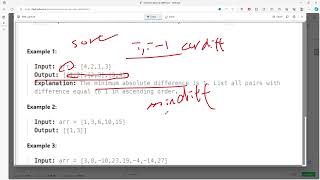

Nick White 6 mins
LeetCode 1200. Minimum Absolute Difference (Algorithm Explained)
Ayushi Sharma 10 mins
Minimum Absolute Difference🔥 | Leetcode 1200 | Sorting
codestorywithMIK 9 mins
Minimum Absolute Difference | Simple Explanation | Leetcode 1200 | codestorywithMIK
Fisher Coder 10 mins
LeetCode 1200: Minimum Absolute Difference - Interview Prep Ep 2
Code with Carter 7 mins
1200. Minimum Absolute Difference - LeetCode Python Solution
Leetcode Daily 9 mins
1200. Minimum Absolute Difference | Leetcode Daily - Python
Programming Live with Larry 9 mins
1200. Minimum Absolute Difference (Leetcode Easy)
Study Placement 6 mins
Minimum Absolute Difference | LeetCode 1200 🔥 Sorting + Linear Scan
Developer Coder 8 mins
Minimum Absolute Difference in Sliding Submatrix | LeetCode 3567 | Java Code | Developer Coder
Tim Huang 4 mins
Minimum Absolute Difference - Leetcode 1200 - Python
Sleepy Cracker 3 mins
LeetCode 1200 | Minimum Absolute Difference Array | Java
OBrutus 7 mins
1200 Minimum Absolute Difference
12 videos
did my crawler come up with invalid videos ? drop me a line.
Similar Problems
- problem 2144: Minimum Cost of Buying Candies With Discount
1 similar problem
Solved On The Same Day
4 easy
- problem 944: Delete Columns to Make Sorted
- problem 1030: Matrix Cells in Distance Order
- problem 1252: Cells with Odd Values in a Matrix
- problem 1290: Convert Binary Number in a Linked List to Integer
- problem 419: Battleships in a Board
- problem 816: Ambiguous Coordinates
- problem 866: Prime Palindrome
- problem 926: Flip String to Monotone Increasing
- problem 962: Maximum Width Ramp
- problem 979: Distribute Coins in Binary Tree
11 solutions
December 19, 2023
Extra
There are a few extra pages giving you some insights into my setup:
- Tech Stack - my development environment and tools
- AI - how AI helped me create this website (NOT solving the problems)
- Progress - progression over time
- Quality - code quality