Python 1284.py
class Solution:
    def minFlips(self, mat: List[List[int]]) -> int:
        m = len(mat[0])
        n = len(mat)
        limit = m * n

        best = 99999
        for mask in range(1 << limit):
            if mask.bit_count() >= best:
                continue

            # deep copy
            grid = []
            for row in mat:
                grid.append(row.copy())

            # try all positions
            for bit in range(limit):
                if (1 << bit) & mask:
                    x = bit %  m
                    y = bit // m

                    grid[y][x] ^= 1
                    if x > 0:     grid[y][x-1] ^= 1
                    if x < m - 1: grid[y][x+1] ^= 1
                    if y > 0:     grid[y-1][x] ^= 1
                    if y < n - 1: grid[y+1][x] ^= 1

            total = 0
            for row in grid:
                total += sum(row)
            if total == 0:
                best = min(best, mask.bit_count())

        return best if best < 99999 else -1
35 lines
|
1041 bytes
|
submitted November 6, 2023
|
GitHub
7% comment ratio
|
tab size 4
|
moderate complexity
Difficulty
This problem is ranked as
and has an acceptance rate of about 73% (50k+ submissions).
Typical patterns to solve this problem:
easy
medium
hard
and has an acceptance rate of about 73% (50k+ submissions).
Typical patterns to solve this problem:
- Array
- Bit Manipulation
- Breadth First Search
- Hash Table
- Matrix
I solved 663 easy, 1250 medium and 309 hard problems
AI Disclaimer
Every single line of code was written by me, 100% from scratch, between August 2023 and August 2024.
However, two years later I set up this website and used various AI tools to generate most of the walkthrough / explanations below.
See this dedicated page for more details.
Code Walkthrough
Overview
The provided implementation solves the “minimum number of flips” problem for a binary matrix. The goal is to turn every cell to zero by repeatedly selecting a cell and toggling it together with its four orthogonal neighbours. The algorithm explores every possible combination of flip positions using a bitmask representation, tracks the smallest number of flips that achieve an all-zero matrix, and returns that count or -1 when no combination works.
Core Logic
The method begins by extracting the dimensions of the input matrix. The width m is taken from the first row, while the height n is the number of rows. The product limit = m * n represents the total number of cells and therefore the number of bits required to encode a candidate flip set.
m = len(mat[0])
n = len(mat)
limit = m * n
A variable best is initialized with a large sentinel value. It stores the smallest flip count discovered so far. The main loop iterates over every integer mask from 0 up to 2**limit - 1. Each bit in mask indicates whether the corresponding cell is flipped.
best = 99999
for mask in range(1 << limit):
    if mask.bit_count() >= best:
        continue
    ...
The early continue statement discards any mask whose number of set bits is not better than the current best solution, preventing unnecessary work.
Bitmask Enumeration
The enumeration treats the matrix as a flat list ordered row-wise. For a given bit index, the column x is obtained with bit % m and the row y with bit // m. The condition (1 << bit) & mask checks whether the current cell is part of the flip set.
for bit in range(limit):
    if (1 << bit) & mask:
        x = bit %  m
        y = bit // m
        ...
Grid Copying
Because each mask must be evaluated on an independent copy of the original matrix, a deep copy is created before any flips are applied. The copy is built by iterating over the rows and invoking row.copy(), which duplicates the inner lists while preserving the outer list structure.
grid = []
for row in mat:
    grid.append(row.copy())
Flip Simulation
When a cell is selected for flipping, the algorithm toggles the cell itself and any existing orthogonal neighbours. The XOR operator ^= 1 flips a binary value. Boundary checks (x > 0, x < m - 1, y > 0, y < n - 1) ensure that neighbour accesses stay within the matrix limits, thereby handling edge rows and columns gracefully.
grid[y][x] ^= 1
if x > 0:     grid[y][x-1] ^= 1
if x < m - 1: grid[y][x+1] ^= 1
if y > 0:     grid[y-1][x] ^= 1
if y < n - 1: grid[y+1][x] ^= 1
Result Evaluation
After all flips dictated by the current mask have been applied, the algorithm computes the sum of all cells in grid. If the total is zero, the mask successfully turned the entire matrix into zeros. The best variable is then updated with the smaller of its current value and the number of flips used (mask.bit_count()).
total = 0
for row in grid:
    total += sum(row)
if total == 0:
    best = min(best, mask.bit_count())
When the loop finishes, the method returns best if a solution was found; otherwise it returns -1.
return best if best < 99999 else -1Edge Cases Handled
The implementation naturally accommodates matrices that are already all zeros. In that situation the mask 0 (no flips) yields a total of zero, causing best to become 0. The early pruning condition also works correctly for this case because mask.bit_count() is 0, which is less than the initial sentinel.
When the matrix dimensions are 1 x 1, the neighbour checks become false, and only the selected cell toggles itself. The algorithm still enumerates the two possible masks (0 and 1) and correctly determines whether a single flip is sufficient.
If no combination of flips can clear the matrix, the sentinel value remains unchanged, and the final conditional returns -1. This signals the impossibility of achieving an all-zero state.
Performance Optimizations
The code leverages several built-in language features to reduce overhead. The use of mask.bit_count() provides a fast count of set bits without manual iteration. The early continue based on this count eliminates large swaths of masks that cannot improve the current best solution, dramatically cutting the search space in practice.
Copying the matrix with row.copy() avoids the cost of a full deep copy via generic utilities, keeping the duplication step lightweight. The neighbour toggles are performed in place with XOR, which is both concise and computationally cheap.
By representing the entire flip configuration as a single integer, the algorithm benefits from efficient bitwise operations for both selection testing and counting, allowing the exhaustive search to run as quickly as possible given the combinatorial nature of the problem.
written by openai gpt
ELI5 - Simplified Explanation
Imagine a flat board made of many squares, where each square can be either a zero or a one. Some squares are one, which is like a light being turned on, and others are zero, which is like a light being turned off. The goal is to make all the lights turn off so the whole board becomes zero.
The code tries a game to fix the lights. It looks at every single square and decides whether to flip the switch there. When a switch is flipped, it changes that square and all the neighbors right next to it. For example, if a square is a one, it becomes a zero, and if it is a zero, it becomes a one.
The code plays this game in many different ways by trying every possible combination of switches. It keeps track of how many times it flips a switch to see if it can clear the board using the smallest number of moves. It starts by guessing that it might take a huge number of moves, and every time it finds a way to clear the board with fewer moves, it remembers that new, better number. After trying all the combinations, the code knows the smallest amount of work needed to turn all the lights off.
written by google gemini
Code Quality
Several LLMs ranked my code quality on a scale from 1 (very poor) to 10 (outstanding):
n = 26
|
median = 5
|
μ = 5.00
|
σ = 1.82
Complexity Analysis
Time: exponential
As a rule of thumb, the maximum input size for one second execution time is
As a rule of thumb, the maximum input size for one second execution time is
- factorial: up to 10 elements
- exponential: up to 20 elements
- polynomial: a few thousand elements
- loglinear: up to 100,000 elements
- linear: a few million elements
- logarithmic: a billion elements
- constant: practically unlimited
generated automatically
Other Solutions
I wrote a basic crawler to find other solutions to that problem.
Obviously, I did that after I solved the problem myself.
In general, AlgoMonster and WalkCCC solutions are high-quality and always worth a look.
I haven't checked most of the other solutions, but they might be helpful as well.
And of course, the LeetCode forum is always a good place (or even the best) to look for alternative approaches.
(click on a column header to sort the table)
| author | ||||||||
|---|---|---|---|---|---|---|---|---|
| author | solutions | |||||||
| www | AlgoMonster | C++ | Python | Java | TS | |||
| WalkCCC | C++ | Python | Java | |||||
| leetcode.ca | C++ | Python | Java | Go | ||||
| Progiez | C++ | Python | Java | |||||
| github | black-shadows | C++ | ||||||
| charles-wangkai | Java | |||||||
| everthis | JS | |||||||
| fsq | C++ | |||||||
| JoshCrozier | JS | |||||||
| keineahnung2345 | C++ | |||||||
| lkwq007 | Python | |||||||
| suxrobGM | C# | |||||||
| wisdompeak | C++ | |||||||
| AlgoMonster | C++, Python, Java, TypeScript | |||||||
| WalkCCC | C++, Python, Java | |||||||
| leetcode.ca | C++, Go, Java, Python | |||||||
| Progiez | C++, Java, Python | |||||||
| black-shadows | C++, C++ | |||||||
| charles-wangkai | Java | |||||||
| everthis | JavaScript | |||||||
| fsq | C++ | |||||||
| JoshCrozier | JavaScript | |||||||
| keineahnung2345 | C++ | |||||||
| lkwq007 | Python | |||||||
| suxrobGM | C# | |||||||
| wisdompeak | C++ |
23 links
|
13 authors
|
7 languages
Videos
These are a few popular YouTube videos for this problem:
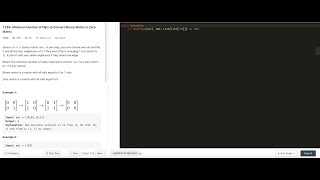




Algorithms for Big Bucks 11 mins
Leetcode 1284. Minimum Number of Flips to Convert Binary Matrix to Zero Matrix
Navyaa Sharma 29 mins
Minimum Number of Flips to Convert Binary Matrix to Zero Matrix | Leetcode 1284 | BFS
Navyaa Sharma 29 mins
Minimum Number of Flips to Convert Binary Matrix to Zero Matrix | Leetcode 1284 | BFS
AlgorithmicIQ 33 mins
Leetcode 1284 Minimum Number of Flips to Convert Binary Matrix to Zero Matrix - Hard Question
Software the Hard Way 55 mins
Daily Code Challenge 1 - Minimum Number of Flips to Convert Binary Matrix to Zero Matrix
LetsCode 23 mins
Leetcode 1284. Minimum Number of Flips to Convert Binary Matrix to Zero Matrix (bit mask)
6 videos
did my crawler come up with invalid videos ? drop me a line.
Similar Problems
- problem 2174: Remove All Ones With Row and Column Flips II
1 similar problem
Solved On The Same Day
2 hard
- problem 1206: Design Skiplist
- problem 1345: Jump Game IV
3 solutions
November 6, 2023
Extra
There are a few extra pages giving you some insights into my setup:
- Tech Stack - my development environment and tools
- AI - how AI helped me create this website (NOT solving the problems)
- Progress - progression over time
- Quality - code quality