Python 1299.py
class Solution:
    def replaceElements(self, arr: List[int]) -> List[int]:
        high = -1
        result = []
        arr.reverse()
        for i in range(len(arr)):
            result.append(high)
            high = max(high, arr[i])

        result.reverse()
        return result
Difficulty
This problem is ranked as
and has an acceptance rate of about 72% (700k+ submissions).
Typical patterns to solve this problem:
easy
medium
hard
and has an acceptance rate of about 72% (700k+ submissions).
Typical patterns to solve this problem:
- Array
I solved 663 easy, 1250 medium and 309 hard problems
AI Disclaimer
Every single line of code was written by me, 100% from scratch, between August 2023 and August 2024.
However, two years later I set up this website and used various AI tools to generate most of the walkthrough / explanations below.
See this dedicated page for more details.
However, two years later I set up this website and used various AI tools to generate most of the walkthrough / explanations below.
See this dedicated page for more details.
Code Walkthrough
Overview
The provided implementation solves the “replace each element with the greatest element on its right” problem by traversing the input list from the end toward the beginning. It builds the output list in reverse order, records the maximum seen so far, and finally restores the original order before returning the result. The algorithm works in a single linear pass after an initial reversal of the input array.
Key Steps
The first important operation establishes a sentinel value that represents the greatest element to the right of the last position.
high = -1Next, an empty container is prepared to accumulate the transformed values.
result = []The input list is reversed in place, which enables forward iteration while effectively processing the original list from right to left.
arr.reverse()The core loop iterates over the indices of the reversed list. For each element, the current sentinel value is appended to the result list, then the sentinel is updated to be the larger of its current value and the element just examined.
for i in range(len(arr)):
    result.append(high)
    high = max(high, arr[i])
After the loop finishes, the result list holds the desired values but in reverse order. Reversing it restores the correct left-to-right orientation.
result.reverse()Finally, the method returns the populated list.
return resultEdge Cases Handled
When the input list is empty, the reversal operation leaves it unchanged, the loop body never executes, and the method returns an empty list, matching the expected behavior for a vacuous input.
If the input contains a single element, the reversal does not alter the list, the loop runs once, appends the sentinel value -1 to the result, and then the final reversal yields a list containing only -1. This correctly reflects that there is no element to the right of the sole entry.
The algorithm also correctly processes lists that are strictly decreasing, strictly increasing, or contain repeated values. Because the sentinel high is updated with the maximum of itself and the current element at each step, it always reflects the greatest value encountered so far in the reversed traversal, ensuring that each position receives the proper greatest-to-right value regardless of the ordering pattern.
Negative numbers are accommodated as long as the sentinel -1 is appropriate for the problem’s definition of “no greater element.” If all elements are less than -1, the sentinel will remain larger than any array entry, and the output will consist of -1 for every position, which aligns with the convention that -1 denotes the absence of a greater element.
Performance Optimizations
Reversing the input list in place avoids allocating an auxiliary copy of the data, thereby conserving memory. The subsequent forward iteration over the reversed list eliminates the need for index arithmetic that would be required when iterating backward, simplifying the loop logic and allowing the use of Python’s efficient range iterator.
Updating the sentinel with a single call to the built-in max function provides a constant-time comparison at each step, ensuring that the overall processing time scales linearly with the length of the input.
Collecting the output in a separate list rather than modifying the original array preserves the input for callers that may rely on its unchanged state, while still achieving linear time performance because each element is appended exactly once.
The final reversal of the result list is also performed in place, reusing the allocated storage without additional copying. This two-step reversal strategy-first on the input, then on the output-maintains a tight memory footprint while delivering the required ordering.
written by openai gpt
ELI5 - Simplified Explanation
Imagine a long line of toy blocks, each having a different number written on it. The goal is to walk along these blocks, but instead of looking at the number on the block in your hand, you want to know which one is the biggest among all the blocks that come after it.
To solve this, the code starts by turning the whole line of blocks around so the very last one is now first. It keeps track of a special number, which starts at negative one because there is nothing after the last block.
As it looks at each block one by one, it first writes down that special number on a new piece of paper. Then, it compares the number on the current block with the special number it is holding. If the block has a bigger number, that becomes the new special number to remember for the next step.
Once it reaches the end of the line, the new list of numbers is turned back around to match the original order. Every spot now shows the largest number that was hiding to its right.
written by google gemini
Code Quality
Several LLMs ranked my code quality on a scale from 1 (very poor) to 10 (outstanding):
n = 27
|
median = 7
|
μ = 7.00
|
σ = 1.19
Complexity Analysis
Time: linear
As a rule of thumb, the maximum input size for one second execution time is
As a rule of thumb, the maximum input size for one second execution time is
- factorial: up to 10 elements
- exponential: up to 20 elements
- polynomial: a few thousand elements
- loglinear: up to 100,000 elements
- linear: a few million elements
- logarithmic: a billion elements
- constant: practically unlimited
generated automatically
Other Solutions
I wrote a basic crawler to find other solutions to that problem.
Obviously, I did that after I solved the problem myself.
In general, AlgoMonster and WalkCCC solutions are high-quality and always worth a look.
I haven't checked most of the other solutions, but they might be helpful as well.
And of course, the LeetCode forum is always a good place (or even the best) to look for alternative approaches.
(click on a column header to sort the table)
| author | ||||||||||
|---|---|---|---|---|---|---|---|---|---|---|
| author | solutions | |||||||||
| www | AlgoMonster | C++ | Java | Python | TS | |||||
| WalkCCC | C++ | Java | Python | |||||||
| leetcode.ca | C++ | Java | Python | Go | TS | |||||
| Progiez | C++ | Java | Python | |||||||
| github | BigEggStudy | C# | ||||||||
| black-shadows | C++ | |||||||||
| charles-wangkai | Java | |||||||||
| Dijkstra-Edu | Java | |||||||||
| DimitrisJim | C | |||||||||
| everthis | JS | |||||||||
| fartem | Ruby | |||||||||
| fsq | C++ | |||||||||
| halfrost | Go | |||||||||
| JoshCrozier | JS | |||||||||
| keineahnung2345 | C++ | |||||||||
| lkwq007 | Python | |||||||||
| shreymehul | C# | |||||||||
| suxrobGM | C# | |||||||||
| varunu28 | Java | |||||||||
| YuriSpiridonov | Python | |||||||||
| AlgoMonster | C++, Python, Java, TypeScript | |||||||||
| WalkCCC | C++, Python, Java | |||||||||
| leetcode.ca | C++, Go, Java, Python, TypeScript | |||||||||
| Progiez | C++, Java, Python | |||||||||
| BigEggStudy | C# | |||||||||
| black-shadows | C++, C++ | |||||||||
| charles-wangkai | Java | |||||||||
| Dijkstra-Edu | Java | |||||||||
| DimitrisJim | C | |||||||||
| everthis | JavaScript | |||||||||
| fartem | Ruby | |||||||||
| fsq | C++ | |||||||||
| halfrost | Go | |||||||||
| JoshCrozier | JavaScript | |||||||||
| keineahnung2345 | C++ | |||||||||
| lkwq007 | Python | |||||||||
| shreymehul | C# | |||||||||
| suxrobGM | C# | |||||||||
| varunu28 | Java | |||||||||
| YuriSpiridonov | Python |
31 links
|
20 authors
|
9 languages
Videos
These are a few popular YouTube videos for this problem:








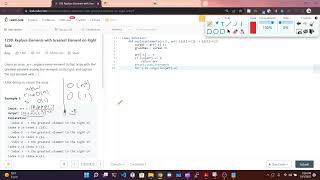
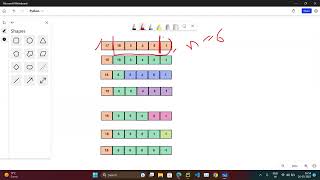
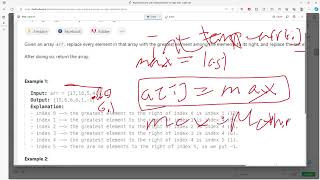
NeetCode 9 mins
Leetcode 1299 - REPLACE ELEMENTS WITH GREATEST ELEMENT ON RIGHT SIDE
AlgorithmicIQ 5 mins
Leetcode 1299 Replace Elements with Greatest Element on Right Side
Aditya Mahajan 6 mins
LeetCode - 1299 Replace Elements with Greatest Element on Right Side | Arrays Card
code Explainer 4 mins
1299. Replace Elements with Greatest Element on Right Side || easy question || c++ solution
Super Lazy Coder 15 mins
Replace Element with Greatest Element on Right Side | Leetcode 1299 | FAANG interview question
John Leonardo 3 mins
Leetcode Solution - 1299 Replace Elements with Greatest Element on Right Side
Varun Agarwal 5 mins
1299. Replace Elements with Greatest Element on Right Side (Leetcode solution)
Unknown Koder 7 mins
LeetCode Problem 1299. Replace Elements with Greatest Element to Right || Java Solution Walkthrough
Andrew Rodriguez 15 mins
LeetCode Solution 1299: Replace Elements with Greatest Element on Right Side
Sumanshu Nankana 13 mins
Leetcode # 1299. Replace Elements with Greatest Element on Right Side
Sleepy Cracker 4 mins
LeetCode 1299 | Replace Elements with Greatest Element on Right Side | Array | Java
11 videos
did my crawler come up with invalid videos ? drop me a line.
Similar Problems
- problem 2454: Next Greater Element IV
1 similar problem
Solved On The Same Day
9 easy
- problem 455: Assign Cookies
- problem 500: Keyboard Row
- problem 575: Distribute Candies
- problem 1009: Complement of Base 10 Integer
- problem 1071: Greatest Common Divisor of Strings
- problem 1748: Sum of Unique Elements
- problem 1979: Find Greatest Common Divisor of Array
- problem 2148: Count Elements With Strictly Smaller and Greater Elements
- problem 2309: Greatest English Letter in Upper and Lower Case
- problem 216: Combination Sum III
- problem 229: Majority Element II
- problem 373: Find K Pairs with Smallest Sums
- problem 470: Implement Rand10() Using Rand7()
- problem 503: Next Greater Element II
- problem 556: Next Greater Element III
- problem 622: Design Circular Queue
- problem 1262: Greatest Sum Divisible by Three
- problem 2657: Find the Prefix Common Array of Two Arrays
- problem 2807: Insert Greatest Common Divisors in Linked List
20 solutions
August 14, 2023
Extra
There are a few extra pages giving you some insights into my setup:
- Tech Stack - my development environment and tools
- AI - how AI helped me create this website (NOT solving the problems)
- Progress - progression over time
- Quality - code quality