Python 1312.py
class Solution:
    def minInsertions(self, s: str) -> int:
        @cache
        def deeper(left, right):
            if left >= right:
                return 0

            if s[left] == s[right]:
                return deeper(left+1, right-1)

            insertleft  = deeper(left+1, right)
            insertright = deeper(left, right-1)
            return 1 + min(insertleft, insertright)

return deeper(0, len(s) - 1)Difficulty
This problem is ranked as
and has an acceptance rate of about 74% (400k+ submissions).
Typical patterns to solve this problem:
easy
medium
hard
and has an acceptance rate of about 74% (400k+ submissions).
Typical patterns to solve this problem:
- Dynamic Programming
- String
I solved 663 easy, 1250 medium and 309 hard problems
AI Disclaimer
Every single line of code was written by me, 100% from scratch, between August 2023 and August 2024.
However, two years later I set up this website and used various AI tools to generate most of the walkthrough / explanations below.
See this dedicated page for more details.
However, two years later I set up this website and used various AI tools to generate most of the walkthrough / explanations below.
See this dedicated page for more details.
Code Walkthrough
Overview
The provided implementation solves the classic problem of determining the minimum number of insertions required to transform a given string into a palindrome. It does so by employing a depth-first recursive strategy that explores the relationship between characters at symmetric positions and leverages memoization to avoid redundant computation. The algorithm is encapsulated in a single public method minInsertions, which delegates the heavy lifting to an inner helper function deeper.
Core Logic
At the heart of the solution lies a recursive function that examines a substring defined by two indices, left and right. The function returns the minimal insertion count needed to make the substring s[left:right+1] a palindrome. The base case triggers when the left index meets or surpasses the right index, indicating that the substring is either empty or a single character-both of which are inherently palindromic, requiring zero insertions.
if left >= right:
    return 0
When the characters at the current boundaries match, the algorithm proceeds inward without incurring any insertion cost, because the matching pair already satisfies the palindrome condition.
if s[left] == s[right]:
    return deeper(left + 1, right - 1)
If the characters differ, the algorithm considers two possibilities: inserting a character to match the left side or inserting a character to match the right side. Each option incurs a cost of one insertion plus the optimal cost of the resulting subproblem. The minimum of these two alternatives yields the optimal solution for the current substring.
insertleft  = deeper(left + 1, right)
insertright = deeper(left, right - 1)
return 1 + min(insertleft, insertright)
The public method initiates the recursion on the full string by calling deeper(0, len(s) - 1).
Recursive Structure
The recursion explores the problem space by progressively narrowing the interval [left, right]. Each recursive call reduces the interval length by at least one, guaranteeing eventual termination. The two recursive branches that arise when characters mismatch correspond to the two logical ways to resolve the mismatch: either treat the left character as if it were inserted on the right side, or treat the right character as if it were inserted on the left side. This exhaustive exploration ensures that the algorithm accounts for all possible insertion sequences, ultimately selecting the one with the smallest count.
Memoization
A critical performance feature is the use of the @cache decorator from Python’s functools module. By decorating deeper, the implementation automatically stores the result of each unique (left, right) pair. Subsequent calls with the same arguments retrieve the precomputed value instead of recomputing the subproblem. This transformation converts the naive exponential recursion into a dynamic programming solution with polynomial behavior, as each distinct sub-interval is evaluated at most once.
@cache
def deeper(left, right):
    ...
The memoization mechanism is transparent to the rest of the code, requiring no explicit dictionary management, and it integrates seamlessly with the recursive definition.
Edge Cases Handled
The algorithm gracefully handles several edge conditions without additional code:
- An empty string results in
left = 0andright = -1. The base caseleft >= rightevaluates to true, returning zero insertions, which is correct because an empty string is already a palindrome. - A single-character string yields
left = 0andright = 0. The base case again triggers, confirming that no insertions are needed. - Strings that are already palindromes cause the equality branch to fire at every level, leading to a cascade of recursive calls that simply shrink the interval until the base case, ultimately returning zero.
- Strings with repeated characters but not fully palindromic still benefit from the equality check, reducing the number of recursive branches explored.
Performance Optimizations
Beyond memoization, the code exhibits a concise control flow that minimizes overhead. The early return when characters match prevents unnecessary branching, effectively pruning large portions of the recursion tree for inputs with many matching pairs. By directly returning the result of the inner recursive call in this scenario, the implementation avoids the extra work of evaluating the two insertion alternatives.
The use of Python’s built-in min function to select the cheaper insertion path is both readable and efficient, leveraging the interpreter’s optimized handling of primitive operations. Additionally, the function signatures and variable names are deliberately short, reducing attribute lookup costs during deep recursion.
Overall, the combination of a well-structured recursive decomposition, strategic early exits, and automatic caching yields a solution that scales efficiently with input size while maintaining clear and maintainable code.
written by openai gpt
ELI5 - Simplified Explanation
Imagine this code is playing a game to make a word a palindrome, which is a word that reads the same forwards and backwards, like radar. The code looks at the very first letter and the very last letter of the word at the same time. If those two letters match, it is happy, so it moves inward to look at the next pair of letters inside.
If the letters do not match, the code has to do a little bit of work to fix it. It thinks about adding a matching letter to one side or the other to make things balance out. It tries both ways to see which one takes the fewest steps to finish the puzzle.
There is a helpful trick called caching where the code remembers what it already figured out. If it sees the same pair of letters again, it does not need to do the thinking all over again because it already has the answer written down in a notebook. It keeps doing this until the whole word matches perfectly, and it counts how many letters it had to add along the way.
written by google gemini
Code Quality
Several LLMs ranked my code quality on a scale from 1 (very poor) to 10 (outstanding):
n = 27
|
median = 8
|
μ = 7.07
|
σ = 1.74
Complexity Analysis
Time: polynomial
As a rule of thumb, the maximum input size for one second execution time is
As a rule of thumb, the maximum input size for one second execution time is
- factorial: up to 10 elements
- exponential: up to 20 elements
- polynomial: a few thousand elements
- loglinear: up to 100,000 elements
- linear: a few million elements
- logarithmic: a billion elements
- constant: practically unlimited
generated automatically
Other Solutions
I wrote a basic crawler to find other solutions to that problem.
Obviously, I did that after I solved the problem myself.
In general, AlgoMonster and WalkCCC solutions are high-quality and always worth a look.
I haven't checked most of the other solutions, but they might be helpful as well.
And of course, the LeetCode forum is always a good place (or even the best) to look for alternative approaches.
(click on a column header to sort the table)
| author | |||||||||
|---|---|---|---|---|---|---|---|---|---|
| author | solutions | ||||||||
| www | AlgoMonster | C++ | Java | Python | TS | ||||
| WalkCCC | C++ | Java | Python | ||||||
| leetcode.ca | C++ | Java | Go | Python | |||||
| Progiez | C++ | Java | Python | ||||||
| github | begeekmyfriend | C | |||||||
| black-shadows | C++ | ||||||||
| charles-wangkai | Java | ||||||||
| everthis | JS | ||||||||
| fsq | C++ | ||||||||
| JoshCrozier | JS | ||||||||
| lzl124631x | C++ | ||||||||
| suxrobGM | C# | ||||||||
| varunu28 | Java | ||||||||
| wisdompeak | C++ | ||||||||
| AlgoMonster | C++, Python, Java, TypeScript | ||||||||
| WalkCCC | C++, Python, Java | ||||||||
| leetcode.ca | C++, Go, Java, Python | ||||||||
| Progiez | C++, Java, Python | ||||||||
| begeekmyfriend | C | ||||||||
| black-shadows | C++, C++ | ||||||||
| charles-wangkai | Java | ||||||||
| everthis | JavaScript | ||||||||
| fsq | C++ | ||||||||
| JoshCrozier | JavaScript | ||||||||
| lzl124631x | C++ | ||||||||
| suxrobGM | C# | ||||||||
| varunu28 | Java | ||||||||
| wisdompeak | C++ |
24 links
|
14 authors
|
8 languages
Videos
These are a few popular YouTube videos for this problem:
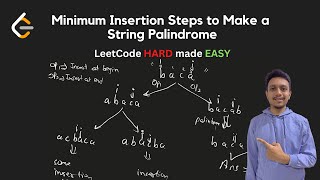
code Explainer 9 mins
1312. Minimum Insertion Steps to Make a String Palindrome | LEETCODE HARD | DYNAMIC PROGRAMMING
Aryan Mittal 9 mins
Minimum Insertion Steps to Make a String Palindrome || Longest Palindromic Subsequence || DP
Happy Coding 28 mins
LeetCode 1312. Minimum Insertion Steps to Make a String Palindrome
Deep Tech 19 mins
1312. Minimum Insertion Steps to Make a String Palindrome | LeetCode Daily Challenge | LeetCode POTD
Programming Live with Larry 8 mins
Daily Leetcode #1117: Apr 22, 2023 - 1312. Minimum Insertion Steps to Make a String Palindrome
CodeThurst 14 mins
1312. Minimum insertion steps to make a string palindrome @leetcode @gfg @CodeThurst
6 videos
did my crawler come up with invalid videos ? drop me a line.
Similar Problems
- problem 2193: Minimum Number of Moves to Make Palindrome
1 similar problem
Solved On The Same Day
2 medium
- problem 1218: Longest Arithmetic Subsequence of Given Difference
- problem 1631: Path With Minimum Effort
- problem 329: Longest Increasing Path in a Matrix
- problem 332: Reconstruct Itinerary
- problem 1964: Find the Longest Valid Obstacle Course at Each Position
6 solutions
September 17, 2023
Extra
There are a few extra pages giving you some insights into my setup:
- Tech Stack - my development environment and tools
- AI - how AI helped me create this website (NOT solving the problems)
- Progress - progression over time
- Quality - code quality