Python 1331.py
class Solution:
    def arrayRankTransform(self, arr: List[int]) -> List[int]:
        unique = list(sorted(set(arr)))
        rank   = {}
        for i, u in enumerate(unique):
            rank[u] = i + 1

        for a in arr:
            yield rank[a]
Difficulty
This problem is ranked as
and has an acceptance rate of about 71% (400k+ submissions).
Typical patterns to solve this problem:
easy
medium
hard
and has an acceptance rate of about 71% (400k+ submissions).
Typical patterns to solve this problem:
- Array
- Hash Table
- Sorting
I solved 663 easy, 1250 medium and 309 hard problems
AI Disclaimer
Every single line of code was written by me, 100% from scratch, between August 2023 and August 2024.
However, two years later I set up this website and used various AI tools to generate most of the walkthrough / explanations below.
See this dedicated page for more details.
However, two years later I set up this website and used various AI tools to generate most of the walkthrough / explanations below.
See this dedicated page for more details.
Code Walkthrough
Overview
The provided implementation defines a class Solution with a single method arrayRankTransform. The method receives a list of integers and produces a sequence of rank values that correspond to the relative ordering of the distinct elements in the input. The smallest distinct value receives rank 1, the next smallest receives rank 2, and so on. The method yields each rank in the order of the original list, effectively transforming the input array into its rank representation.
Key Steps
Removing Duplicates and Sorting
unique = list(sorted(set(arr)))The first operation converts the input list into a set, which eliminates duplicate entries. Converting the set back into a list after applying sorted produces an ordered collection of the distinct values. This step guarantees that each value appears exactly once and that the ordering reflects the natural numeric order.
Building the Rank Mapping
rank = {}
for i, u in enumerate(unique):
    rank[u] = i + 1
An empty dictionary rank is created to store the mapping from each distinct value to its rank. The enumerate function supplies a zero-based index i for each element u in the sorted unique list. Adding one to the index yields the 1-based rank required by the problem specification. The dictionary enables constant-time lookup of a rank given a value.
Producing the Result Sequence
for a in arr:
    yield rank[a]
The final loop iterates over the original input list arr. For each element a, the corresponding rank is retrieved from the rank dictionary and yielded. Using yield turns the method into a generator, allowing the caller to consume the transformed values lazily without constructing an intermediate list.
Edge Cases Handled
When the input list is empty, the set conversion yields an empty set, and the subsequent sorted call returns an empty list. The rank dictionary remains empty, and the final loop does not execute, resulting in an empty generator. This behavior correctly reflects that there are no elements to rank.
If all elements in the input are identical, the set reduces the collection to a single value. After sorting, unique contains one element, and the rank dictionary maps that value to rank 1. The generator then yields 1 for each occurrence in the original list, preserving the length of the input while assigning the same rank to every element.
The algorithm also accommodates negative numbers, zero, and large integer values because the sorting and dictionary operations rely on Python’s built-in comparison and hashing mechanisms, which handle the full range of integer values.
Performance Optimizations
The use of a set to eliminate duplicates is an O(n) operation that avoids the need for nested loops to detect repeated values. Sorting the deduplicated collection is performed on a list whose length equals the number of distinct elements, which is at most the length of the original array, thereby minimizing the amount of work required for ordering.
Storing ranks in a dictionary provides O(1) average-case lookup time when translating each original element to its rank. This eliminates the need for repeated linear searches through the sorted list.
Finally, yielding results instead of building a list reduces memory consumption, especially for large inputs. The generator produces each rank on demand, allowing the caller to process the output incrementally without allocating additional space for the entire transformed array.
written by openai gpt
ELI5 - Simplified Explanation
Imagine having a big pile of mixed-up building blocks with numbers written on them. To figure out the order of these blocks, the first step is to take all the blocks and lay them out in a row from the smallest number to the largest one. While doing this, any extra blocks that have the same number are put away so that every number is unique.
Now, it is time to give each of these unique numbers a little badge to show its rank. The smallest number gets a badge that says one, the next smallest gets a badge that says two, and so on for all of them. These badges are kept in a special organized folder where you can look up any number to instantly see what its rank badge should be.
Finally, the code goes back through the original messy pile of blocks one by one. For every block, it checks the folder to find the right rank badge and points it out. This way, even though the blocks started in a jumble, every single one ends up with the correct label showing whether it is the smallest, the second smallest, or any other rank in the group.
written by google gemini
Code Quality
Several LLMs ranked my code quality on a scale from 1 (very poor) to 10 (outstanding):
n = 27
|
median = 7
|
μ = 6.67
|
σ = 1.83
Complexity Analysis
Time: loglinear
As a rule of thumb, the maximum input size for one second execution time is
As a rule of thumb, the maximum input size for one second execution time is
- factorial: up to 10 elements
- exponential: up to 20 elements
- polynomial: a few thousand elements
- loglinear: up to 100,000 elements
- linear: a few million elements
- logarithmic: a billion elements
- constant: practically unlimited
generated automatically
Other Solutions
I wrote a basic crawler to find other solutions to that problem.
Obviously, I did that after I solved the problem myself.
In general, AlgoMonster and WalkCCC solutions are high-quality and always worth a look.
I haven't checked most of the other solutions, but they might be helpful as well.
And of course, the LeetCode forum is always a good place (or even the best) to look for alternative approaches.
(click on a column header to sort the table)
| author | ||||||||||
|---|---|---|---|---|---|---|---|---|---|---|
| author | solutions | |||||||||
| www | AlgoMonster | C++ | Python | Java | TS | |||||
| WalkCCC | C++ | Python | Java | |||||||
| leetcode.ca | C++ | Python | JS | Java | Go | Rust | TS | |||
| Progiez | C++ | Python | Java | |||||||
| github | BigEggStudy | C# | ||||||||
| black-shadows | C++ | |||||||||
| chandansgowda | Python | |||||||||
| charles-wangkai | Java | |||||||||
| everthis | JS | |||||||||
| fsq | C++ | |||||||||
| JoshCrozier | JS | |||||||||
| keineahnung2345 | C++ | |||||||||
| Krazune | C++ | |||||||||
| lkwq007 | Python | |||||||||
| lzl124631x | C++ | |||||||||
| Shamik07 | Dart | |||||||||
| shreymehul | C# | |||||||||
| suxrobGM | C# | |||||||||
| varunu28 | Java | |||||||||
| withaarzoo | C++ | |||||||||
| YuriSpiridonov | Python | |||||||||
| AlgoMonster | C++, Python, Java, TypeScript | |||||||||
| WalkCCC | C++, Python, Java | |||||||||
| leetcode.ca | C++, Go, Java, JavaScript, Python, Rust, TypeScript | |||||||||
| Progiez | C++, Java, Python | |||||||||
| BigEggStudy | C# | |||||||||
| black-shadows | C++, C++ | |||||||||
| chandansgowda | Python | |||||||||
| charles-wangkai | Java | |||||||||
| everthis | JavaScript | |||||||||
| fsq | C++ | |||||||||
| JoshCrozier | JavaScript | |||||||||
| keineahnung2345 | C++ | |||||||||
| Krazune | C++ | |||||||||
| lkwq007 | Python | |||||||||
| lzl124631x | C++ | |||||||||
| Shamik07 | Dart | |||||||||
| shreymehul | C# | |||||||||
| suxrobGM | C# | |||||||||
| varunu28 | Java | |||||||||
| withaarzoo | C++ | |||||||||
| YuriSpiridonov | Python |
34 links
|
21 authors
|
9 languages
Videos
These are a few popular YouTube videos for this problem:
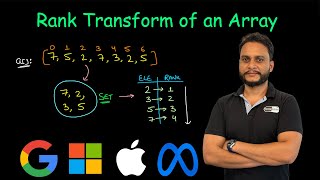


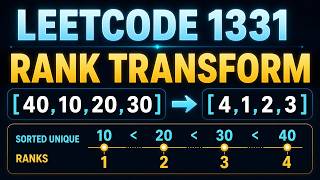

Techdose 10 mins
Rank Transform of an Array | Leetcode 1331
Becoming A Better Dev (with David) 7 mins
How to Solve "1331 Rank Transform of an Array" on LeetCode? - Javascript
Cracking FAANG 4 mins
RANK TRANSFORM OF AN ARRAY | LEETCODE 1331 | PYTHON SOLUTION
Random Chronicles 13 mins
Leetcode 1331. Rank Transform of an Array || Easy Problem || Easy And Short Approach
Math Geeks 3 mins
Leetcode solution: 1331 Rank Transform of an Array
Programming Live with Larry 22 mins
Daily Leetcode #1646: Oct 02, 2024 - 1331. Rank Transform of an Array
Mayur Programming Club 11 mins
Solve 1331. Rank Transform of an Array - Java & C++ Solutions | October Challenge
Developer Coder 9 mins
Rank Transform of an Array | Leetcode 1331 | Java Code | Developer Coder
Data Bots 3 mins
Leetcode 1331. Rank Transform of an Array
9 videos
did my crawler come up with invalid videos ? drop me a line.
Similar Problems
- problem 1632: Rank Transform of a Matrix
- problem 2089: Find Target Indices After Sorting Array
2 similar problems
Solved On The Same Day
2 easy
- problem 1332: Remove Palindromic Subsequences
- problem 1475: Final Prices With a Special Discount in a Shop
- problem 424: Longest Repeating Character Replacement
- problem 1558: Minimum Numbers of Function Calls to Make Target Array
5 solutions
January 12, 2024
Extra
There are a few extra pages giving you some insights into my setup:
- Tech Stack - my development environment and tools
- AI - how AI helped me create this website (NOT solving the problems)
- Progress - progression over time
- Quality - code quality