Python 1383.py
class Solution:
    def maxPerformance(self, n: int, speed: List[int], efficiency: List[int], k: int) -> int:
        all = [ ( e, s ) for e, s in zip(efficiency, speed ) ]
        all.sort(reverse = True)

        result = 0
        total  = 0 # sum(speed of selected engineers)

        # pick most efficient first, keep track of the slowest
        team = []
        for e, s in all:
            # add an engineer to the team
            total += s
            heappush(team, s)

            # maximum team size reached. drop the slowest
            if len(team) > k:
                total -= heappop(team)

            # current engineer is the least efficient
            result = max(result, total * e)

        return result % 1_000_000_007
23 lines
|
771 bytes
|
submitted June 17, 2024
|
GitHub
35% comment ratio
|
tab size 4
|
low complexity
Difficulty
This problem is ranked as
and has an acceptance rate of about 48% (200k+ submissions).
Typical patterns to solve this problem:
easy
medium
hard
and has an acceptance rate of about 48% (200k+ submissions).
Typical patterns to solve this problem:
- Array
- Greedy
- Heap (Priority Queue)
- Sorting
I solved 663 easy, 1250 medium and 309 hard problems
AI Disclaimer
Every single line of code was written by me, 100% from scratch, between August 2023 and August 2024.
However, two years later I set up this website and used various AI tools to generate most of the walkthrough / explanations below.
See this dedicated page for more details.
However, two years later I set up this website and used various AI tools to generate most of the walkthrough / explanations below.
See this dedicated page for more details.
Code Walkthrough
Overview
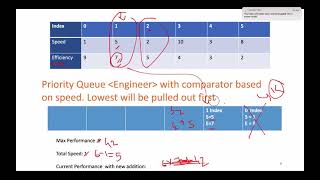
The function computes the maximum possible performance of a team formed from n engineers. Each engineer is described by a speed and an efficiency value. Performance is defined as the product of the sum of speeds of the selected engineers and the minimum efficiency among them. The algorithm selects up to k engineers to maximize this product and returns the result modulo 1,000,000,007.
Preparing the Engineer Data
The first step pairs each engineer’s efficiency with its speed and orders the pairs so that the most efficient engineers are processed first.
all = [(e, s) for e, s in zip(efficiency, speed)]
all.sort(reverse=True)
Sorting in descending order of efficiency guarantees that when the algorithm reaches a particular engineer, that engineer’s efficiency is the smallest efficiency in the current team. This property allows the product total * e to represent the exact performance for the current team composition.
Initializing Accumulators
Two variables are created to keep track of the best performance seen so far (result) and the cumulative speed of the engineers currently in the team (total).
result = 0
total = 0  # sum(speed of selected engineers)
Both start at zero because an empty team yields zero performance.
Maintaining a Bounded Team with a Min-Heap
A min-heap named team stores the speeds of the engineers that are currently part of the candidate team. The heap enables efficient removal of the slowest engineer whenever the team size would exceed the allowed limit k.
team = []
for e, s in all:
    total += s
    heappush(team, s)

    if len(team) > k:
        total -= heappop(team)
When a new engineer is added, its speed is added to total and pushed onto the heap. If the heap size becomes larger than k, the smallest speed (the slowest engineer) is popped, and its speed is subtracted from total. This ensures that the team always contains at most k engineers and that the sum of speeds reflects the fastest possible combination for the current efficiency threshold.
Updating the Best Performance
After adjusting the team size, the algorithm computes the performance for the current configuration. Because the loop processes engineers in decreasing efficiency order, the current engineer’s efficiency e is the minimum efficiency of the team. Multiplying total by e yields the performance for this team, and result is updated if this value is larger.
result = max(result, total * e)The max function guarantees that result always holds the highest performance observed across all iterations.
Final Modulo Operation
The problem statement requires the answer modulo 1,000,000,007. The function applies the modulo operation only once, after the loop has finished, to avoid repeated reductions that could affect intermediate calculations.
return result % 1_000_000_007Edge Cases Handled
When k is larger than or equal to n, the condition len(team) > k never triggers, so the algorithm retains all engineers. The heap therefore simply accumulates all speeds, and the final performance uses the sum of all speeds multiplied by the smallest efficiency (the last engineer processed).
If any engineer has a speed of zero, adding that engineer does not change total. The heap still stores the zero value, and if the team size exceeds k, the zero may be removed without affecting the sum. This behavior correctly handles engineers that contribute no speed.
When all efficiencies are identical, the sorting step preserves the original order of speeds, but the algorithm still correctly evaluates every possible prefix of the sorted list, ensuring the optimal subset is considered.
If k equals one, the heap never exceeds size one, so each iteration evaluates a team consisting solely of the current engineer. The result becomes the maximum of speed[i] * efficiency[i] across all engineers, which matches the definition of performance for a single-member team.
Performance Optimizations
The algorithm leverages sorting to impose a monotonic relationship between the current engineer’s efficiency and the minimum efficiency of the team. This eliminates the need for nested loops that would otherwise recompute the minimum efficiency for each subset.
Using a min-heap to store speeds provides O(log k) insertion and removal, allowing the algorithm to maintain the sum of the fastest k speeds without scanning the entire team on each iteration. The heap size never exceeds k, keeping the memory footprint bounded.
Incremental updates to total avoid recomputing the sum of speeds from scratch after each insertion or removal. By adjusting total only when an engineer is added or the slowest engineer is removed, the algorithm performs a constant amount of work per iteration aside from heap operations.
Deferring the modulo operation until the final return avoids the overhead of repeated modular reductions and ensures that intermediate products remain exact, which is important for preserving the correctness of the maximum comparison.
written by openai gpt
ELI5 - Simplified Explanation
Imagine building a team of super engineers to finish a puzzle. You have piles of cards that tell you how fast each person works and how clever they are. To make the best team, you start by lining up all the engineers starting with the most clever ones first. Then you look at them one by one. As you pick each person, you add their speed to your total and keep track of who is in your group. If you pick too many people, you find the slowest person in the group and say goodbye to them to make room for someone better. After every step, you multiply your total speed by the cleverness of the person you just looked at to see if this new group is the very best one yet. You keep doing this until you have checked everybody, and then you know which group works the fastest.
written by google gemini
Code Quality
Several LLMs ranked my code quality on a scale from 1 (very poor) to 10 (outstanding):
n = 27
|
median = 8
|
μ = 7.85
|
σ = 0.70
Complexity Analysis
Time: loglinear
As a rule of thumb, the maximum input size for one second execution time is
As a rule of thumb, the maximum input size for one second execution time is
- factorial: up to 10 elements
- exponential: up to 20 elements
- polynomial: a few thousand elements
- loglinear: up to 100,000 elements
- linear: a few million elements
- logarithmic: a billion elements
- constant: practically unlimited
generated automatically
Other Solutions
I wrote a basic crawler to find other solutions to that problem.
Obviously, I did that after I solved the problem myself.
In general, AlgoMonster and WalkCCC solutions are high-quality and always worth a look.
I haven't checked most of the other solutions, but they might be helpful as well.
And of course, the LeetCode forum is always a good place (or even the best) to look for alternative approaches.
(click on a column header to sort the table)
| author | |||||||
|---|---|---|---|---|---|---|---|
| author | solutions | ||||||
| www | AlgoMonster | C++ | Java | Python | TS | ||
| WalkCCC | C++ | Java | Python | ||||
| leetcode.ca | C++ | Java | Python | Go | |||
| Progiez | C++ | Java | Python | ||||
| github | black-shadows | C++ | |||||
| charles-wangkai | Java | ||||||
| everthis | JS | ||||||
| fsq | C++ | ||||||
| halfrost | Go | ||||||
| JoshCrozier | JS | ||||||
| keineahnung2345 | C++ | ||||||
| lkwq007 | Python | ||||||
| varunu28 | Java | ||||||
| vthwang | Java | ||||||
| wisdompeak | C++ | ||||||
| AlgoMonster | C++, Python, Java, TypeScript | ||||||
| WalkCCC | C++, Python, Java | ||||||
| leetcode.ca | C++, Go, Java, Python | ||||||
| Progiez | C++, Java, Python | ||||||
| black-shadows | C++, C++ | ||||||
| charles-wangkai | Java | ||||||
| everthis | JavaScript | ||||||
| fsq | C++ | ||||||
| halfrost | Go | ||||||
| JoshCrozier | JavaScript | ||||||
| keineahnung2345 | C++ | ||||||
| lkwq007 | Python | ||||||
| varunu28 | Java | ||||||
| vthwang | Java | ||||||
| wisdompeak | C++ |
25 links
|
15 authors
|
6 languages
Videos
These are a few popular YouTube videos for this problem:





Coding Decoded 14 mins
Maximum Performance of a Team | Leetcode 1383 | Live coding session
babybear4812 18 mins
MAXIMUM PERFORMANCE OF A TEAM (Leetcode) - Code & Whiteboard
Algorithms Made Easy 16 mins
Maximum Performance of a Team | Live Coding with Explanation | Leetcode - 1383
Timothy H Chang 9 mins
Leetcode - Maximum Performance of a Team (Python)
CTO Bhaiya 74 mins
Day 71/90 |⚡🔥(LeetCode 1383) Maximum Performance of a Team (Brute → Heap) 🚀#8 #topk
Emerald Bay 16 mins
Leetcode 1383 - Maximum Performance of a Team (Greedy)
6 videos
did my crawler come up with invalid videos ? drop me a line.
Similar Problems
- problem 2106: Maximum Fruits Harvested After at Most K Steps
1 similar problem
Solved On The Same Day
1 medium
- problem 2861: Maximum Number of Alloys
- problem 1349: Maximum Students Taking Exam
- problem 1851: Minimum Interval to Include Each Query
4 solutions
June 17, 2024
Extra
There are a few extra pages giving you some insights into my setup:
- Tech Stack - my development environment and tools
- AI - how AI helped me create this website (NOT solving the problems)
- Progress - progression over time
- Quality - code quality