Python 1401.py
class Solution:
    def checkOverlap(self, radius: int, xCenter: int, yCenter: int, x1: int, y1: int, x2: int, y2: int) -> bool:
        # check bounding box
        if x1 > xCenter + radius or y1 > yCenter + radius:
            return False
        if x2 < xCenter - radius or y2 < yCenter - radius:
            return False

        # check if x,y is inside the rectangle
        insideRect   = lambda x, y: x1 <= x <= x2 and y1 <= y <= y2
        # check if x,y is inside the circle
        insideCircle = lambda x, y: sqrt((x - xCenter)**2 + (y - yCenter)**2) <= radius

        # top/right/bottom/left of the circle
        if insideRect(xCenter + radius, yCenter) or insideRect(xCenter - radius, yCenter):
            return True
        if insideRect(xCenter, yCenter + radius) or insideRect(xCenter, yCenter - radius):
            return True

        # corners of the rectangle
        if insideCircle(x1, y1) or insideCircle(x1, y2) or \
           insideCircle(x2, y1) or insideCircle(x2, y2):
            return True


        # randomized approach

        # sample a few points
        samples = 1000
        for _ in range(samples):
            angle = randint(0, 360) / 180 * pi
            # on the circumference
            x = xCenter + cos(angle) * radius
            y = yCenter + sin(angle) * radius
            if insideRect(x, y):
                return True

            # and inside the circle
            distance = randint(0, radius)
            x = xCenter + cos(angle) * distance
            y = yCenter + sin(angle) * distance
            if insideRect(x, y):
                return True

            # random integer coordinates inside the circle
            x = xCenter + randint(-radius, +radius)
            y = yCenter + randint(-radius, +radius)
            d = sqrt(x*x + y*y)
            if d <= radius and insideRect(x, y):
                return True

            # random integer coordinates inside the rectangle
            x = randint(x1, x2)
            y = randint(y1, y2)
            if insideCircle(x, y):
                return True
            # and on its border
            if insideCircle(x1, y) or insideCircle(x2, y) or \
               insideCircle(x, y1) or insideCircle(x, y2):
               return True

        return False
62 lines
|
2347 bytes
|
submitted December 1, 2023
|
GitHub
30% comment ratio
|
tab size 4
|
more than moderate complexity
Difficulty
This problem is ranked as
and has an acceptance rate of about 50% (50k+ submissions).
Typical patterns to solve this problem:
easy
medium
hard
and has an acceptance rate of about 50% (50k+ submissions).
Typical patterns to solve this problem:
- Geometry
- Math
I solved 663 easy, 1250 medium and 309 hard problems
AI Disclaimer
Every single line of code was written by me, 100% from scratch, between August 2023 and August 2024.
However, two years later I set up this website and used various AI tools to generate most of the walkthrough / explanations below.
See this dedicated page for more details.
However, two years later I set up this website and used various AI tools to generate most of the walkthrough / explanations below.
See this dedicated page for more details.
Code Walkthrough
Overview
The checkOverlap method determines whether a circle and an axis-aligned rectangle intersect. It proceeds through a series of deterministic geometric checks followed by a stochastic sampling phase. Early exit conditions prune impossible cases quickly, while reusable lambda expressions keep the core predicates concise. The random sampling loop adds robustness for configurations that are not captured by the deterministic checks.
Deterministic Bounding-Box Test
The first two if statements compare the rectangle’s extents with the circle’s axis-aligned bounding box. If the rectangle lies completely to the right or above the circle’s bounding box, or completely to the left or below it, the method returns False immediately.
if x1 > xCenter + radius or y1 > yCenter + radius:
    return False
if x2 < xCenter - radius or y2 < yCenter - radius:
    return False
These comparisons eliminate the majority of non-overlapping configurations without any arithmetic beyond simple additions and comparisons.
Predicate Definitions
Two lambda functions encapsulate the core geometric predicates:
insideRect   = lambda x, y: x1 <= x <= x2 and y1 <= y <= y2
insideCircle = lambda x, y: sqrt((x - xCenter)**2 + (y - yCenter)**2) <= radius
insideRect checks whether a point lies within the rectangle’s inclusive bounds, while insideCircle evaluates the Euclidean distance from the circle’s center. Defining them once avoids repeated code and keeps later checks readable.
Direct Intersection Checks
The method then tests several deterministic scenarios that guarantee overlap:
- Circle cardinal points inside the rectangle - the left, right, top, and bottom points on the circle’s perimeter are examined. If any of these lie inside the rectangle, the shapes intersect.
if insideRect(xCenter + radius, yCenter) or insideRect(xCenter - radius, yCenter):
    return True
if insideRect(xCenter, yCenter + radius) or insideRect(xCenter, yCenter - radius):
return True- Rectangle corners inside the circle - each of the four rectangle vertices is tested against the circle predicate. A corner inside the circle also confirms overlap.
if insideCircle(x1, y1) or insideCircle(x1, y2) or \
   insideCircle(x2, y1) or insideCircle(x2, y2):
    return True
These checks capture the most common overlap patterns: a circle crossing a rectangle edge or a rectangle corner penetrating the circle.
Stochastic Sampling Phase
When deterministic checks are inconclusive, the method resorts to random sampling. A fixed budget of 1,000 iterations balances thoroughness with runtime predictability.
samples = 1000
for _ in range(samples):
    angle = randint(0, 360) / 180 * pi
    # on the circumference
    x = xCenter + cos(angle) * radius
    y = yCenter + sin(angle) * radius
    if insideRect(x, y):
        return True
    # and inside the circle
    distance = randint(0, radius)
    x = xCenter + cos(angle) * distance
    y = yCenter + sin(angle) * distance
    if insideRect(x, y):
        return True
    # random integer coordinates inside the circle
    x = xCenter + randint(-radius, +radius)
    y = yCenter + randint(-radius, +radius)
    d = sqrt(x*x + y*y)
    if d <= radius and insideRect(x, y):
        return True
    # random integer coordinates inside the rectangle
    x = randint(x1, x2)
    y = randint(y1, y2)
    if insideCircle(x, y):
        return True
    # and on its border
    if insideCircle(x1, y) or insideCircle(x2, y) or \
       insideCircle(x, y1) or insideCircle(x, y2):
       return True
The loop explores several random point families:
- Points on the circle’s perimeter.
- Points uniformly distributed along a radial line inside the circle.
- Integer lattice points within the circle’s axis-aligned bounding square, filtered by the true circular radius.
- Integer lattice points inside the rectangle, tested against the circle.
- Points on the rectangle’s four edges, also tested against the circle.
If any sampled point satisfies the opposite shape’s predicate, the method returns True. After exhausting the sample budget, it concludes that the shapes do not overlap and returns False.
Edge Cases Handled
The early bounding-box test correctly handles cases where the rectangle is completely separated from the circle in any cardinal direction, including when the rectangle touches the circle’s bounding box but does not intersect the actual circle.
The cardinal-point checks treat points exactly on the rectangle’s border as inside because the insideRect predicate uses inclusive comparisons (<=). Similarly, insideCircle includes points on the circle’s circumference due to the <= comparison with the radius.
The corner checks capture scenarios where the rectangle’s vertex lies precisely on the circle’s perimeter.
During random sampling, integer coordinate generation respects the rectangle’s inclusive limits (randint(x1, x2) and randint(y1, y2)), ensuring that border points are considered. The distance check for points generated inside the circle’s square (d <= radius) also includes points on the circle’s edge.
Performance Optimizations
The method’s most significant optimization is the early exit after the bounding-box test, which eliminates the need for any trigonometric or square-root calculations in clearly non-overlapping cases.
Reusing the lambda predicates avoids recomputing the same expressions multiple times, reducing function call overhead and keeping the inner loop tight.
The deterministic checks are placed before the stochastic loop, guaranteeing that the expensive random sampling is only invoked when necessary.
Within the sampling loop, the code reuses the same random angle for both perimeter and interior radial points, saving an extra random number generation per iteration.
Limiting the sampling to a fixed count (1,000) provides a predictable upper bound on execution time, preventing pathological runtimes on pathological geometric configurations.
By generating integer coordinates directly within the rectangle’s bounds, the code avoids unnecessary floating-point arithmetic for those samples, which can be faster on many architectures.
Overall, the combination of early pruning, concise predicate reuse, and a bounded stochastic phase yields a method that quickly resolves the majority of inputs while still offering a probabilistic guarantee for more complex overlap patterns.
written by openai gpt
ELI5 - Simplified Explanation
Imagine you have a big bouncy ball and a sheet of paper with a square drawn on it. This code tries to figure out if the ball is touching the square at all.
First, the code looks at the cardboard box that perfectly fits the ball. If the square is far away from that box, the ball cannot possibly touch it, so the computer stops early.
Next, the code checks the edges of the ball to see if they land on the square. It also checks the four sharp corners of the square to see if they are hiding inside the ball.
Since fancy shapes can be tricky, the computer then plays a game of throwing a thousand invisible darts. It throws some darts right on the edge of the ball, some inside the ball, and some inside the square. Every time a dart hits both the ball and the paper at the same time, the computer knows the two shapes are touching. If it throws all those darts and none of them manage to connect the two shapes, then the ball and the square are definitely apart.
written by google gemini
Code Quality
Several LLMs ranked my code quality on a scale from 1 (very poor) to 10 (outstanding):
n = 27
|
median = 3
|
μ = 3.81
|
σ = 1.68
Complexity Analysis
Time: constant
As a rule of thumb, the maximum input size for one second execution time is
As a rule of thumb, the maximum input size for one second execution time is
- factorial: up to 10 elements
- exponential: up to 20 elements
- polynomial: a few thousand elements
- loglinear: up to 100,000 elements
- linear: a few million elements
- logarithmic: a billion elements
- constant: practically unlimited
generated automatically
Other Solutions
I wrote a basic crawler to find other solutions to that problem.
Obviously, I did that after I solved the problem myself.
In general, AlgoMonster and WalkCCC solutions are high-quality and always worth a look.
I haven't checked most of the other solutions, but they might be helpful as well.
And of course, the LeetCode forum is always a good place (or even the best) to look for alternative approaches.
(click on a column header to sort the table)
| author | |||||||
|---|---|---|---|---|---|---|---|
| author | solutions | ||||||
| www | AlgoMonster | C++ | Java | Python | TS | ||
| WalkCCC | C++ | ||||||
| leetcode.ca | C++ | Java | Go | Python | TS | ||
| Progiez | C++ | Java | Python | ||||
| github | black-shadows | C++ | |||||
| charles-wangkai | Java | ||||||
| fsq | C++ | ||||||
| JoshCrozier | JS | ||||||
| keineahnung2345 | C++ | ||||||
| lzl124631x | C++ | ||||||
| wisdompeak | C++ | ||||||
| AlgoMonster | C++, Python, Java, TypeScript | ||||||
| WalkCCC | C++ | ||||||
| leetcode.ca | C++, Go, Java, Python, TypeScript | ||||||
| Progiez | C++, Java, Python | ||||||
| black-shadows | C++, C++ | ||||||
| charles-wangkai | Java | ||||||
| fsq | C++ | ||||||
| JoshCrozier | JavaScript | ||||||
| keineahnung2345 | C++ | ||||||
| lzl124631x | C++ | ||||||
| wisdompeak | C++ |
20 links
|
11 authors
|
6 languages
Videos
These are a few popular YouTube videos for this problem:

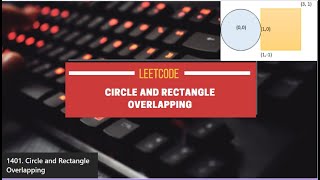

Let's Leet 18 mins
Episode 58 | Leetcode | Hindi and English | Circle and Rectangle Overlapping
Leet Kodee 19 mins
LeetCode 1401 || Circle and Rectangle Overlapping
Code-Yao 15 mins
leetcode 1401. [Google Interview Question] Circle and Rectangle Overlapping - elementary math
CodeTogether 29 mins
Circle and Rectangle Overlapping || LC 1401 || #6Companies30Days Challenge || Brute to Optimal
4 videos
did my crawler come up with invalid videos ? drop me a line.
Solved On The Same Day
2 easy
- problem 1281: Subtract the Product and Sum of Digits of an Integer
- problem 1662: Check If Two String Arrays are Equivalent
- problem 522: Longest Uncommon Subsequence II
- problem 2616: Minimize the Maximum Difference of Pairs
- problem 847: Shortest Path Visiting All Nodes
6 solutions
December 1, 2023
Extra
There are a few extra pages giving you some insights into my setup:
- Tech Stack - my development environment and tools
- AI - how AI helped me create this website (NOT solving the problems)
- Progress - progression over time
- Quality - code quality