Python 1559.py
class Solution:
    def containsCycle(self, grid: List[List[str]]) -> bool:
        width  = len(grid[0])
        height = len(grid)

        deltas = [ +1, 0, -1, 0 ] # compact encoding of (0,1),(1,0),(0,-1),(-1,0)
        known  = set()            # visited cells

        # if we avoid the last cell then any time we visit an already known cell there is a cycle of length 4 or more
        def deeper(x, y, oldx = -1, oldy = -1): # True if cycle found
            if (x, y) in known:
                return True # cycle found
            known.add(( x, y ))

            dx = dy = 0
            for d in deltas:
                dy = dx
                dx = d

                nx = x + dx
                ny = y + dy
                # avoid stepping back => that would be a "cycle" of length 2, which is allowed
                if nx == oldx and ny == oldy:
                    continue

                # same color, respect borders
                if 0 <= nx < width and 0 <= ny < height and grid[ny][nx] == grid[y][x]:
                    if deeper(nx, ny, x, y):
                        return True

            # no cycle (yet)
            return False

        # start at each (unknown) cell
        for y in range(height):
            for x in range(width):
                if (x, y) not in known and deeper(x, y):
                    return True

        return False
40 lines
|
1418 bytes
|
submitted January 22, 2024
|
GitHub
33% comment ratio
|
tab size 4
|
low complexity
Difficulty
This problem is ranked as
and has an acceptance rate of about 53% (100k+ submissions).
Typical patterns to solve this problem:
easy
medium
hard
and has an acceptance rate of about 53% (100k+ submissions).
Typical patterns to solve this problem:
- Array
- Breadth First Search
- Depth First Search
- Matrix
- Union Find
I solved 663 easy, 1250 medium and 309 hard problems
AI Disclaimer
Every single line of code was written by me, 100% from scratch, between August 2023 and August 2024.
However, two years later I set up this website and used various AI tools to generate most of the walkthrough / explanations below.
See this dedicated page for more details.
However, two years later I set up this website and used various AI tools to generate most of the walkthrough / explanations below.
See this dedicated page for more details.
Code Walkthrough
Overview
The provided implementation determines whether a rectangular grid of characters contains a cycle formed by adjacent cells of the same character. A cycle is defined as a closed path of length four or more that returns to a previously visited cell without immediately back-tracking to the predecessor. The algorithm explores the grid using depth-first search (DFS) while tracking visited cells globally to avoid redundant work.
Core Logic
Grid dimensions
width  = len(grid[0])
height = len(grid)
The width and height are computed once, allowing constant-time boundary checks throughout the search.
Direction encoding
deltas = [ +1, 0, -1, 0 ] # encodes (0,1),(1,0),(0,-1),(-1,0)A compact list stores the four orthogonal moves. By rotating the values inside the loop, the code derives dx and dy without allocating separate tuples for each direction.
Global visited set
known = set() # visited cellsAll cells that have been examined in any DFS branch are stored in a set of coordinate tuples. This set prevents revisiting regions that have already been proven not to contain a cycle, reducing the overall number of recursive calls.
Recursive DFS (deeper)
def deeper(x, y, oldx = -1, oldy = -1):
    if (x, y) in known:
        return True
    known.add((x, y))

    dx = dy = 0
    for d in deltas:
        dy = dx
        dx = d

        nx = x + dx
        ny = y + dy
        if nx == oldx and ny == oldy:
            continue
        if 0 <= nx < width and 0 <= ny < height and grid[ny][nx] == grid[y][x]:
            if deeper(nx, ny, x, y):
                return True
    return False
The function receives the current cell (x, y) and the coordinates of the cell from which it arrived (oldx, oldy). The first test checks whether the current cell has already been recorded in known. Encountering a known cell indicates that a path has looped back to a previously visited location, satisfying the cycle condition. The cell is then added to known to mark it as explored.
The inner loop iterates over the four possible moves. By swapping dx and dy before each assignment, the code generates the orthogonal offsets without extra data structures. The continue statement skips the immediate back-track to the predecessor, which would otherwise be interpreted as a trivial two-cell “cycle” that the problem definition excludes.
Boundary checks (0 <= nx < width and 0 <= ny < height) guarantee that the search stays inside the grid. The color comparison (grid[ny][nx] == grid[y][x]) ensures that only cells with the same character are considered part of the same component. When a neighbor satisfies all constraints, the recursion proceeds with the neighbor as the new current cell and the current cell as its predecessor. If any recursive call returns True, the function propagates the success upward.
If the loop finishes without finding a cycle, the function returns False, indicating that the current DFS branch did not encounter a repeated cell.
Initiating DFS from each component
for y in range(height):
    for x in range(width):
        if (x, y) not in known and deeper(x, y):
            return True
return False
The double loop scans the grid row-by-row. For each cell that has not yet been visited, it launches a new DFS. Because known accumulates cells from previous searches, each connected component is explored exactly once. If any invocation of deeper reports a cycle, the outer function returns True immediately. If the entire grid is processed without detecting a cycle, the function returns False.
Edge Cases Handled
When the grid consists of a single row or a single column, the boundary checks prevent out-of-range neighbor calculations, and the back-track avoidance ensures that a two-cell back-and-forth does not falsely trigger a cycle.
If the grid contains isolated cells (no adjacent same-colored neighbors), the DFS adds the cell to known and terminates without recursion, correctly reporting the absence of a cycle.
Grids where all cells share the same character are processed efficiently: the first DFS will traverse the entire grid, marking every cell as known. Any later start positions are skipped because they are already in known, preventing unnecessary repeated traversals.
The algorithm also correctly handles grids with multiple disconnected components of the same character. Each component is explored independently, and a cycle in any component leads to an early return.
Performance Optimizations
The use of a single global known set eliminates the need for a separate visited structure per DFS call, thereby reducing memory overhead and avoiding repeated allocation of temporary containers.
Encoding the four directions in a flat list and deriving dx/dy through variable swapping avoids the creation of tuple objects for each neighbor, which can be a noticeable cost in tight loops.
Early termination is built into both the recursive function and the outer scanning loops. As soon as a cycle is discovered, the recursion unwinds and the outer function returns, preventing further exploration of the remaining grid.
By checking if (x, y) not in known before launching a new DFS, the algorithm guarantees that each connected component is visited only once, yielding linear work relative to the number of cells.
The boundary checks are performed before the character comparison, ensuring that the more expensive string equality is only evaluated for valid neighbor coordinates.
Overall, the design balances clarity with low-level efficiency, leveraging Python’s set membership tests and minimalistic neighbor generation to achieve fast detection of cycles in typical grid sizes.
written by openai gpt
ELI5 - Simplified Explanation
Imagine you are looking at a big grid of colorful square tiles on the floor. The goal is to see if any path of the same color makes a closed loop, like a circle that leads back to where it started.
To solve this, the code acts like a tiny explorer walking across the grid. It keeps a secret notebook called known where it writes down the address of every tile it has already visited.
The explorer starts at the top left corner and begins moving to a neighbor tile only if that neighbor has the exact same color as the current one. If the explorer finds a tile that is already written in the notebook, that means a circle has been formed.
However, the explorer is very careful. It remembers exactly which tile it just came from, so it does not count walking backward as finding a circle. It wants to find a real, meaningful path that travels through different tiles before meeting itself again.
The code repeats this process for every single tile in the grid. It checks every square to make sure no hidden loops are hiding anywhere. If it ever lands on a tile that is already in the notebook while looking for a friend of the same color, it knows a cycle exists. It keeps searching until it has checked everything or found a loop.
written by google gemini
Code Quality
Several LLMs ranked my code quality on a scale from 1 (very poor) to 10 (outstanding):
n = 27
|
median = 7
|
μ = 5.96
|
σ = 1.69
Complexity Analysis
Time: polynomial
As a rule of thumb, the maximum input size for one second execution time is
As a rule of thumb, the maximum input size for one second execution time is
- factorial: up to 10 elements
- exponential: up to 20 elements
- polynomial: a few thousand elements
- loglinear: up to 100,000 elements
- linear: a few million elements
- logarithmic: a billion elements
- constant: practically unlimited
generated automatically
Other Solutions
I wrote a basic crawler to find other solutions to that problem.
Obviously, I did that after I solved the problem myself.
In general, AlgoMonster and WalkCCC solutions are high-quality and always worth a look.
I haven't checked most of the other solutions, but they might be helpful as well.
And of course, the LeetCode forum is always a good place (or even the best) to look for alternative approaches.
(click on a column header to sort the table)
| author | |||||||||
|---|---|---|---|---|---|---|---|---|---|
| author | solutions | ||||||||
| www | AlgoMonster | C++ | Java | Python | TS | ||||
| WalkCCC | C++ | Java | |||||||
| leetcode.ca | C++ | JS | Java | Python | Go | Rust | TS | ||
| Progiez | C++ | Java | Python | ||||||
| github | black-shadows | C++ | |||||||
| charles-wangkai | Java | ||||||||
| everthis | JS | ||||||||
| FelixFan1122 | Java | ||||||||
| fsq | C++ | ||||||||
| JoshCrozier | JS | ||||||||
| keineahnung2345 | C++ | ||||||||
| lkwq007 | Python | ||||||||
| suxrobGM | C# | ||||||||
| wisdompeak | C++ | ||||||||
| withaarzoo | C++ | ||||||||
| AlgoMonster | C++, Python, Java, TypeScript | ||||||||
| WalkCCC | C++, Java | ||||||||
| leetcode.ca | C++, Go, Java, JavaScript, Python, Rust, TypeScript | ||||||||
| Progiez | C++, Java, Python | ||||||||
| black-shadows | C++, C++ | ||||||||
| charles-wangkai | Java | ||||||||
| everthis | JavaScript | ||||||||
| FelixFan1122 | Java | ||||||||
| fsq | C++ | ||||||||
| JoshCrozier | JavaScript | ||||||||
| keineahnung2345 | C++ | ||||||||
| lkwq007 | Python | ||||||||
| suxrobGM | C# | ||||||||
| wisdompeak | C++ | ||||||||
| withaarzoo | C++ |
27 links
|
15 authors
|
8 languages
Videos
These are a few popular YouTube videos for this problem:
Programming Live with Larry 18 mins
Daily Leetcode #2217: Apr 26, 2026 - 1559. Detect Cycles in 2D Grid
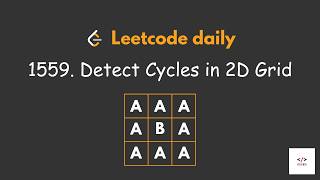
WEBCODE 8 mins
LeetCode 1559 | Detect Cycles in 2D Grid 🔄 | Daily Challenge Explained (BFS + Intuition)
Code Like Him 4 mins
Leetcode 1559 | Detect Cycles in 2D Grid
Techie On Track 11 mins
👉 1559. Detect Cycles in 2D Grid | POTD 14 April 2026 | C++ | Leetcode
4 videos
did my crawler come up with invalid videos ? drop me a line.
Solved On The Same Day
3 medium
- problem 1573: Number of Ways to Split a String
- problem 1626: Best Team With No Conflicts
- problem 1705: Maximum Number of Eaten Apples
- problem 1723: Find Minimum Time to Finish All Jobs
5 solutions
January 22, 2024
Extra
There are a few extra pages giving you some insights into my setup:
- Tech Stack - my development environment and tools
- AI - how AI helped me create this website (NOT solving the problems)
- Progress - progression over time
- Quality - code quality