Python 1588.py
class Solution:
    def sumOddLengthSubarrays(self, arr: List[int]) -> int:
        result = 0
        for i in range(len(arr)):
            current = 0
            for j in range(len(arr) - i):
                current += arr[i + j]
                if (j & 1) == 0: # if j is even then the length is odd
                    result += current
        return result
10 lines
|
374 bytes
|
submitted December 24, 2023
|
GitHub
10% comment ratio
|
tab size 4
|
low complexity
Difficulty
This problem is ranked as
and has an acceptance rate of about 84% (300k+ submissions).
Typical patterns to solve this problem:
easy
medium
hard
and has an acceptance rate of about 84% (300k+ submissions).
Typical patterns to solve this problem:
- Array
- Math
- Prefix Sum
I solved 663 easy, 1250 medium and 309 hard problems
AI Disclaimer
Every single line of code was written by me, 100% from scratch, between August 2023 and August 2024.
However, two years later I set up this website and used various AI tools to generate most of the walkthrough / explanations below.
See this dedicated page for more details.
However, two years later I set up this website and used various AI tools to generate most of the walkthrough / explanations below.
See this dedicated page for more details.
Code Walkthrough
Overview
The provided implementation defines a class Solution with a method sumOddLengthSubarrays that computes the sum of all subarrays of an input list arr whose lengths are odd. The algorithm iterates over every possible starting index, builds cumulative sums for subarrays that begin at that index, and selectively adds those sums to the final result when the subarray length is odd. By using a running total (current) for each start position, the code avoids recomputing the sum of a subarray from scratch, which yields a more efficient traversal of the input.
Core Logic
The outer loop selects each possible starting position i in the array. For each i, a variable current is reset to zero. This variable accumulates the sum of elements as the inner loop extends the subarray one element at a time.
for i in range(len(arr)):
    current = 0
    ...
The inner loop runs over the remaining elements from the start index i. The index j represents the offset from i, and the element at position i + j is added to current. This incremental addition means that the sum of the subarray [i, i + j] is available immediately after the update.
for j in range(len(arr) - i):
    current += arr[i + j]
    ...
The condition (j & 1) == 0 checks whether j is even. Since the length of the subarray is j + 1, an even offset corresponds to an odd length. When this condition holds, the accumulated sum current is added to the overall result.
if (j & 1) == 0:  # if j is even then the length is odd
    result += current
Finally, after all start positions have been processed, the method returns the accumulated result.
return resultEdge Cases Handled
When the input list is empty, the outer loop does not execute because range(len(arr)) yields no values. Consequently, result remains zero and the method returns zero, which correctly represents the sum of odd-length subarrays for an empty collection.
If the list contains a single element, the outer loop runs once with i = 0. The inner loop runs once with j = 0, current becomes the value of that element, the condition (j & 1) == 0 is true, and the element is added to result. The method therefore returns the element itself, matching the expected sum of the only odd-length subarray.
For lists with repeated values or negative numbers, the cumulative addition current += arr[i + j] correctly aggregates the signed values, and the selective addition to result respects the odd-length constraint without any special handling. The bitwise check works uniformly for any integer offset, ensuring consistent behavior across all possible subarray lengths.
Performance Optimizations
The algorithm leverages a running cumulative sum (current) for each starting index rather than recomputing the sum of each subarray from scratch. By updating current incrementally as the inner loop progresses, the code reduces the number of arithmetic operations required for overlapping subarrays. This approach eliminates the need for an inner nested loop that would otherwise sum each subarray element by element, thereby cutting down redundant work.
The use of a bitwise AND operation (j & 1) to test the parity of j is a low-level optimization compared to a modulo operation. Bitwise checks are typically faster because they operate directly on the binary representation of the integer, allowing the condition to be evaluated with minimal overhead.
Resetting current at the start of each outer iteration ensures that the cumulative sum is scoped to the current starting position, preventing the need for additional data structures to track partial sums across different start indices. This in-place accumulation keeps memory usage minimal and avoids the overhead of allocating auxiliary arrays.
written by openai gpt
ELI5 - Simplified Explanation
Imagine a long train made of many colorful toy cars. Each car has a number on it. This set of instructions is like a game to find all the smaller parts of the train that have an odd number of cars. An odd number is just a number like one, three, or five, where you cannot split the cars into two equal groups without one left over.
The computer starts at the first car and slowly walks down the line. It picks up one car, then two, then three, adding up all the numbers painted on them. Every time the number of cars held in its hand is odd, it remembers the total sum of those numbers by tucking it into a special box called result. It repeats this for every place where a group of cars could start. By the time it reaches the very last car, all those little sums from the odd-sized groups are added together to make one big final number.
written by google gemini
Code Quality
Several LLMs ranked my code quality on a scale from 1 (very poor) to 10 (outstanding):
n = 26
|
median = 7
|
μ = 7.08
|
σ = 1.36
Complexity Analysis
Time: polynomial
As a rule of thumb, the maximum input size for one second execution time is
As a rule of thumb, the maximum input size for one second execution time is
- factorial: up to 10 elements
- exponential: up to 20 elements
- polynomial: a few thousand elements
- loglinear: up to 100,000 elements
- linear: a few million elements
- logarithmic: a billion elements
- constant: practically unlimited
generated automatically
Other Solutions
I wrote a basic crawler to find other solutions to that problem.
Obviously, I did that after I solved the problem myself.
In general, AlgoMonster and WalkCCC solutions are high-quality and always worth a look.
I haven't checked most of the other solutions, but they might be helpful as well.
And of course, the LeetCode forum is always a good place (or even the best) to look for alternative approaches.
(click on a column header to sort the table)
| author | |||||||||||
|---|---|---|---|---|---|---|---|---|---|---|---|
| author | solutions | ||||||||||
| www | AlgoMonster | C++ | Python | Java | TS | ||||||
| WalkCCC | C++ | Python | Java | ||||||||
| leetcode.ca | C++ | Python | Java | Go | C | Rust | TS | ||||
| Progiez | C++ | Python | Java | ||||||||
| github | black-shadows | C++ | |||||||||
| charles-wangkai | Java | ||||||||||
| DimitrisJim | C | ||||||||||
| everthis | JS | ||||||||||
| fartem | Ruby | ||||||||||
| fsq | C++ | ||||||||||
| JoshCrozier | JS | ||||||||||
| keineahnung2345 | C++ | ||||||||||
| Krazune | C++ | ||||||||||
| lkwq007 | Python | ||||||||||
| muhammadfarhankt | Go | ||||||||||
| suxrobGM | C# | ||||||||||
| trung-hn | Python | ||||||||||
| varunu28 | Java | ||||||||||
| YuriSpiridonov | Python | ||||||||||
| AlgoMonster | C++, Python, Java, TypeScript | ||||||||||
| WalkCCC | C++, Python, Java | ||||||||||
| leetcode.ca | C, C++, Go, Java, Python, Rust, TypeScript | ||||||||||
| Progiez | C++, Java, Python | ||||||||||
| black-shadows | C++, C++ | ||||||||||
| charles-wangkai | Java | ||||||||||
| DimitrisJim | C | ||||||||||
| everthis | JavaScript | ||||||||||
| fartem | Ruby | ||||||||||
| fsq | C++ | ||||||||||
| JoshCrozier | JavaScript | ||||||||||
| keineahnung2345 | C++ | ||||||||||
| Krazune | C++ | ||||||||||
| lkwq007 | Python | ||||||||||
| muhammadfarhankt | Go | ||||||||||
| suxrobGM | C# | ||||||||||
| trung-hn | Python | ||||||||||
| varunu28 | Java | ||||||||||
| YuriSpiridonov | Python |
32 links
|
19 authors
|
10 languages
Videos
These are a few popular YouTube videos for this problem:
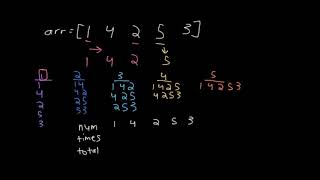
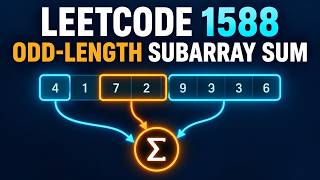
Nate Santti 16 mins
Sum of All Odd Length Subarrays | LeetCode 1588 | Explained and Java Code
Kacy Codes 8 mins
Leetcode 1588. Sum of All Odd Length Subarrays - O(n)
Programming Live with Larry 4 mins
1588. Sum of All Odd Length Subarrays (Leetcode Easy)
Sleepy Cracker 5 mins
LeetCode 1588 | Sum of All Odd Length Subarrays | Math | Java
Math Geeks 3 mins
Leetcode solving 1588. Sum of All Odd Length Subarrays
5 videos
did my crawler come up with invalid videos ? drop me a line.
Similar Problems
- problem 2778: Sum of Squares of Special Elements
1 similar problem
Solved On The Same Day
3 easy
- problem 2325: Decode the Message
- problem 2367: Number of Arithmetic Triplets
- problem 2974: Minimum Number Game
- problem 2428: Maximum Sum of an Hourglass
5 solutions
December 24, 2023
Extra
There are a few extra pages giving you some insights into my setup:
- Tech Stack - my development environment and tools
- AI - how AI helped me create this website (NOT solving the problems)
- Progress - progression over time
- Quality - code quality