Python 1590.py
class Solution:
    def minSubarray(self, nums: List[int], p: int) -> int:
        size = len(nums)

        # zeros don't change the result but simplify edge cases
        nums   = [ 0 ] + nums + [ 0 ]
        length = len(nums)

        # prefix sum, put positions in p slots, according to their modulo
        remain = defaultdict(list)
        have = 0
        for i, n in enumerate(nums):
            have += n
            remain[have % p].append(i)

        # sum(nums) % p == 0, remove nothing
        if have % p == 0:
            return 0

        result = size # without zeros
        have   = 0
        for i in reversed(range(length)): # including zeros
            n     = nums[i]
            have += n
            mod   = have % p

            # complementary number
            need  = p - mod if mod > 0 else 0

            # find closest position on the left
            # first remove everything on the right side
            while remain[need] and remain[need][-1] >= i:
                remain[need].pop()
            # need check that position which is on the left
            if remain[need]:
                remove = i - remain[need][-1] - 1
                result = min(result, remove)

        return result if result < size else -1
39 lines
|
1296 bytes
|
submitted March 6, 2024
|
GitHub
36% comment ratio
|
tab size 4
|
low complexity
Difficulty
This problem is ranked as
and has an acceptance rate of about 43% (500k+ submissions).
Typical patterns to solve this problem:
easy
medium
hard
and has an acceptance rate of about 43% (500k+ submissions).
Typical patterns to solve this problem:
- Array
- Hash Table
- Prefix Sum
I solved 663 easy, 1250 medium and 309 hard problems
AI Disclaimer
Every single line of code was written by me, 100% from scratch, between August 2023 and August 2024.
However, two years later I set up this website and used various AI tools to generate most of the walkthrough / explanations below.
See this dedicated page for more details.
However, two years later I set up this website and used various AI tools to generate most of the walkthrough / explanations below.
See this dedicated page for more details.
Code Walkthrough
Overview
The provided implementation solves the problem of finding the smallest contiguous sub-array that can be removed so that the sum of the remaining elements becomes divisible by a given integer p. The algorithm works by augmenting the original array with sentinel zeros, building a prefix-sum map keyed by modulo values, and then scanning the array backwards to locate the optimal removal length. Throughout the process it leverages constant-time list operations and avoids recomputation of sums, which yields an efficient solution for large inputs.
Prefix-sum construction with modulo buckets
The first major phase computes cumulative sums while grouping indices by the remainder of the sum modulo p. This grouping enables rapid lookup of positions that can balance a target remainder later on.
remain = defaultdict(list)
have = 0
for i, n in enumerate(nums):
    have += n
    remain[have % p].append(i)
Each entry in remain holds a list of indices where a particular remainder occurs. By storing the indices in the order they appear, the algorithm can later prune entries that lie to the right of the current scanning position.
Early exit when the total sum is already divisible
Before any further work, the code checks whether the total sum of the augmented array satisfies the divisibility condition. If the remainder is zero, no removal is necessary and the function returns immediately.
if have % p == 0:
    return 0
This guard eliminates unnecessary work for the common case where the input already meets the requirement.
Backward scan to locate the minimal removable segment
The core search proceeds from the end of the augmented array toward the front. At each step it updates a running suffix sum, computes its remainder, and determines the complementary remainder needed to achieve a total sum divisible by p.
result = size
have = 0
for i in reversed(range(length)):
    n = nums[i]
    have += n
    mod = have % p
    need = p - mod if mod > 0 else 0
The variable need represents the remainder that must be found on the left side of the current index to form a valid removal window.
Pruning of right-side positions
Because the scan moves leftward, any indices stored in remain[need] that are greater than or equal to the current position cannot contribute to a valid sub-array. The algorithm discards such entries in a tight loop, ensuring that the remaining list always contains only candidates on the left.
while remain[need] and remain[need][-1] >= i:
    remain[need].pop()
By popping from the end of the list, the operation runs in amortized constant time, and the list stays sorted in decreasing order relative to the current scan direction.
Updating the best answer
If after pruning there is still at least one index left in remain[need], the distance between the current position and the nearest left candidate yields a candidate removal length. The algorithm updates the best result accordingly.
if remain[need]:
    remove = i - remain[need][-1] - 1
    result = min(result, remove)
The subtraction of one accounts for the exclusive nature of the removal window, and the min call preserves the smallest length found so far.
Edge-case handling through sentinel zeros
The initial augmentation of the input list with a leading and trailing zero simplifies boundary conditions. By guaranteeing that there is always a zero at both ends, the algorithm avoids special checks for sub-arrays that start at index zero or end at the last element. This design also ensures that the removal length never exceeds the original array size, as the sentinel values are never counted toward the final answer.
nums = [0] + nums + [0]Performance-focused data structures
The use of defaultdict(list) provides on-demand creation of buckets without explicit existence checks, reducing branching overhead. Storing indices in lists rather than more complex structures keeps memory layout compact and cache-friendly. The backward iteration combined with in-place popping eliminates the need for binary search or additional pointer arithmetic, resulting in a tight inner loop that operates with minimal instruction count.
Final result determination
After the scan completes, the algorithm returns the smallest removal length found, or -1 if no valid sub-array exists. The comparison against the original size ensures that sentinel zeros do not inflate the answer.
return result if result < size else -1Through careful construction of prefix sums, strategic use of modulo buckets, and a reverse scan that prunes irrelevant candidates on the fly, the code delivers a concise and performant solution to the minimum sub-array removal problem.
written by openai gpt
ELI5 - Simplified Explanation
Imagine a big box of numbered blocks sitting in a row. The goal is to take away a small section of these blocks so that what stays behind can be shared equally among a group of people. If the group has a specific number of members, we want to make sure the total number of blocks left over is something that divides perfectly.
To solve this, the computer looks at all the blocks from the left side and keeps a running total of how many there are. It writes down each total and keeps track of which blocks were used. Because the group has a certain size, the computer only cares about the leftovers after sharing, which is like keeping track of the remainders.
After looking at the blocks from left to right, the computer turns around and looks at the blocks starting from the right side. It now knows exactly how many blocks it needs to toss out to make everything balance out perfectly. By checking the notebook where it wrote down the positions of the blocks from the first pass, it can quickly find the smallest slice of blocks that solves the problem. If it finds a way to take away just a few blocks, it remembers that as the best way to do it. Otherwise, it decides that the task might be impossible, so it stops and says so.
written by google gemini
Code Quality
Several LLMs ranked my code quality on a scale from 1 (very poor) to 10 (outstanding):
n = 27
|
median = 6
|
μ = 5.93
|
σ = 2.07
Complexity Analysis
Time: linear
As a rule of thumb, the maximum input size for one second execution time is
As a rule of thumb, the maximum input size for one second execution time is
- factorial: up to 10 elements
- exponential: up to 20 elements
- polynomial: a few thousand elements
- loglinear: up to 100,000 elements
- linear: a few million elements
- logarithmic: a billion elements
- constant: practically unlimited
generated automatically
Other Solutions
I wrote a basic crawler to find other solutions to that problem.
Obviously, I did that after I solved the problem myself.
In general, AlgoMonster and WalkCCC solutions are high-quality and always worth a look.
I haven't checked most of the other solutions, but they might be helpful as well.
And of course, the LeetCode forum is always a good place (or even the best) to look for alternative approaches.
(click on a column header to sort the table)
| author | |||||||||
|---|---|---|---|---|---|---|---|---|---|
| author | solutions | ||||||||
| www | AlgoMonster | C++ | Java | Python | TS | ||||
| WalkCCC | C++ | Java | Python | ||||||
| leetcode.ca | C++ | JS | Java | Python | Go | Rust | TS | ||
| Progiez | C++ | Java | Python | ||||||
| github | black-shadows | C++ | |||||||
| charles-wangkai | Java | ||||||||
| everthis | JS | ||||||||
| fsq | C++ | ||||||||
| JoshCrozier | JS | ||||||||
| keineahnung2345 | C++ | ||||||||
| lkwq007 | Python | ||||||||
| suxrobGM | C# | ||||||||
| varunu28 | Java | ||||||||
| wisdompeak | C++ | ||||||||
| withaarzoo | C++ | ||||||||
| AlgoMonster | C++, Python, Java, TypeScript | ||||||||
| WalkCCC | C++, Python, Java | ||||||||
| leetcode.ca | C++, Go, Java, JavaScript, Python, Rust, TypeScript | ||||||||
| Progiez | C++, Java, Python | ||||||||
| black-shadows | C++, C++ | ||||||||
| charles-wangkai | Java | ||||||||
| everthis | JavaScript | ||||||||
| fsq | C++ | ||||||||
| JoshCrozier | JavaScript | ||||||||
| keineahnung2345 | C++ | ||||||||
| lkwq007 | Python | ||||||||
| suxrobGM | C# | ||||||||
| varunu28 | Java | ||||||||
| wisdompeak | C++ | ||||||||
| withaarzoo | C++ |
28 links
|
15 authors
|
8 languages
Videos
These are a few popular YouTube videos for this problem:

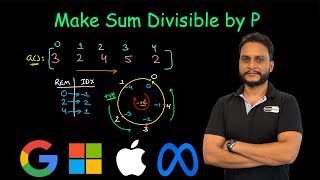


codestorywithMIK 28 mins
Make Sum Divisible by P | Simplest Explanation | Full Dry Run | Leetcode 1590 | codestorywithMIK
Techdose 23 mins
Make Sum Divisible by P | Leetcode 1590
AlgorithmHQ 15 mins
1590. Make Sum Divisible by P | Leetcode Daily (POTD) 3 Oct 2024 | Meidum | Java | Hindi
Leet Programmer 16 mins
Make Sum Divisible by P | Leetcode 1590 | Python | Prefix Sum
4 videos
did my crawler come up with invalid videos ? drop me a line.
Similar Problems
- problem 974: Subarray Sums Divisible by K
- problem 2575: Find the Divisibility Array of a String
2 similar problems
Solved On The Same Day
6 medium
- problem 1462: Course Schedule IV
- problem 1497: Check If Array Pairs Are Divisible by k
- problem 1574: Shortest Subarray to be Removed to Make Array Sorted
- problem 1654: Minimum Jumps to Reach Home
- problem 1733: Minimum Number of People to Teach
- problem 1750: Minimum Length of String After Deleting Similar Ends
7 solutions
March 6, 2024
Extra
There are a few extra pages giving you some insights into my setup:
- Tech Stack - my development environment and tools
- AI - how AI helped me create this website (NOT solving the problems)
- Progress - progression over time
- Quality - code quality