Python 1790.py
class Solution:
    def areAlmostEqual(self, s1: str, s2: str) -> bool:
        diffs = []
        for i, (c1, c2) in enumerate(zip(s1, s2)):
            if c1 != c2:
                diffs.append(i)

        # exactly two or no differences
        if not diffs:
            return True
        if len(diffs) != 2:
            return False

        # make sure the swapped letters are identical
        return s1[diffs[0]] == s2[diffs[1]] and s1[diffs[1]] == s2[diffs[0]]
15 lines
|
486 bytes
|
submitted November 3, 2023
|
GitHub
18% comment ratio
|
tab size 4
|
low complexity
Difficulty
This problem is ranked as
and has an acceptance rate of about 50% (600k+ submissions).
Typical patterns to solve this problem:
easy
medium
hard
and has an acceptance rate of about 50% (600k+ submissions).
Typical patterns to solve this problem:
- Counting
- Hash Table
- String
I solved 663 easy, 1250 medium and 309 hard problems
AI Disclaimer
Every single line of code was written by me, 100% from scratch, between August 2023 and August 2024.
However, two years later I set up this website and used various AI tools to generate most of the walkthrough / explanations below.
See this dedicated page for more details.
Code Walkthrough
Overview
The provided implementation defines a method areAlmostEqual that determines whether two strings of equal length can be made identical by swapping at most one pair of characters in the first string. The algorithm proceeds by scanning both strings in parallel, collecting the indices where the characters differ, and then applying a small set of logical checks to decide the result.
Key Steps
The first logical block iterates over the characters of s1 and s2 simultaneously. For each position, the code compares the characters and records the index when a mismatch occurs.
diffs = []
for i, (c1, c2) in enumerate(zip(s1, s2)):
    if c1 != c2:
        diffs.append(i)
After the scan, the method evaluates the size of the diffs list. If the list is empty, the strings are already identical and the method returns True.
if not diffs:
    return True
If the number of mismatched positions is anything other than two, a single swap cannot resolve the differences, so the method returns False.
if len(diffs) != 2:
    return False
When exactly two mismatches are present, the code verifies that swapping the characters at those two indices would align the strings. This is done by checking that the character from s1 at the first mismatched index equals the character from s2 at the second mismatched index, and vice-versa.
return s1[diffs[0]] == s2[diffs[1]] and s1[diffs[1]] == s2[diffs[0]]Edge Cases Handled
The algorithm gracefully handles the situation where the input strings are already equal; the early if not diffs clause captures this and returns True without further processing. It also correctly rejects cases where the number of differing positions is one, three, or any number greater than two, because a single swap cannot reconcile more than two mismatches. When exactly two mismatches exist, the final comparison ensures that the characters are cross-compatible for a swap, thereby covering cases where the mismatched characters are identical (e.g., swapping two identical letters) as well as cases where they differ but can be exchanged to achieve equality.
Performance Optimizations
The implementation performs a single linear pass over the input strings, collecting only the indices of mismatches. By stopping the collection after the entire strings are examined, it avoids unnecessary early termination logic while still keeping the amount of stored data minimal-at most two indices are needed for the final decision. The use of zip together with enumerate provides an efficient iterator that yields paired characters without creating intermediate lists. The final conditional check operates directly on the original strings using the stored indices, eliminating the need for any additional data structures or string reconstruction. This streamlined approach ensures that the method runs with minimal overhead while maintaining clear and direct logic.
written by openai gpt
ELI5 - Simplified Explanation
Imagine you have two rows of colorful building blocks and you want to see if they look almost exactly the same. The code starts by looking at both rows side by side, one block at a time. It keeps a little list of all the spots where the blocks do not match. If every block matches perfectly, then the rows are already the same. If the list of mismatched spots has exactly two items, the code checks if those two blocks were just swapped with each other. If the first mismatched block in the first row is the same as the second mismatched block in the second row, and the other way around, then swapping them once would make the two rows identical.
written by google gemini
Code Quality
Several LLMs ranked my code quality on a scale from 1 (very poor) to 10 (outstanding):
n = 27
|
median = 8
|
μ = 8.11
|
σ = 1.55
Complexity Analysis
Time: linear
As a rule of thumb, the maximum input size for one second execution time is
As a rule of thumb, the maximum input size for one second execution time is
- factorial: up to 10 elements
- exponential: up to 20 elements
- polynomial: a few thousand elements
- loglinear: up to 100,000 elements
- linear: a few million elements
- logarithmic: a billion elements
- constant: practically unlimited
generated automatically
Other Solutions
I wrote a basic crawler to find other solutions to that problem.
Obviously, I did that after I solved the problem myself.
In general, AlgoMonster and WalkCCC solutions are high-quality and always worth a look.
I haven't checked most of the other solutions, but they might be helpful as well.
And of course, the LeetCode forum is always a good place (or even the best) to look for alternative approaches.
(click on a column header to sort the table)
| author | ||||||||||||
|---|---|---|---|---|---|---|---|---|---|---|---|---|
| author | solutions | |||||||||||
| www | AlgoMonster | C++ | Python | Java | TS | |||||||
| WalkCCC | C++ | Python | Java | |||||||||
| leetcode.ca | C++ | Python | Java | C | Go | Rust | TS | |||||
| Progiez | C++ | Python | Java | |||||||||
| github | black-shadows | C++ | ||||||||||
| charles-wangkai | Java | |||||||||||
| DimitrisJim | C | |||||||||||
| everthis | JS | |||||||||||
| fartem | Ruby | |||||||||||
| fsq | C++ | |||||||||||
| haoel | C++ | |||||||||||
| JoshCrozier | JS | |||||||||||
| lkwq007 | Python | |||||||||||
| Shamik07 | Dart | |||||||||||
| suxrobGM | C# | |||||||||||
| varunu28 | Java | |||||||||||
| YuriSpiridonov | Python | |||||||||||
| AlgoMonster | C++, Python, Java, TypeScript | |||||||||||
| WalkCCC | C++, Python, Java | |||||||||||
| leetcode.ca | C, C++, Go, Java, Python, Rust, TypeScript | |||||||||||
| Progiez | C++, Java, Python | |||||||||||
| black-shadows | C++, C++ | |||||||||||
| charles-wangkai | Java | |||||||||||
| DimitrisJim | C | |||||||||||
| everthis | JavaScript | |||||||||||
| fartem | Ruby | |||||||||||
| fsq | C++ | |||||||||||
| haoel | C++ | |||||||||||
| JoshCrozier | JavaScript | |||||||||||
| lkwq007 | Python | |||||||||||
| Shamik07 | Dart | |||||||||||
| suxrobGM | C# | |||||||||||
| varunu28 | Java | |||||||||||
| YuriSpiridonov | Python |
30 links
|
17 authors
|
11 languages
Videos
These are a few popular YouTube videos for this problem:
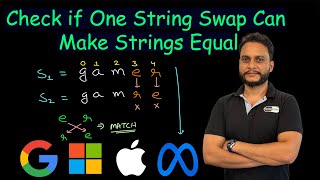
NeetCodeIO 9 mins
Check if One String Swap Can Make Strings Equal - Leetcode 1790 - Python
codestorywithMIK 18 mins
Check if One String Swap Can Make Strings Equal | 2 Approaches | Leetcode 1790 | codestorywithMIK
Techdose 11 mins
Check if One String Swap Can Make Strings Equal | Leetcode 1790
Programming Live with Larry 5 mins
1790. Check if One String Swap Can Make Strings Equal (Leetcode Easy)
Code-Yao 8 mins
leetcode 1790. Check if One String Swap Can Make Strings Equal - check non-matching indices and swap
5 videos
did my crawler come up with invalid videos ? drop me a line.
Similar Problems
- problem 859: Buddy Strings
- problem 2531: Make Number of Distinct Characters Equal
2 similar problems
Solved On The Same Day
7 easy
- problem 1317: Convert Integer to the Sum of Two No-Zero Integers
- problem 1417: Reformat The String
- problem 1556: Thousand Separator
- problem 2259: Remove Digit From Number to Maximize Result
- problem 2582: Pass the Pillow
- problem 2605: Form Smallest Number From Two Digit Arrays
- problem 2729: Check if The Number is Fascinating
- problem 881: Boats to Save People
- problem 1503: Last Moment Before All Ants Fall Out of a Plank
- problem 1578: Minimum Time to Make Rope Colorful
- problem 1685: Sum of Absolute Differences in a Sorted Array
- problem 1701: Average Waiting Time
13 solutions
November 3, 2023
Extra
There are a few extra pages giving you some insights into my setup:
- Tech Stack - my development environment and tools
- AI - how AI helped me create this website (NOT solving the problems)
- Progress - progression over time
- Quality - code quality