Python 1793.py
class Solution:
    def maximumScore(self, nums: List[int], k: int) -> int:
        low  = [ inf ] * len(nums)
        # lowest element between nums[i] and nums[k]
        have = nums[k]
        for i in range(k, -1, -1):
            have = min(have, nums[i])
            low[i] = have
        # lowest element between nums[k] and nums[j]
        have = nums[k]
        for j in range(k + 1, len(nums)):
            have = min(have, nums[j])
            low[j] = have

        result = len(low) * min(low[0], low[-1]) # the whole array could be a good subarray, too
        i = j = k
        while i > 0 or j < len(low) - 1:
            # same minimum, try to maximize the width
            while i > 0     and low[i] == low[i - 1]:
                i -= 1
            while j < k - 1 and low[j] == low[j + 1]:
                j += 1

            width  = j - i + 1
            result = max(result, width * min(low[i], low[j]))

            # reached border
            if i == 0:
                j += 1
                continue
            if j == len(low) - 1:
                i -= 1
                continue

            # extend the side with the higher minimum
            if low[i - 1] > low[j + 1]:
                i -= 1
            else:
                j += 1

        return result
41 lines
|
1333 bytes
|
submitted November 27, 2023
|
GitHub
19% comment ratio
|
tab size 4
|
moderate complexity
Difficulty
This problem is ranked as
and has an acceptance rate of about 64% (100k+ submissions).
easy
medium
hard
and has an acceptance rate of about 64% (100k+ submissions).
I solved 663 easy, 1250 medium and 309 hard problems
AI Disclaimer
Every single line of code was written by me, 100% from scratch, between August 2023 and August 2024.
However, two years later I set up this website and used various AI tools to generate most of the walkthrough / explanations below.
See this dedicated page for more details.
However, two years later I set up this website and used various AI tools to generate most of the walkthrough / explanations below.
See this dedicated page for more details.
Code Walkthrough
Overview
The provided implementation computes the maximum possible score of a subarray that must contain a fixed index k. The score of a subarray is defined as the product of its length and the minimum element within that subarray. The algorithm first builds an auxiliary array that records, for every position, the smallest value seen when expanding from the mandatory index k outward. It then expands a window around k while maintaining the current minimum on each side, updating the best score whenever a larger width is found. The approach works in a single pass over the input after the auxiliary array is prepared, guaranteeing that all candidate subarrays are examined without redundant recomputation.
Building the minimum-to-k array
The first phase creates an array low where low[i] holds the minimum element between positions i and k (inclusive). Two sweeps are performed: one moving left from k to the start of the list, and another moving right from k+1 to the end.
low  = [ inf ] * len(nums)
have = nums[k]
for i in range(k, -1, -1):
    have = min(have, nums[i])
    low[i] = have

have = nums[k]
for j in range(k + 1, len(nums)):
    have = min(have, nums[j])
    low[j] = have
The leftward sweep updates have with the smallest value encountered so far, storing it at each index. The rightward sweep does the same for positions to the right of k. After these loops, low[i] correctly reflects the minimum value that would be present in any subarray extending from i to k.
Initial result candidate
Before entering the main expansion loop, the algorithm considers the whole array as a possible subarray. The score for the entire array is computed using the smallest of the two extreme minima stored in low.
result = len(low) * min(low[0], low[-1])This handles the edge case where the optimal subarray spans the full length of nums, ensuring that the final answer is never smaller than this baseline.
Expanding the window around k
Two pointers, i and j, start at the mandatory index k. The loop continues while either pointer can move outward. Inside the loop, the algorithm first collapses any consecutive positions that share the same minimum value, effectively skipping over flat regions that would not improve the score.
while i > 0 or j < len(low) - 1:
    while i > 0     and low[i] == low[i - 1]:
        i -= 1
    while j < k - 1 and low[j] == low[j + 1]:
        j += 1
By moving past equal minima, the code avoids unnecessary width calculations for subarrays that would yield identical scores, thereby reducing the number of iterations.
Updating the best score
After the pointers have been adjusted, the current window width and the minimum value at its boundaries are used to compute a candidate score. The result is updated if this candidate exceeds the previous best.
width  = j - i + 1
result = max(result, width * min(low[i], low[j]))
The use of min(low[i], low[j]) correctly captures the smallest element inside the current window, because low[i] and low[j] already represent the minima from each side to k.
Handling borders
When one side of the window reaches the array boundary, the algorithm forces expansion on the opposite side. This ensures that all subarrays that include k and extend to the ends are examined.
if i == 0:
    j += 1
    continue
if j == len(low) - 1:
    i -= 1
    continue
These conditions gracefully handle the edge cases where the leftmost or rightmost index is reached, preventing out-of-range accesses while still allowing the window to grow.
Choosing the side to expand
If neither pointer is at a border, the algorithm decides which side to extend based on the next potential minimum values. The side with the larger upcoming minimum is chosen, because extending that side is more likely to increase the product of width and minimum.
if low[i - 1] > low[j + 1]:
    i -= 1
else:
    j += 1
This greedy choice steers the expansion toward regions that preserve a higher minimum, thereby focusing the search on promising candidates without exhaustive enumeration.
Performance optimizations
The construction of low uses two linear sweeps, each updating a running minimum in constant time per element. This eliminates the need for nested loops that would recompute minima for every possible subarray.
During the expansion phase, the inner loops that skip over equal minima compress stretches of identical values into a single step. By doing so, the algorithm reduces the number of iterations proportional to the number of distinct minima rather than the total length of the array.
The decision to extend the side with the larger next minimum avoids unnecessary exploration of subarrays that would quickly drop the minimum value, effectively pruning the search space. Combined with the border checks, this results in a tight traversal that visits each index at most a constant number of times.
Overall, the method achieves a linear-time execution pattern, processing the input array a fixed number of times and performing only simple arithmetic and comparison operations in each step. This makes it well-suited for large inputs where a naïve quadratic approach would be prohibitive.
written by openai gpt
ELI5 - Simplified Explanation
Imagine you have a long line of numbered building blocks sitting in a row on the floor. You choose one stone in the middle to be your special starting point. The goal is to stretch out a rectangle as wide as you can while keeping the numbers inside the rectangle big and tall.
First, the code walks to the left and then to the right from your special starting stone. As it travels, it keeps track of the smallest number it has seen so far. Think of this like keeping a record of the shortest friend in a group, because the shortest friend determines how tall the whole group can stand.
After measuring all the possible heights in both directions, the code starts growing the rectangle. It looks at the numbers on both edges of the current rectangle to see which side has a taller friend waiting next in line. It always picks the taller side to make the rectangle wider, because that keeps the area as large as possible. If the numbers are the same, it stretches out as far as it can on both sides to grab more space.
As the rectangle grows, it constantly checks how much space it covers by multiplying the width by the height of the smallest number it included. Every time it finds a new, bigger total, it remembers that as the new best score. It continues doing this until it reaches the very ends of the line of blocks.
written by google gemini
Code Quality
Several LLMs ranked my code quality on a scale from 1 (very poor) to 10 (outstanding):
n = 27
|
median = 6
|
μ = 6.07
|
σ = 1.25
Complexity Analysis
Time: linear
As a rule of thumb, the maximum input size for one second execution time is
As a rule of thumb, the maximum input size for one second execution time is
- factorial: up to 10 elements
- exponential: up to 20 elements
- polynomial: a few thousand elements
- loglinear: up to 100,000 elements
- linear: a few million elements
- logarithmic: a billion elements
- constant: practically unlimited
generated automatically
Other Solutions
I wrote a basic crawler to find other solutions to that problem.
Obviously, I did that after I solved the problem myself.
In general, AlgoMonster and WalkCCC solutions are high-quality and always worth a look.
I haven't checked most of the other solutions, but they might be helpful as well.
And of course, the LeetCode forum is always a good place (or even the best) to look for alternative approaches.
(click on a column header to sort the table)
| author | ||||||||
|---|---|---|---|---|---|---|---|---|
| author | solutions | |||||||
| www | AlgoMonster | C++ | Java | Python | TS | |||
| WalkCCC | C++ | Java | Python | |||||
| leetcode.ca | C++ | Java | Go | Python | TS | |||
| Progiez | C++ | Java | Python | |||||
| github | black-shadows | C++ | ||||||
| charles-wangkai | Java | |||||||
| everthis | JS | |||||||
| fsq | C++ | |||||||
| haoel | C++ | |||||||
| JoshCrozier | JS | |||||||
| MacJim | C++ | |||||||
| suxrobGM | C# | |||||||
| wisdompeak | C++ | |||||||
| AlgoMonster | C++, Python, Java, TypeScript | |||||||
| WalkCCC | C++, Python, Java | |||||||
| leetcode.ca | C++, Go, Java, Python, TypeScript | |||||||
| Progiez | C++, Java, Python | |||||||
| black-shadows | C++, C++ | |||||||
| charles-wangkai | Java | |||||||
| everthis | JavaScript | |||||||
| fsq | C++ | |||||||
| haoel | C++ | |||||||
| JoshCrozier | JavaScript | |||||||
| MacJim | C++ | |||||||
| suxrobGM | C# | |||||||
| wisdompeak | C++ |
24 links
|
13 authors
|
7 languages
Videos
These are a few popular YouTube videos for this problem:




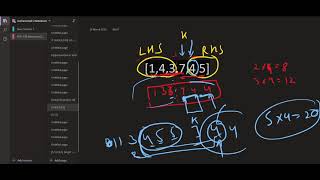




NeetCodeIO 9 mins
Maximum Score of a Good Subarray - Leetcode 1793 - Python
NeetCodeIO 9 mins
Maximum Score of a Good Subarray - Leetcode 1793 - Python
codestorywithMIK 26 mins
Maximum Score of a Good Subarray | GREEDY | INTUITION | AMAZON | Leetcode - 1793
Cherry Coding [IIT-G] 16 mins
LeetCode 1793. Maximum Score of a Good Subarray | Hard | 🏆 Weekly Contest 232 | Algorithm Explained
Happy Coding 15 mins
LeetCode 1793. Maximum Score of a Good Subarray
Fraz 14 mins
1793. Maximum Score of a Good Subarray
Programming Live with Larry 19 mins
1793. Maximum Score of a Good Subarray (Leetcode Hard)
Programming Live with Larry 23 mins
Daily Leetcode #1300: Oct 22, 2023 - 1793. Maximum Score of a Good Subarray
CodeInsanity 12 mins
Day 14/75: Problem Name: Maximum Score Of A Good Subarray | Leetcode | #75DaysHardLeetcode
宰相小甘罗 3 mins
LeetCode 1793. Maximum Score of a Good Subarray 中文 | Weekly Contest 292
Alpha-Code 11 mins
Maximum Score of a Good Subarray - LeetCode 1793 - Python
Web Fusion with Bharadwaj 35 mins
98. Leetcode 1793. Maximum Score of a Good Subarray : Javascript
12 videos
did my crawler come up with invalid videos ? drop me a line.
Similar Problems
- problem 84: Largest Rectangle in Histogram
1 similar problem
Solved On The Same Day
1 easy
- problem 1005: Maximize Sum Of Array After K Negations
- problem 935: Knight Dialer
- problem 1029: Two City Scheduling
- problem 1769: Minimum Number of Operations to Move All Balls to Each Box
- problem 2080: Range Frequency Queries
- problem 793: Preimage Size of Factorial Zeroes Function
- problem 878: Nth Magical Number
- problem 902: Numbers At Most N Given Digit Set
- problem 1751: Maximum Number of Events That Can Be Attended II
10 solutions
November 27, 2023
Extra
There are a few extra pages giving you some insights into my setup:
- Tech Stack - my development environment and tools
- AI - how AI helped me create this website (NOT solving the problems)
- Progress - progression over time
- Quality - code quality