Python 1855.py
class Solution:
    def maxDistance(self, nums1: List[int], nums2: List[int]) -> int:
        result = 0

        i = 0
        for j in range(len(nums2)):
            while i < len(nums1) - 1 and i < j and nums1[i] > nums2[j]:
                i += 1

            if nums1[i] <= nums2[j]:
                distance = j - i
                result   = max(result, distance)

        return result
Difficulty
This problem is ranked as
and has an acceptance rate of about 61% (200k+ submissions).
Typical patterns to solve this problem:
easy
medium
hard
and has an acceptance rate of about 61% (200k+ submissions).
Typical patterns to solve this problem:
- Array
- Binary Search
- Two Pointers
I solved 663 easy, 1250 medium and 309 hard problems
AI Disclaimer
Every single line of code was written by me, 100% from scratch, between August 2023 and August 2024.
However, two years later I set up this website and used various AI tools to generate most of the walkthrough / explanations below.
See this dedicated page for more details.
However, two years later I set up this website and used various AI tools to generate most of the walkthrough / explanations below.
See this dedicated page for more details.
Code Walkthrough
Overview
The provided Solution class implements a method maxDistance that receives two integer lists, nums1 and nums2. The goal of the method is to compute the largest possible index distance j - i such that i is a valid index in nums1, j is a valid index in nums2, i ≤ j, and the element at i in nums1 does not exceed the element at j in nums2. The algorithm walks through nums2 with an outer index j while maintaining a monotonic pointer i into nums1. By advancing i only when necessary, the method avoids redundant comparisons and directly evaluates candidate distances.
Key Steps
The algorithm can be broken down into three essential phases: initialization, iterative scanning with conditional advancement, and result updating.
Initialization
At the start, the method creates a variable result set to zero, which will hold the maximum distance found. It also declares an index i initialized to zero, representing the current candidate position in nums1.
result = 0
i = 0
Iterative Scanning
The outer loop iterates over every possible j index in nums2. For each j, a nested while loop moves the i pointer forward while three conditions hold: i has not reached the penultimate element of nums1, i is still less than j, and the element at nums1[i] is greater than the element at nums2[j]. This loop ensures that i points to the leftmost position that satisfies the required inequality for the current j.
for j in range(len(nums2)):
    while i < len(nums1) - 1 and i < j and nums1[i] > nums2[j]:
        i += 1
Distance Evaluation
After the inner loop finishes, the algorithm checks whether the current pair (i, j) meets the condition nums1[i] <= nums2[j]. If it does, the distance j - i is computed and compared with the current result. The larger of the two values becomes the new result.
if nums1[i] <= nums2[j]:
    distance = j - i
    result = max(result, distance)
Finally, the method returns the accumulated maximum distance.
return resultEdge Cases Handled
The code gracefully handles several boundary situations without explicit special-case logic.
When nums1 contains only one element, the condition i < len(nums1) - 1 prevents the inner loop from attempting to advance i beyond the sole index, thereby avoiding an out-of-range scenario.
If j is smaller than i during iteration, the i < j guard in the while condition stops any further movement of i, ensuring that the required ordering i ≤ j is never violated.
When all elements of nums1 are larger than every element of nums2, the inner loop will push i as far right as allowed (up to the second-last index). The subsequent if test will fail for every j, leaving result at its initial value of zero, which correctly reflects that no valid pair exists.
Conversely, if every element of nums1 is less than or equal to every element of nums2, the inner loop never increments i, and the distance calculation uses the full span from the start of nums1 to each j. The maximum distance will then be the difference between the last index of nums2 and the first index of nums1, which the algorithm captures.
The loop bounds (len(nums2) for j and len(nums1) - 1 for the inner condition) guarantee that both indices stay within the valid range of their respective lists throughout execution.
Performance Optimizations
The primary optimization stems from the single forward movement of the pointer i. Because i never moves backward, each element of nums1 is examined at most once across the entire execution. This monotonic progression eliminates the need for nested full scans, reducing the total number of element comparisons dramatically compared with a naïve double-loop approach.
By checking i < len(nums1) - 1 before accessing nums1[i], the code avoids an unnecessary boundary check inside the loop body, allowing the interpreter to skip the final element of nums1 when it is not needed for further advancement.
The use of the built-in max function to update result provides a concise and efficient way to keep track of the best distance without additional conditional branches.
Overall, the algorithm leverages a two-pointer technique that aligns with the sorted-like nature of the problem constraints, ensuring that each list is traversed in linear time while maintaining constant auxiliary storage.
written by openai gpt
ELI5 - Simplified Explanation
Imagine you have two long rows of colorful building blocks laid out on the floor. Each block has a number written on it. Some blocks have big numbers and some have small numbers. You have a special mission to pick one block from the first row and one block from the second row to see how far apart they are.
The code starts by looking at the very first block in each row. It moves along the second row one step at a time, just like a little toy car driving down a track. While the car drives, it keeps checking the first row to see if it can find a pair of blocks that match the rule. To follow the rule, the block in the first row must have a number that is smaller than or the same size as the block in the second row.
If the block in the first row is too big, the helper advances to look at the next block in that row to find a better fit. Once a good pair is found, the code measures the space between the two blocks by counting how many steps are between them. It remembers the biggest space found so far and keeps that giant number in a special spot. It repeats this for every single block in the second row until it reaches the very end of the line.
written by google gemini
Code Quality
Several LLMs ranked my code quality on a scale from 1 (very poor) to 10 (outstanding):
n = 26
|
median = 7
|
μ = 7.27
|
σ = 1.23
Complexity Analysis
Time: linear
As a rule of thumb, the maximum input size for one second execution time is
As a rule of thumb, the maximum input size for one second execution time is
- factorial: up to 10 elements
- exponential: up to 20 elements
- polynomial: a few thousand elements
- loglinear: up to 100,000 elements
- linear: a few million elements
- logarithmic: a billion elements
- constant: practically unlimited
generated automatically
Other Solutions
I wrote a basic crawler to find other solutions to that problem.
Obviously, I did that after I solved the problem myself.
In general, AlgoMonster and WalkCCC solutions are high-quality and always worth a look.
I haven't checked most of the other solutions, but they might be helpful as well.
And of course, the LeetCode forum is always a good place (or even the best) to look for alternative approaches.
(click on a column header to sort the table)
| author | ||||||||||
|---|---|---|---|---|---|---|---|---|---|---|
| author | solutions | |||||||||
| www | AlgoMonster | C++ | Java | Python | TS | |||||
| WalkCCC | C++ | Java | Python | |||||||
| leetcode.ca | C++ | JS | Java | Python | Go | Rust | TS | |||
| Progiez | C++ | Java | Python | |||||||
| github | AdelDaniel | Dart | ||||||||
| black-shadows | C++ | |||||||||
| charles-wangkai | Java | |||||||||
| everthis | JS | |||||||||
| fsq | C++ | |||||||||
| haoel | C++ | |||||||||
| JoshCrozier | JS | |||||||||
| lkwq007 | Python | |||||||||
| suxrobGM | C# | |||||||||
| varunu28 | Java | |||||||||
| withaarzoo | C++ | |||||||||
| AlgoMonster | C++, Python, Java, TypeScript | |||||||||
| WalkCCC | C++, Python, Java | |||||||||
| leetcode.ca | C++, Go, Java, JavaScript, Python, Rust, TypeScript | |||||||||
| Progiez | C++, Java, Python | |||||||||
| AdelDaniel | Dart | |||||||||
| black-shadows | C++, C++ | |||||||||
| charles-wangkai | Java | |||||||||
| everthis | JavaScript | |||||||||
| fsq | C++ | |||||||||
| haoel | C++ | |||||||||
| JoshCrozier | JavaScript | |||||||||
| lkwq007 | Python | |||||||||
| suxrobGM | C# | |||||||||
| varunu28 | Java | |||||||||
| withaarzoo | C++ |
28 links
|
15 authors
|
9 languages
Videos
These are a few popular YouTube videos for this problem:





Programming Live with Larry 23 mins
Daily Leetcode #2210: Apr 19, 2026 - 1855. Maximum Distance Between a Pair of Values
Leetcode Daily 5 mins
1855. Maximum Distance Between a Pair of Values | Leetcode Daily - Python
ExpertFunda 10 mins
Leetcode 1855. Maximum Distance Between a Pair of Values
Developer Coder 15 mins
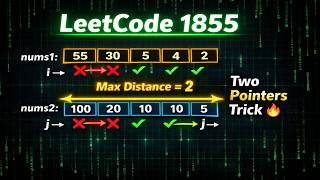
Maximum Distance Between a Pair of Values | LeetCode 1855 | 2 Pointers | Java Code | Developer Coder
Eye on AI and DSA 18 mins
Leetcode 1855. Maximum Distance Between a Pair of Values | 3 Methods | Daily Challenge
Luc Taylor 10 mins
Leetcode - 1855 Maximum Distance Between a Pair of Values
Techie On Track 13 mins
👉 1855. Maximum Distance Between a Pair of Values | POTD 19 April 2026 | C++ | Leetcode
codewarriortelugu 9 mins
1855. Maximum Distance Between a Pair of Values | Leetcode Daily | #dsa #leetcode #telugu #python
iOSxBank 10 mins
Day 716: LeetCode Problem 1855. Maximum Distance Between a Pair of Values - Swift
codewithsitaram 27 mins
Maximum Distance Between a Pair of Values | Leetcode 1855 | Explanation With Code | Java
KittyCat, Keyboard and LeetCode 9 mins
# 19.04.2026 [1855. Maximum Distance Between a Pair of Values]
11 videos
did my crawler come up with invalid videos ? drop me a line.
Solved On The Same Day
2 easy
- problem 1854: Maximum Population Year
- problem 1869: Longer Contiguous Segments of Ones than Zeros
- problem 1239: Maximum Length of a Concatenated String with Unique Characters
- problem 1839: Longest Substring Of All Vowels in Order
5 solutions
January 24, 2024
Extra
There are a few extra pages giving you some insights into my setup:
- Tech Stack - my development environment and tools
- AI - how AI helped me create this website (NOT solving the problems)
- Progress - progression over time
- Quality - code quality