Python 1914.py
class Solution:
    def rotateGrid(self, grid: List[List[int]], k: int) -> List[List[int]]:
        height = len(grid)
        width  = len(grid[0])

        done = []
        for y in range(height):
            done.append([ False ] * width)

        rings  = defaultdict(list)
        deltas = [ [ +1, 0 ], [ 0, +1 ], [ -1, 0 ], [ 0, -1 ] ]
        x = y  = direction = 0
        dx, dy = deltas[direction]
        level  = 1
        while not done[y][x]:
            rings[level].append(( x, y ))
            done[y][x] = True
            x += dx
            y += dy
            # change direction, potentially process next ring
            if x < 0 or y < 0 or x == width or y == height or done[y][x]:
                # undo
                x -= dx
                y -= dy
                # switch direction
                direction += 1
                # start new ring/level
                if direction == len(deltas):
                    direction = 0
                    level    += 1
                dx, dy = deltas[direction]
                x += dx
                y += dy

        # allocate memory
        result = []
        for y in range(height):
            result.append([ None ] * width)

        # process ring-by-ring
        for r in rings:
            size = len(rings[r])
            for one in range(size):
                two = (one + k) % size
                x,  y  = rings[r][one]
                gx, gy = rings[r][two]
                result[y][x] = grid[gy][gx]

        return result
49 lines
|
1567 bytes
|
submitted April 8, 2024
|
GitHub
15% comment ratio
|
tab size 4
|
moderate complexity
Difficulty
This problem is ranked as
and has an acceptance rate of about 74% (100k+ submissions).
Typical patterns to solve this problem:
easy
medium
hard
and has an acceptance rate of about 74% (100k+ submissions).
Typical patterns to solve this problem:
- Array
- Matrix
- Simulation
I solved 663 easy, 1250 medium and 309 hard problems
AI Disclaimer
Every single line of code was written by me, 100% from scratch, between August 2023 and August 2024.
However, two years later I set up this website and used various AI tools to generate most of the walkthrough / explanations below.
See this dedicated page for more details.
However, two years later I set up this website and used various AI tools to generate most of the walkthrough / explanations below.
See this dedicated page for more details.
Code Walkthrough
Overview
The provided implementation rotates the elements of a rectangular matrix by moving each element along its concentric “ring”. The rotation distance k is applied uniformly to every ring, preserving the shape of the matrix while shifting values clockwise (or counter-clockwise depending on the sign of k). The algorithm proceeds in three conceptual phases: marking visited cells, collecting coordinates for each ring, and writing the rotated values into a newly allocated result grid.
Key Steps
The first phase creates a boolean matrix done that mirrors the dimensions of the input grid. This matrix records whether a cell has already been assigned to a ring, preventing revisits during the traversal.
height = len(grid)
width  = len(grid[0])

done = []
for y in range(height):
    done.append([ False ] * width)
Next, the algorithm walks the grid in a spiral pattern using a direction vector list deltas. The variables x, y, and direction track the current position and movement direction. The level variable identifies the current ring index, starting at 1. As long as the current cell has not been visited, its coordinates are appended to the list for the current ring in the rings dictionary, and the cell is marked as visited.
rings  = defaultdict(list)
deltas = [ [ +1, 0 ], [ 0, +1 ], [ -1, 0 ], [ 0, -1 ] ]
x = y = direction = 0
dx, dy = deltas[direction]
level  = 1
while not done[y][x]:
    rings[level].append(( x, y ))
    done[y][x] = True
    x += dx
    y += dy
    if x < 0 or y < 0 or x == width or y == height or done[y][x]:
        x -= dx
        y -= dy
        direction += 1
        if direction == len(deltas):
            direction = 0
            level    += 1
        dx, dy = deltas[direction]
        x += dx
        y += dy
After the traversal completes, a result matrix of the same size is allocated, initially filled with None. This matrix will receive the rotated values.
result = []
for y in range(height):
    result.append([ None ] * width)
The final phase iterates over each ring stored in rings. For each position one in a ring, the target position after rotation is computed as (one + k) % size, where size is the number of cells in the ring. The value from the source coordinate gx, gy is placed into the destination coordinate x, y of the result matrix.
for r in rings:
    size = len(rings[r])
    for one in range(size):
        two = (one + k) % size
        x,  y  = rings[r][one]
        gx, gy = rings[r][two]
        result[y][x] = grid[gy][gx]
The function returns the fully populated result matrix, which reflects the original grid after the specified rotation.
Edge Cases Handled
The traversal logic includes boundary checks (x < 0 or y < 0 or x == width or y == height) that automatically stop movement when the next step would leave the matrix. The additional condition done[y][x] ensures that the algorithm correctly transitions to the next inner ring once the outer perimeter is exhausted. Because the while loop continues until the current cell is already marked, the code gracefully handles grids where the height and width differ, as well as degenerate cases such as a single row or a single column. In those scenarios, the direction changes occur precisely when the next step would either cross the border or revisit a cell, resulting in a correct ring decomposition even when a ring consists of a line rather than a closed loop.
The modulo operation (one + k) % size guarantees that any integer k, positive or negative, maps to a valid index within the ring. This prevents out-of-range accesses and naturally wraps the rotation around the ring regardless of the magnitude of k.
Performance Optimizations
The algorithm avoids repeated allocation of intermediate structures by constructing the done matrix once and reusing it throughout the traversal. The use of a defaultdict(list) for rings eliminates the need for explicit existence checks when appending coordinates, streamlining the ring collection step.
By pre-allocating the result matrix with a single pass over the rows, the code ensures that each assignment in the final phase writes directly to its final location without additional copying. The inner loop that copies values from the source grid to the result grid accesses each cell exactly once, resulting in a linear pass over the total number of elements.
Direction changes are performed only when necessary-specifically when the next coordinate would be out of bounds or already visited-so the traversal proceeds with minimal branching. The incremental update of x and y using dx and dy keeps arithmetic simple and cache-friendly, contributing to efficient execution even for large matrices.
written by openai gpt
ELI5 - Simplified Explanation
Imagine a big square box filled with toys arranged in layers, like a set of nested boxes sitting inside one another. The goal is to take all the toys on the outermost layer and shift them over by a certain number of spaces, and then do the same thing for the layer inside that one, and repeat until every layer has been moved.
First, the code builds a map to keep track of which toys belong to which layer. It walks along the edge of the box, picking up the position of every toy until it finishes a full loop, and then it moves to the next inner layer to do it again. It keeps a helpful list that says exactly which toys are in which layer so nothing gets lost.
Once the layers are mapped out, the code brings out a fresh, empty box. It looks at a specific layer, counts how many spots it needs to slide the toys, and picks up a toy from one spot in the old box and sets it into its new home in the fresh box. It does this for every single toy in every single layer. By the time it finishes moving all the toys to their new spots, the new box is completely filled and every toy has been shifted exactly the right amount.
written by google gemini
Code Quality
Several LLMs ranked my code quality on a scale from 1 (very poor) to 10 (outstanding):
n = 27
|
median = 6
|
μ = 5.89
|
σ = 1.55
Complexity Analysis
Time: polynomial
As a rule of thumb, the maximum input size for one second execution time is
As a rule of thumb, the maximum input size for one second execution time is
- factorial: up to 10 elements
- exponential: up to 20 elements
- polynomial: a few thousand elements
- loglinear: up to 100,000 elements
- linear: a few million elements
- logarithmic: a billion elements
- constant: practically unlimited
generated automatically
Other Solutions
I wrote a basic crawler to find other solutions to that problem.
Obviously, I did that after I solved the problem myself.
In general, AlgoMonster and WalkCCC solutions are high-quality and always worth a look.
I haven't checked most of the other solutions, but they might be helpful as well.
And of course, the LeetCode forum is always a good place (or even the best) to look for alternative approaches.
(click on a column header to sort the table)
| author | |||||||||
|---|---|---|---|---|---|---|---|---|---|
| author | solutions | ||||||||
| www | AlgoMonster | C++ | Python | Java | TS | ||||
| WalkCCC | C++ | Python | Java | ||||||
| leetcode.ca | C++ | Python | Java | Go | Rust | TS | |||
| Progiez | C++ | Python | Java | ||||||
| github | black-shadows | C++ | |||||||
| charles-wangkai | Java | ||||||||
| everthis | JS | ||||||||
| fsq | C++ | ||||||||
| JoshCrozier | JS | ||||||||
| lkwq007 | Python | ||||||||
| suxrobGM | C# | ||||||||
| withaarzoo | C++ | ||||||||
| AlgoMonster | C++, Python, Java, TypeScript | ||||||||
| WalkCCC | C++, Python, Java | ||||||||
| leetcode.ca | C++, Go, Java, Python, Rust, TypeScript | ||||||||
| Progiez | C++, Java, Python | ||||||||
| black-shadows | C++, C++ | ||||||||
| charles-wangkai | Java | ||||||||
| everthis | JavaScript | ||||||||
| fsq | C++ | ||||||||
| JoshCrozier | JavaScript | ||||||||
| lkwq007 | Python | ||||||||
| suxrobGM | C# | ||||||||
| withaarzoo | C++ |
24 links
|
12 authors
|
8 languages
Videos
These are a few popular YouTube videos for this problem:

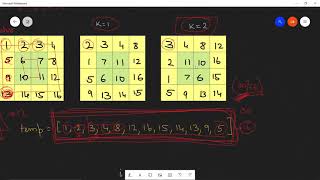

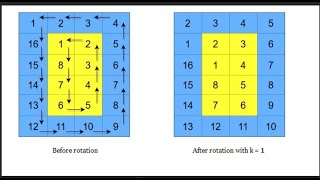

codestorywithMIK 21 mins
Cyclically Rotating a Grid | Simplified and Easy | Dry Run | Leetcode 1914 | codestorywithMIK
Leetcode Daily 6 mins
1914. Cyclically Rotating a Grid | Leetcode Daily - Python
Coding Ninjas Webinars and Contest Editorials 25 mins
LeetCode Weekly Contest 247 Question 2: Cyclically Rotating a Grid
Kernel Queen 👑 12 mins
Cyclically Rotating a Grid | Leetcode 1914 | Java | Hindi | Detailed Explanation
Programming Live with Larry 21 mins
1914. Cyclically Rotating a Grid (Leetcode Medium)
impoldev 10 mins
Cyclically Rotating a Grid | LeetCode 1914 - Python
Pragya Gupta 40 mins
Cyclically Rotating a Grid | Leetcode 1914 | Matrix | Grid | 2 Approaches | Inplace | Best time
Streak To Scale 7 mins
Cyclically Rotating a Grid | LeetCode 1914
ExpertFunda 19 mins
Leetcode 1914. Cyclically Rotating a Grid
LeetUp 13 mins
1914. Cyclically Rotating a Grid | LeetCode Problem Explained with Solution"
Developer Coder 24 mins
Cyclically Rotating a Grid | LeetCode 1914 | Java Code | Developer Coder
CodeByTushu 27 mins
LeetCode 1914 | Cyclically Rotating a Grid | Java Matrix Rotation Solution
12 videos
did my crawler come up with invalid videos ? drop me a line.
Solved On The Same Day
1 medium
- problem 1487: Making File Names Unique
- problem 1449: Form Largest Integer With Digits That Add up to Target
3 solutions
April 8, 2024
Extra
There are a few extra pages giving you some insights into my setup:
- Tech Stack - my development environment and tools
- AI - how AI helped me create this website (NOT solving the problems)
- Progress - progression over time
- Quality - code quality