Python 1991.py
class Solution:
    def findMiddleIndex(self, nums: List[int]) -> int:
        left  = 0
        right = sum(nums)
        for i, n in enumerate(nums):
            right -= n
            if left == right:
                return i
            left  += n
        return -1
Difficulty
This problem is ranked as
and has an acceptance rate of about 70% (200k+ submissions).
Typical patterns to solve this problem:
easy
medium
hard
and has an acceptance rate of about 70% (200k+ submissions).
Typical patterns to solve this problem:
- Array
- Prefix Sum
I solved 663 easy, 1250 medium and 309 hard problems
AI Disclaimer
Every single line of code was written by me, 100% from scratch, between August 2023 and August 2024.
However, two years later I set up this website and used various AI tools to generate most of the walkthrough / explanations below.
See this dedicated page for more details.
However, two years later I set up this website and used various AI tools to generate most of the walkthrough / explanations below.
See this dedicated page for more details.
Code Walkthrough
Overview
The provided implementation defines a method that searches for an index in an integer array where the sum of the elements to the left of the index equals the sum of the elements to the right. The method returns the first such index it encounters, or -1 when no equilibrium point exists. The algorithm proceeds in a single pass, maintaining running totals for the left and right sides of the current position.
Initialization
At the start of the method two accumulator variables are created.
left  = 0
right = sum(nums)
left holds the cumulative sum of elements that have been processed, while right is initialized to the total sum of the entire array. This setup allows the algorithm to adjust the right-hand sum incrementally as it moves through the list, avoiding repeated full-array summations.
Iteration and Balance Check
The core of the solution is a for loop that enumerates the array, exposing both the index i and the element value n.
for i, n in enumerate(nums):
    right -= n
    if left == right:
        return i
    left  += n
Inside the loop the current element is first subtracted from right, thereby converting right into the sum of all elements that lie strictly to the right of the current index. The equality test left == right then determines whether the left and right sums are balanced at this position. If they match, the index is returned immediately. After the check, the element is added to left, preparing the left accumulator for the next iteration.
Edge Cases Handled
When the input list is empty, the initial right sum is zero and the loop body never executes, causing the method to fall through to the final return statement and yield -1. This correctly indicates that no middle index exists.
If the equilibrium point is at the first position (index 0), the algorithm still works because right is reduced by the first element before the equality test, leaving left at zero. The condition left == right can therefore be satisfied on the very first iteration.
Similarly, when the equilibrium point is at the last position, the loop will have subtracted all preceding elements from right, and after processing the penultimate element right will become zero. The final iteration will compare left (which now equals the sum of all earlier elements) with right (zero). Since the definition requires the right side to be empty, the condition will be true only if the left sum is also zero, which matches the intended behavior.
Performance Optimizations
The algorithm achieves efficiency by computing the total sum once, then updating the right-hand sum in constant time for each element. This eliminates the need for nested loops or repeated summations, resulting in a linear traversal of the input. The early return upon finding a matching index prevents unnecessary processing of the remaining elements, which can be significant for large arrays where the equilibrium point appears early.
The use of simple integer arithmetic and direct variable updates ensures minimal overhead, and the method avoids auxiliary data structures, keeping the memory footprint low. The approach leverages Python’s built-in sum function for the initial total, which is implemented in C and thus runs faster than a manual accumulation loop.
written by openai gpt
ELI5 - Simplified Explanation
Imagine a long line of numbered blocks sitting on a table. The goal is to figure out if there is a special spot in the middle of the line where the sum of all the blocks to the left is exactly the same as the sum of all the blocks to the right.
To solve this, the code starts by pretending all the blocks are on the right side and zero blocks are on the left side. It then walks down the line one block at a time. Each time it steps, it takes the current block off the right side and adds it to the left side. After the move, it checks to see if the weight of the blocks on the left matches the weight of the blocks on the right. If the two sides weigh the same, that spot is the one being searched for. If the whole line is checked and no such spot is found, the code stops looking because that special middle point does not exist in this line.
written by google gemini
Code Quality
Several LLMs ranked my code quality on a scale from 1 (very poor) to 10 (outstanding):
n = 27
|
median = 8
|
μ = 8.30
|
σ = 1.01
Complexity Analysis
Time: linear
As a rule of thumb, the maximum input size for one second execution time is
As a rule of thumb, the maximum input size for one second execution time is
- factorial: up to 10 elements
- exponential: up to 20 elements
- polynomial: a few thousand elements
- loglinear: up to 100,000 elements
- linear: a few million elements
- logarithmic: a billion elements
- constant: practically unlimited
generated automatically
Other Solutions
I wrote a basic crawler to find other solutions to that problem.
Obviously, I did that after I solved the problem myself.
In general, AlgoMonster and WalkCCC solutions are high-quality and always worth a look.
I haven't checked most of the other solutions, but they might be helpful as well.
And of course, the LeetCode forum is always a good place (or even the best) to look for alternative approaches.
(click on a column header to sort the table)
| author | ||||||||||
|---|---|---|---|---|---|---|---|---|---|---|
| author | solutions | |||||||||
| www | AlgoMonster | C++ | Python | Java | TS | |||||
| WalkCCC | C++ | Python | Java | |||||||
| leetcode.ca | C++ | Python | JS | Java | Go | Rust | TS | |||
| Progiez | C++ | Python | Java | |||||||
| github | black-shadows | C++ | ||||||||
| charles-wangkai | Java | |||||||||
| everthis | JS | |||||||||
| fartem | Ruby | |||||||||
| fsq | C++ | |||||||||
| JoshCrozier | JS | |||||||||
| lkwq007 | Python | |||||||||
| suxrobGM | C# | |||||||||
| trung-hn | Python | |||||||||
| varunu28 | Java | |||||||||
| AlgoMonster | C++, Python, Java, TypeScript | |||||||||
| WalkCCC | C++, Python, Java | |||||||||
| leetcode.ca | C++, Go, Java, JavaScript, Python, Rust, TypeScript | |||||||||
| Progiez | C++, Java, Python | |||||||||
| black-shadows | C++, C++ | |||||||||
| charles-wangkai | Java | |||||||||
| everthis | JavaScript | |||||||||
| fartem | Ruby | |||||||||
| fsq | C++ | |||||||||
| JoshCrozier | JavaScript | |||||||||
| lkwq007 | Python | |||||||||
| suxrobGM | C# | |||||||||
| trung-hn | Python | |||||||||
| varunu28 | Java |
27 links
|
14 authors
|
9 languages
Videos
These are a few popular YouTube videos for this problem:

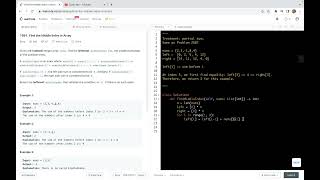

Learn Together 13 mins
Leetcode 1991 : Find the Middle Index in Array
Programming Live with Larry 5 mins
1991. Find the Middle Index in Array (Leetcode Easy)
Daily Code 5 mins
Find the Middle Index in Array | LeetCode | C#
CodingNinja 6 mins
Python Programming - Find the Middle Index in Array | JavaScript, Java and C++ | LeetCode #1991
Sleepy Cracker 5 mins
LeetCode 1991 | Find the Middle Index in Array | Array | Debug | Java
Code-Yao 8 mins
leetcode 1991. Find the Middle Index in Array - partial sum
Mr Surya Sir 5 mins
Leetcode 1991 Find the Middle Index in Array | Java | Pattern 4 : Prefix Sum
7 videos
did my crawler come up with invalid videos ? drop me a line.
Similar Problems
- problem 724: Find Pivot Index
- problem 2574: Left and Right Sum Differences
2 similar problems
Solved On The Same Day
3 easy
- problem 1779: Find Nearest Point That Has the Same X or Y Coordinate
- problem 2042: Check if Numbers Are Ascending in a Sentence
- problem 2062: Count Vowel Substrings of a String
- problem 1780: Check if Number is a Sum of Powers of Three
5 solutions
January 1, 2024
Extra
There are a few extra pages giving you some insights into my setup:
- Tech Stack - my development environment and tools
- AI - how AI helped me create this website (NOT solving the problems)
- Progress - progression over time
- Quality - code quality