Python 2144.py
class Solution:
    def minimumCost(self, cost: List[int]) -> int:
        result = 0
        three  = 1
        for c in sorted(cost, reverse = True):
            if three < 3:
                result += c
                three  += 1
            else:
                three   = 1
        return result
Difficulty
This problem is ranked as
and has an acceptance rate of about 72% (300k+ submissions).
Typical patterns to solve this problem:
easy
medium
hard
and has an acceptance rate of about 72% (300k+ submissions).
Typical patterns to solve this problem:
- Array
- Greedy
- Sorting
I solved 663 easy, 1250 medium and 309 hard problems
AI Disclaimer
Every single line of code was written by me, 100% from scratch, between August 2023 and August 2024.
However, two years later I set up this website and used various AI tools to generate most of the walkthrough / explanations below.
See this dedicated page for more details.
However, two years later I set up this website and used various AI tools to generate most of the walkthrough / explanations below.
See this dedicated page for more details.
Code Walkthrough
Overview
The provided Solution class implements a method minimumCost that computes the smallest possible total price when purchasing a collection of items whose individual costs are given in the list cost. The pricing rule is that for every group of three items, the cheapest one is obtained for free. By arranging the purchases to maximize the value of the free items, the algorithm yields the minimal total expense.
Core Logic
The algorithm proceeds in three distinct phases: sorting the input, iterating through the sorted values while tracking group membership, and accumulating the payable amount.
Sorting the Costs
for c in sorted(cost, reverse = True):The sorted function is invoked with reverse = True, producing a new list ordered from the highest cost to the lowest. Placing the most expensive items first ensures that when groups of three are formed, the free item will be the smallest within each group, thereby maximizing the discount.
Group Counter
three = 1A simple integer variable named three acts as a group counter. It starts at 1 and is incremented for each processed item until it reaches 3. When the counter hits 3, the algorithm knows that the current item should be treated as the free one.
Conditional Accumulation
if three < 3:
    result += c
    three  += 1
else:
    three   = 1
If the counter is less than 3, the current cost c is added to the running total result, and the counter is advanced. When the counter equals 3, the else branch executes: the counter is reset to 1 and the cost is deliberately omitted from result. This omission implements the “free item” rule without needing an explicit subtraction.
Final Return
return resultAfter all costs have been processed, the accumulated result holds the minimal payable amount and is returned to the caller.
Edge-Case Handling
The method gracefully handles several boundary conditions without additional code paths.
When the input list cost is empty, the for loop never iterates, leaving result at its initial value of 0. Consequently, the function returns 0, which correctly represents the cost of buying nothing.
If the list contains one or two elements, the counter never reaches 3. Both items are added to result, reflecting that no free item can be granted when fewer than three purchases are made.
For lists whose length is an exact multiple of three, every third item is omitted from the total. The counter resets after each omission, ensuring that the pattern repeats consistently throughout the entire list.
When the length leaves a remainder of one or two after division by three, the remaining one or two most expensive items are still added to result. The counter’s reset logic guarantees that only complete groups of three trigger the free-item condition.
Performance Optimizations
The implementation leverages a few subtle choices that contribute to efficient execution.
Using the built-in sorted function with the reverse flag takes advantage of the highly optimized Timsort algorithm, which performs well on partially ordered data and minimizes memory overhead by sorting in place when possible.
The group-tracking mechanism relies on a plain integer increment and a comparison rather than a modulo operation (i % 3). This avoids the cost of division and remainder calculation on each iteration, yielding a tighter inner loop.
No auxiliary data structures such as additional lists or sets are created during iteration. The algorithm maintains only three scalar variables (result, three, and the loop variable c), keeping the memory footprint minimal.
By processing the sorted list in a single pass, the method achieves a linear traversal after the initial sort, ensuring that the dominant work is confined to the sorting step while the accumulation phase remains lightweight.
written by openai gpt
ELI5 - Simplified Explanation
Imagine there is a big pile of colorful candies in front of a candy store. The shop has a special deal where if you pick two candies to buy, you get a third one for free. To make sure the shopkeeper packs them correctly, the candies are first lined up from the most expensive one to the cheapest one.
The program starts by looking at the very first candy, which is the most expensive, and puts it in a basket. Then it grabs the next most expensive one and puts that one in the basket too. Since two candies are now waiting to be paid for, the third one is a free gift. Because that third candy is free, the program skips it and stops counting it toward the total price.
After that, the program starts the pattern all over again. It takes the next candy as if it were the start of a new group of three. It keeps doing this, picking two candies to buy and getting one for free, until there are no candies left. By the end, the basket is full of all the candies that need to be paid for, and the total cost for those candies is ready.
written by google gemini
Code Quality
Several LLMs ranked my code quality on a scale from 1 (very poor) to 10 (outstanding):
n = 27
|
median = 7
|
μ = 6.11
|
σ = 1.87
Complexity Analysis
Time: loglinear
As a rule of thumb, the maximum input size for one second execution time is
As a rule of thumb, the maximum input size for one second execution time is
- factorial: up to 10 elements
- exponential: up to 20 elements
- polynomial: a few thousand elements
- loglinear: up to 100,000 elements
- linear: a few million elements
- logarithmic: a billion elements
- constant: practically unlimited
generated automatically
Other Solutions
I wrote a basic crawler to find other solutions to that problem.
Obviously, I did that after I solved the problem myself.
In general, AlgoMonster and WalkCCC solutions are high-quality and always worth a look.
I haven't checked most of the other solutions, but they might be helpful as well.
And of course, the LeetCode forum is always a good place (or even the best) to look for alternative approaches.
(click on a column header to sort the table)
| author | ||||||||
|---|---|---|---|---|---|---|---|---|
| author | solutions | |||||||
| www | AlgoMonster | C++ | Java | Python | TS | |||
| WalkCCC | C++ | Java | Python | |||||
| leetcode.ca | C++ | Java | Python | Go | TS | |||
| Progiez | C++ | Java | Python | |||||
| github | black-shadows | C++ | ||||||
| charles-wangkai | Java | |||||||
| fsq | C++ | |||||||
| JoshCrozier | JS | |||||||
| lkwq007 | Python | |||||||
| shreymehul | C# | |||||||
| suxrobGM | C# | |||||||
| varunu28 | Java | |||||||
| withaarzoo | C++ | |||||||
| AlgoMonster | C++, Python, Java, TypeScript | |||||||
| WalkCCC | C++, Python, Java | |||||||
| leetcode.ca | C++, Go, Java, Python, TypeScript | |||||||
| Progiez | C++, Java, Python | |||||||
| black-shadows | C++, C++ | |||||||
| charles-wangkai | Java | |||||||
| fsq | C++ | |||||||
| JoshCrozier | JavaScript | |||||||
| lkwq007 | Python | |||||||
| shreymehul | C# | |||||||
| suxrobGM | C# | |||||||
| varunu28 | Java | |||||||
| withaarzoo | C++ |
24 links
|
13 authors
|
7 languages
Videos
These are a few popular YouTube videos for this problem:

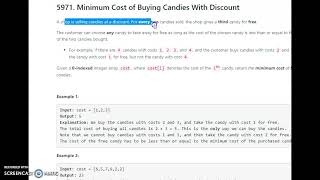


Bro Coders 6 mins
2144 Minimum Cost of Buying Candies With Discount | LeetCode 2144 || BiWeekly- 70 || Greedy
We are Coders 3 mins
Minimum Cost of Buying Candies With Discount | LeetCode | Biweekly Contest 70
Pepcoding 8 mins
Minimum Cost of Buying Candies With Discount | Leetcode 2144 | BI-Weekly Contest 70 Solution | Java
Programming Live with Larry 4 mins
2144. Minimum Cost of Buying Candies With Discount (Leetcode Easy)
Quick Learning With Sree 9 mins
2144. Minimum Cost of Buying Candies With Discount || In JAVA || Leetcode Problem || Easy #leetcode
Pirai's Academy 7 mins
Minimum Cost of Buying Candies With Discount | Leetcode 2144 | Approach + Code with explanation.
6 videos
did my crawler come up with invalid videos ? drop me a line.
Similar Problems
- problem 1200: Minimum Absolute Difference
- problem 3122: Minimum Number of Operations to Satisfy Conditions
- problem 3142: Check if Grid Satisfies Conditions
3 similar problems
Solved On The Same Day
4 easy
- problem 2124: Check if All A's Appears Before All B's
- problem 2129: Capitalize the Title
- problem 2138: Divide a String Into Groups of Size k
- problem 2154: Keep Multiplying Found Values by Two
5 solutions
January 28, 2024
Extra
There are a few extra pages giving you some insights into my setup:
- Tech Stack - my development environment and tools
- AI - how AI helped me create this website (NOT solving the problems)
- Progress - progression over time
- Quality - code quality