Python 2225.py
class Solution:
    def findWinners(self, matches: List[List[int]]) -> List[List[int]]:
        players = set()
        lost = defaultdict(int)
        for m in matches:
            lost[m[1]] += 1
            players.add(m[0])
            players.add(m[1])

        p = sorted(players)

        perfect = [ i for i in p if lost[i] == 0 ]
        one     = [ i for i in p if lost[i] == 1 ]
        return [ perfect, one ]
Difficulty
This problem is ranked as
and has an acceptance rate of about 72% (400k+ submissions).
Typical patterns to solve this problem:
easy
medium
hard
and has an acceptance rate of about 72% (400k+ submissions).
Typical patterns to solve this problem:
- Array
- Counting
- Hash Table
- Sorting
I solved 663 easy, 1250 medium and 309 hard problems
AI Disclaimer
Every single line of code was written by me, 100% from scratch, between August 2023 and August 2024.
However, two years later I set up this website and used various AI tools to generate most of the walkthrough / explanations below.
See this dedicated page for more details.
However, two years later I set up this website and used various AI tools to generate most of the walkthrough / explanations below.
See this dedicated page for more details.
Code Walkthrough
Overview
The provided implementation solves the problem of classifying players based on the number of matches they have lost. It returns two groups: players who have never lost a match and players who have lost exactly one match. The algorithm processes the input list of match results, builds a set of all participants, records loss frequencies, sorts the participants, and finally extracts the two required groups.
Step 1 - Initialise data structures
The solution creates a set to hold every distinct player identifier and a dictionary that defaults missing keys to zero, which will be used to count losses.
players = set()
lost = defaultdict(int)
The set guarantees uniqueness of player IDs while the defaultdict simplifies incrementing loss counters without explicit existence checks.
Step 2 - Populate loss counts and player set
The core loop iterates over each match record, where m[0] is the winner and m[1] is the loser. For every match the loser’s counter is increased, and both winner and loser are added to the global player set.
for m in matches:
    lost[m[1]] += 1
    players.add(m[0])
    players.add(m[1])
This step ensures that every participant appears in the final result, even if they never lost a match.
Step 3 - Sort the complete player list
After gathering all identifiers, the set is converted to a list and sorted in ascending order. Sorting provides deterministic ordering for the output, which matches the problem’s requirement for ordered results.
p = sorted(players)Step 4 - Extract players with zero and one loss
Two list comprehensions filter the sorted player list based on the loss count stored in the dictionary. The first comprehension selects identifiers whose loss count is exactly zero, forming the “perfect” group. The second selects identifiers with a loss count of one.
perfect = [i for i in p if lost[i] == 0]
one = [i for i in p if lost[i] == 1]
Because the dictionary returns zero for any player not present as a loser (thanks to defaultdict), players who never lost are correctly identified without additional checks.
Step 5 - Return the grouped result
The method returns a list containing the two previously built lists, preserving the required order: first the zero-loss group, then the one-loss group.
return [perfect, one]Edge Cases Handled
When the input contains matches where a player appears only as a winner, the defaultdict supplies a zero loss count, allowing that player to be placed in the zero-loss group. If a player loses multiple times, the loss counter accurately reflects the total, and the player is excluded from both output groups because only zero or one loss qualifies. An empty matches list results in an empty player set; the subsequent sorting yields an empty list, and both output groups are empty, which aligns with the expected behavior for no data.
The algorithm also gracefully handles duplicate match entries. Each occurrence increments the loss counter for the loser, so a player who loses the same opponent multiple times will be counted correctly. Winners that appear multiple times are added repeatedly to the set, but the set’s uniqueness property prevents duplication in the final sorted list.
Performance Optimizations Observed
The use of a set for player collection eliminates the need for explicit duplicate checks, providing O(1) average-time insertion and membership operations. The defaultdict removes conditional branches that would otherwise be required to initialise loss counters, streamlining the inner loop. Converting the set to a sorted list is performed once after all data has been gathered, avoiding repeated sorting operations. List comprehensions for filtering are executed in a single pass over the sorted list, leveraging Python’s internal optimisations for fast iteration and element selection. Overall, the design minimises the number of passes over the data and relies on built-in data structures that are highly tuned for the operations performed.
written by openai gpt
ELI5 - Simplified Explanation
Imagine a big group of friends who love playing tag together. Every time two kids play a game, one person wins and the other person loses. We want to sort these friends into two special teams based on how many times they have lost.
First, we look at a long list of all the games that happened. Whenever someone plays, their name goes into a big organizer bucket so we know they were part of the fun. We also keep a little tally pad for everyone who loses a game. Every time a child loses, we put a mark next to their name on the pad. If someone plays but never loses, they get no marks at all.
Once all the games are finished and the tally pad is full, it is time to organize everyone. We put all the names in an order starting from the smallest number to the largest number. This makes it much easier to find who belongs where.
To build our first team, we look at the list of all the friends and pick out everyone who has zero marks on the tally pad. These are the champs who never lost a single time.
For the second team, we look through the list again and find all the friends who have exactly one mark on the tally pad. These are the friends who played really well but had just one small slip during the day. This helps us see exactly how everyone did in the games without getting confused by all the results.
written by google gemini
Code Quality
Several LLMs ranked my code quality on a scale from 1 (very poor) to 10 (outstanding):
n = 27
|
median = 8
|
μ = 7.63
|
σ = 1.09
Complexity Analysis
Time: loglinear
As a rule of thumb, the maximum input size for one second execution time is
As a rule of thumb, the maximum input size for one second execution time is
- factorial: up to 10 elements
- exponential: up to 20 elements
- polynomial: a few thousand elements
- loglinear: up to 100,000 elements
- linear: a few million elements
- logarithmic: a billion elements
- constant: practically unlimited
generated automatically
Other Solutions
I wrote a basic crawler to find other solutions to that problem.
Obviously, I did that after I solved the problem myself.
In general, AlgoMonster and WalkCCC solutions are high-quality and always worth a look.
I haven't checked most of the other solutions, but they might be helpful as well.
And of course, the LeetCode forum is always a good place (or even the best) to look for alternative approaches.
(click on a column header to sort the table)
| author | ||||||||||
|---|---|---|---|---|---|---|---|---|---|---|
| author | solutions | |||||||||
| www | AlgoMonster | Python | Java | C++ | TS | |||||
| WalkCCC | Python | Java | C++ | |||||||
| leetcode.ca | Python | Java | C++ | JS | Go | TS | ||||
| Progiez | Python | Java | C++ | |||||||
| github | black-shadows | C++ | ||||||||
| chandansgowda | Python | |||||||||
| charles-wangkai | Java | |||||||||
| everthis | JS | |||||||||
| fartem | Ruby | |||||||||
| fsq | C++ | |||||||||
| JoshCrozier | JS | |||||||||
| lkwq007 | Python | |||||||||
| pruthvikp | Python | |||||||||
| shreymehul | C# | |||||||||
| suxrobGM | C# | |||||||||
| varunu28 | Java | |||||||||
| vthwang | Java | |||||||||
| yuanliu666 | Kotlin | |||||||||
| AlgoMonster | C++, Python, Java, TypeScript | |||||||||
| WalkCCC | C++, Python, Java | |||||||||
| leetcode.ca | C++, Go, Java, JavaScript, Python, TypeScript | |||||||||
| Progiez | C++, Java, Python | |||||||||
| black-shadows | C++, C++ | |||||||||
| chandansgowda | Python | |||||||||
| charles-wangkai | Java | |||||||||
| everthis | JavaScript | |||||||||
| fartem | Ruby | |||||||||
| fsq | C++ | |||||||||
| JoshCrozier | JavaScript | |||||||||
| lkwq007 | Python | |||||||||
| pruthvikp | Python | |||||||||
| shreymehul | C# | |||||||||
| suxrobGM | C# | |||||||||
| varunu28 | Java | |||||||||
| vthwang | Java | |||||||||
| yuanliu666 | Kotlin |
30 links
|
18 authors
|
9 languages
Videos
These are a few popular YouTube videos for this problem:



Aryan Mittal 21 mins
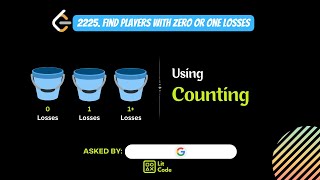
2225. Find Players With Zero or One Losses | 2 Ways to Solve
Algorithms Casts 5 mins
Leetcode 2225: Find Players With Zero or One Losses
Programming Live with Larry 10 mins
Daily Leetcode #1385: Jan 15, 2024 - 2225. Find Players With Zero or One Losses
Lit Code 7 mins
HOW TO Find Players With Zero or One Losses - Leetcode 2225
Alpha-Code 8 mins
LeetCode 2225 - Find Players With Zero or One Losses - Python
ShashTag 50 mins
Solving leetcode live : 2225. Find Players With Zero or One Losses
6 videos
did my crawler come up with invalid videos ? drop me a line.
Similar Problems
- problem 236: Lowest Common Ancestor of a Binary Tree
1 similar problem
Solved On The Same Day
24 medium
- problem 880: Decoded String at Index
- problem 912: Sort an Array
- problem 923: 3Sum With Multiplicity
- problem 973: K Closest Points to Origin
- problem 1010: Pairs of Songs With Total Durations Divisible by 60
- problem 1054: Distant Barcodes
- problem 1079: Letter Tile Possibilities
- problem 1090: Largest Values From Labels
- problem 1347: Minimum Number of Steps to Make Two Strings Anagram
- problem 1366: Rank Teams by Votes
- problem 1419: Minimum Number of Frogs Croaking
- problem 1738: Find Kth Largest XOR Coordinate Value
- problem 1814: Count Nice Pairs in an Array
- problem 1985: Find the Kth Largest Integer in the Array
- problem 2018: Check if Word Can Be Placed In Crossword
- problem 2150: Find All Lonely Numbers in the Array
- problem 2182: Construct String With Repeat Limit
- problem 2232: Minimize Result by Adding Parentheses to Expression
- problem 2244: Minimum Rounds to Complete All Tasks
- problem 2284: Sender With Largest Word Count
- problem 2343: Query Kth Smallest Trimmed Number
- problem 2526: Find Consecutive Integers from a Data Stream
- problem 2844: Minimum Operations to Make a Special Number
- problem 2860: Happy Students
- problem 906: Super Palindromes
- problem 992: Subarrays with K Different Integers
- problem 1106: Parsing A Boolean Expression
- problem 1601: Maximum Number of Achievable Transfer Requests
- problem 2081: Sum of k-Mirror Numbers
- problem 2122: Recover the Original Array
- problem 2416: Sum of Prefix Scores of Strings
32 solutions
September 28, 2023
Extra
There are a few extra pages giving you some insights into my setup:
- Tech Stack - my development environment and tools
- AI - how AI helped me create this website (NOT solving the problems)
- Progress - progression over time
- Quality - code quality