C++ 0229.cpp
class Solution:
    def majorityElement(self, nums: List[int]) -> List[int]:
        freq = defaultdict(int)
        for i in nums:
            freq[i] += 1

        result = []
        threshold = len(nums) // 3
        for i in freq:
            if freq[i] > threshold:
                result.append(i)

        return result
Difficulty
This problem is ranked as
and has an acceptance rate of about 57% (2+ million submissions).
Typical patterns to solve this problem:
easy
medium
hard
and has an acceptance rate of about 57% (2+ million submissions).
Typical patterns to solve this problem:
- Array
- Counting
- Hash Table
- Sorting
I solved 663 easy, 1250 medium and 309 hard problems
AI Disclaimer
Every single line of code was written by me, 100% from scratch, between August 2023 and August 2024.
However, two years later I set up this website and used various AI tools to generate most of the walkthrough / explanations below.
See this dedicated page for more details.
However, two years later I set up this website and used various AI tools to generate most of the walkthrough / explanations below.
See this dedicated page for more details.
Code Walkthrough
Overview
The provided implementation solves the problem of finding all elements in an integer array that appear more than ⌊n/3⌋ times, where n is the length of the array. It follows a straightforward counting strategy using a hash-based frequency table, then filters the table based on the required occurrence threshold. The design is concise, leverages Python’s standard library for brevity, and handles a variety of input shapes without special-case code.
Key Steps
Frequency Accumulation
The algorithm begins by constructing a mapping from each distinct integer to its occurrence count. A defaultdict with an integer default value is employed so that each new key is automatically initialized to zero before being incremented.
freq = defaultdict(int)
for i in nums:
    freq[i] += 1
This loop processes the input list exactly once, updating the count for each element as it appears.
Threshold Computation
After the frequencies are known, the algorithm determines the minimum count an element must exceed to qualify as a majority element under the ⌊n/3⌋ rule. The integer division operator (//) yields the floor of the division, matching the problem’s definition.
threshold = len(nums) // 3Result Extraction
The final phase iterates over the keys of the frequency table, selecting those whose count surpasses the previously computed threshold. Qualified elements are appended to a result list, which is then returned.
result = []
for i in freq:
    if freq[i] > threshold:
        result.append(i)
return result
Edge Cases Handled
The implementation naturally accommodates several edge conditions without additional branching:
-
Empty Input - When
numsis empty,len(nums)is zero, the threshold becomes zero, and the frequency table remains empty. The subsequent loop overfreqyields no iterations, resulting in an empty list, which correctly represents the absence of majority elements. -
Single-Element Input - For a list containing one element, the threshold evaluates to zero (
1 // 3 == 0). The sole element’s count is one, which is greater than zero, so it is included in the result. This aligns with the definition that any element in a single-element array appears more than ⌊1/3⌋ times. -
Two-Element Input - With two elements, the threshold is also zero (
2 // 3 == 0). Both distinct elements, if different, will have a count of one, each exceeding the threshold, and both will be returned. If the two elements are identical, the single distinct value will be returned once, reflecting its count of two. -
All Elements Identical - When every entry in
numsis the same value, its frequency equalsn. Sincenis always greater thann // 3forn > 0, the algorithm returns a list containing that single value. -
Multiple Majority Elements - The algorithm does not assume uniqueness of the majority element. If more than one distinct value exceeds the threshold (possible when the array contains a mixture of three or more distinct values each appearing just over
n/3times), each qualifying value is added to the result list. -
Negative and Zero Values - The frequency table treats all integer keys uniformly, so negative numbers and zero are counted without special handling.
Performance Optimizations Observed
The code exhibits several implicit performance choices:
-
Hash-Based Counting - By using a dictionary (
defaultdict) for frequency storage, the algorithm achieves constant-time updates for each element, avoiding the need for nested loops or repeated scans. -
Single Pass for Counting - The counting loop processes each element exactly once, minimizing the number of read operations on the input list.
-
Iterating Over Distinct Keys - The second loop iterates only over the unique elements present in the input, rather than over the entire list again. This reduces the number of iterations when the input contains many duplicate values.
-
In-Place Threshold Calculation - Computing the threshold once before the filtering loop eliminates repeated division operations inside the loop body.
-
Avoidance of Intermediate Structures - The algorithm builds only the essential frequency map and the final result list, without allocating additional temporary collections such as sorted copies or auxiliary arrays.
These choices collectively keep the runtime low and the memory footprint modest, especially for inputs with a high degree of repetition.
written by openai gpt
ELI5 - Simplified Explanation
Imagine you have a big treasure box full of colorful plastic building blocks. You want to find out which colors appear the most often.
First, you pick up each block one by one and keep a little notebook. Every time you see a blue block, you put a tally mark next to the word blue in your notebook. You do the same for every red, green, or yellow block you find. By the time you finish looking at all the blocks, your notebook shows exactly how many of each color you have.
Next, you need to decide which colors are the winners. You count all the blocks in the pile and divide that number by three to set a special goal. If a color has more tally marks than that goal, it means that color is very popular. You take those winning colors and put them into a brand new box to keep. If a color does not have enough tally marks, it just stays behind in the big pile, and you ignore it.
written by google gemini
Code Quality
Several LLMs ranked my code quality on a scale from 1 (very poor) to 10 (outstanding):
n = 26
|
median = 7
|
μ = 6.54
|
σ = 1.39
Complexity Analysis
Time: linear
As a rule of thumb, the maximum input size for one second execution time is
As a rule of thumb, the maximum input size for one second execution time is
- factorial: up to 10 elements
- exponential: up to 20 elements
- polynomial: a few thousand elements
- loglinear: up to 100,000 elements
- linear: a few million elements
- logarithmic: a billion elements
- constant: practically unlimited
generated automatically
Other Solutions
I wrote a basic crawler to find other solutions to that problem.
Obviously, I did that after I solved the problem myself.
In general, AlgoMonster and WalkCCC solutions are high-quality and always worth a look.
I haven't checked most of the other solutions, but they might be helpful as well.
And of course, the LeetCode forum is always a good place (or even the best) to look for alternative approaches.
(click on a column header to sort the table)
| author | |||||||||||
|---|---|---|---|---|---|---|---|---|---|---|---|
| author | solutions | ||||||||||
| www | AlgoMonster | C++ | Python | Java | TS | ||||||
| WalkCCC | C++ | Python | Java | ||||||||
| leetcode.ca | C++ | Python | C# | Java | Go | PHP | |||||
| LeetcodeHelp | C++ | Python | Java | ||||||||
| MemoryLimitExceeded | C++ | Python | |||||||||
| Progiez | C++ | Python | Java | ||||||||
| github | aylei | Rust | |||||||||
| begeekmyfriend | C | ||||||||||
| BigEggStudy | C# | ||||||||||
| black-shadows | C++ | ||||||||||
| chandansgowda | Python | ||||||||||
| charles-wangkai | Java | ||||||||||
| chenyanzhe | C++ | ||||||||||
| everthis | JS | ||||||||||
| fengvyi | C++ | ||||||||||
| gaosq0604 | Python | ||||||||||
| halfrost | Go | ||||||||||
| JoshCrozier | JS | ||||||||||
| keineahnung2345 | C++ | ||||||||||
| linouk23 | C++ | ||||||||||
| lkwq007 | Python | ||||||||||
| MacJim | C++ | ||||||||||
| qiyuangong | Python | ||||||||||
| ruoru | Rust | ||||||||||
| shreymehul | C# | ||||||||||
| sonugiri1043 | C++ | ||||||||||
| suxrobGM | C# | ||||||||||
| trung-hn | Python | ||||||||||
| varunu28 | Java | ||||||||||
| vli02 | C | ||||||||||
| wisdompeak | C++ | ||||||||||
| YuriSpiridonov | Python | ||||||||||
| zfang399 | C++ | ||||||||||
| AlgoMonster | C++, Python, Java, TypeScript | ||||||||||
| WalkCCC | C++, Python, Java | ||||||||||
| leetcode.ca | C++, C#, Go, Java, PHP, Python | ||||||||||
| LeetcodeHelp | C++, Java, Python | ||||||||||
| MemoryLimitExceeded | Python, C++ | ||||||||||
| Progiez | C++, Java, Python | ||||||||||
| aylei | Rust | ||||||||||
| begeekmyfriend | C | ||||||||||
| BigEggStudy | C# | ||||||||||
| black-shadows | C++, C++ | ||||||||||
| chandansgowda | Python | ||||||||||
| charles-wangkai | Java | ||||||||||
| chenyanzhe | C++ | ||||||||||
| everthis | JavaScript | ||||||||||
| fengvyi | C++ | ||||||||||
| gaosq0604 | Python | ||||||||||
| halfrost | Go | ||||||||||
| JoshCrozier | JavaScript | ||||||||||
| keineahnung2345 | C++ | ||||||||||
| linouk23 | C++ | ||||||||||
| lkwq007 | Python | ||||||||||
| MacJim | C++ | ||||||||||
| qiyuangong | Python | ||||||||||
| ruoru | Rust | ||||||||||
| shreymehul | C# | ||||||||||
| sonugiri1043 | C++ | ||||||||||
| suxrobGM | C# | ||||||||||
| trung-hn | Python | ||||||||||
| varunu28 | Java | ||||||||||
| vli02 | C | ||||||||||
| wisdompeak | C++ | ||||||||||
| YuriSpiridonov | Python | ||||||||||
| zfang399 | C++ |
48 links
|
33 authors
|
10 languages
Videos
These are a few popular YouTube videos for this problem:



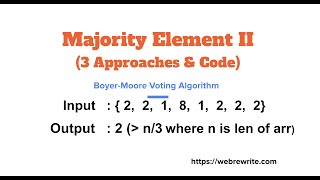







NeetCodeIO 15 mins
Majority Element II - Leetcode 229 - Python
codestorywithMIK 32 mins
Majority Element I | Majority Element II | Boyer-Moore | Made Simple | Leetcode 229 | Leetcode 169
Pepcoding 21 mins
Majority Element - 2 | Arrays & Strings | Leetcode 229. Solution in Hindi
Programming Tutorials 19 mins
Majority Element II | LeetCode 229 | Majority Element (Greater than N/3 Times)
Sai Anish Malla 19 mins
Majority Element II | Leet code 229 | Theory explained + Python code
Code Bashers 18 mins
Majority Element II LeetCode | Leetcode 229 | N/3 repeat | Leetcode September Challenge
happygirlzt 11 mins
LeetCode 169. Majority Element and 229. Majority Element II
vanAmsen 7 mins
Mastering 229. Majority Element II with Boyer-Moore! | Deep Dive Coding Session
Baozi Training 5 mins
Baozi Training Leetcode 229 solution: Major Element II
Programming Live with Larry 18 mins
3739. Count Subarrays With Majority Element II (Leetcode Hard)
Programming Live with Larry 30 mins
Daily Leetcode #1283: Oct 05, 2023 - 229. Majority Element II
Web Fusion with Bharadwaj 12 mins
19. Leetcode 229. Majority Element II : JAVA
Shiva Prasad Gurram 16 mins
Majority Element II - LeetCode 229 | SOLVED in 3 ways | T.C O(N) | S.C O(1)
CodeFreaks 8 mins
229 || Majority Element II || C++ || Leetcode Daily Challenge
Programming Live with Larry 35 mins
Daily Leetcode #175: Sep 22, 2020 - 229. Majority Element II
Alpha-Code 26 mins
Majority Element II - LeetCode 229 - Python - Boyer Moore
SM TechWorld 19 mins
Majority Element II LeetCode 229 September Challenge
Leet Logics 15 mins
Majority Element II | LeetCode 229 || Brute-Better-Optimal
Mayur Programming Club 14 mins
229. Majority Element II | October | C++ | Java | Python 3
Sleepy Cracker 8 mins
LeetCode 229 | Majority Element II | Array | Java
20 videos
did my crawler come up with invalid videos ? drop me a line.
Similar Problems
- problem 169: Majority Element
- problem 1150: Check If a Number Is Majority Element in a Sorted Array
2 similar problems
Solved On The Same Day
10 easy
- problem 455: Assign Cookies
- problem 500: Keyboard Row
- problem 575: Distribute Candies
- problem 1009: Complement of Base 10 Integer
- problem 1071: Greatest Common Divisor of Strings
- problem 1299: Replace Elements with Greatest Element on Right Side
- problem 1748: Sum of Unique Elements
- problem 1979: Find Greatest Common Divisor of Array
- problem 2148: Count Elements With Strictly Smaller and Greater Elements
- problem 2309: Greatest English Letter in Upper and Lower Case
- problem 216: Combination Sum III
- problem 373: Find K Pairs with Smallest Sums
- problem 470: Implement Rand10() Using Rand7()
- problem 503: Next Greater Element II
- problem 556: Next Greater Element III
- problem 622: Design Circular Queue
- problem 1262: Greatest Sum Divisible by Three
- problem 2657: Find the Prefix Common Array of Two Arrays
- problem 2807: Insert Greatest Common Divisors in Linked List
20 solutions
August 14, 2023
Extra
There are a few extra pages giving you some insights into my setup:
- Tech Stack - my development environment and tools
- AI - how AI helped me create this website (NOT solving the problems)
- Progress - progression over time
- Quality - code quality