Python 0232.py
class MyQueue:
    stack = []

    def reverse(self, s):
        result = []
        while (len(s) > 0):
            result.append(s.pop())
        return result


    def __init__(self):
        self.stack = []

    def push(self, x: int) -> None:
        self.stack.append(x)

    def pop(self) -> int:
        other = self.reverse(self.stack)
        result = other.pop()
        self.stack = self.reverse(other)
        return result

    def peek(self) -> int:
        other = self.reverse(self.stack)
        result = other.pop()
        self.stack.append(result)
        while (len(other) > 0):
            self.stack.append(other.pop())
        return result

    def empty(self) -> bool:
        return len(self.stack) == 0
Difficulty
This problem is ranked as
and has an acceptance rate of about 70% (2+ million submissions).
Typical patterns to solve this problem:
easy
medium
hard
and has an acceptance rate of about 70% (2+ million submissions).
Typical patterns to solve this problem:
- Design
- Queue
- Stack
I solved 663 easy, 1250 medium and 309 hard problems
AI Disclaimer
Every single line of code was written by me, 100% from scratch, between August 2023 and August 2024.
However, two years later I set up this website and used various AI tools to generate most of the walkthrough / explanations below.
See this dedicated page for more details.
However, two years later I set up this website and used various AI tools to generate most of the walkthrough / explanations below.
See this dedicated page for more details.
Code Walkthrough
Overview
The provided implementation defines a MyQueue class that mimics a first-in-first-out (FIFO) queue using a single Python list as an underlying stack. The class supplies the typical queue operations-push, pop, peek, and empty-and relies on a helper method reverse to reorder elements when necessary. By repeatedly reversing the internal list, the code transforms stack semantics into queue semantics without introducing additional data structures.
Core Components
The reverse Helper
def reverse(self, s):
    result = []
    while (len(s) > 0):
        result.append(s.pop())
    return result
The reverse method consumes the input list s by repeatedly popping its last element and appending that element to a new list result. Because list.pop() without an index removes the final element in constant time, the reversal proceeds efficiently. The method returns a brand-new list that contains the elements of s in opposite order, leaving s empty after execution.
Constructor
def __init__(self):
    self.stack = []
The constructor initializes an instance attribute stack as an empty list. This attribute holds the elements that have been enqueued. The class also declares a class-level variable stack = [], but the instance attribute shadows it, ensuring each queue instance maintains its own storage.
push Operation
def push(self, x: int) -> None:
    self.stack.append(x)
Adding an element to the queue is a direct append to the internal list. Since appending to the end of a Python list is an amortized constant-time operation, the push method introduces minimal overhead.
pop Operation
def pop(self) -> int:
    other = self.reverse(self.stack)
    result = other.pop()
    self.stack = self.reverse(other)
    return result
To remove the front element, the method first reverses self.stack, turning the oldest element into the last position of the new list other. It then pops that element, which corresponds to the queue’s head. Finally, it restores the original order by reversing other back into self.stack. The two reversals guarantee that the internal representation always reflects the order of enqueued items after a pop.
peek Operation
def peek(self) -> int:
    other = self.reverse(self.stack)
    result = other.pop()
    self.stack.append(result)
    while (len(other) > 0):
        self.stack.append(other.pop())
    return result
The peek method follows a similar pattern to pop but preserves the front element. After reversing self.stack into other, it extracts the front value with other.pop(). The extracted value is immediately re-appended to self.stack, and the remaining elements of other are transferred back in reverse order, effectively reconstructing the original stack without discarding the peeked element.
empty Check
def empty(self) -> bool:
    return len(self.stack) == 0
The emptiness test simply evaluates the length of the internal list. An empty list yields True, indicating that no elements are present in the queue.
Edge Cases Handled
When the queue is empty, both pop and peek invoke reverse on an empty list. The while loop inside reverse terminates immediately, returning an empty list. Subsequent calls to pop() on this empty list would raise an IndexError, which aligns with the typical behavior of a queue when attempting to remove from an empty container. The empty method correctly reports the state before such operations.
For a single-element queue, the reversal process yields a list containing that sole element. The pop method removes it, and the subsequent reversal restores an empty internal list. The peek method extracts the element, re-adds it, and then restores the original order, leaving the queue unchanged after the peek.
Multiple elements are handled by the two-step reversal in pop and the three-step transfer in peek. The order of elements after each operation matches the FIFO contract, regardless of how many items have been enqueued.
Performance Optimizations Observed
The implementation leverages Python’s list pop() from the end, which operates in constant time, to achieve an efficient reversal without explicit indexing. By constructing a new list during reversal rather than inserting at the front, the code avoids the linear-time cost associated with list.insert(0, ...).
Both pop and peek reuse the same reverse routine, eliminating duplicated logic and ensuring that any internal optimization to the reversal process benefits all queue operations.
The push method’s direct append avoids any intermediate copying, keeping the amortized cost low even under heavy insertion workloads.
Overall, the design balances simplicity with the intrinsic performance characteristics of Python lists, delivering queue semantics while staying within the constraints of the underlying stack-based storage.
written by openai gpt
ELI5 - Simplified Explanation
Imagine a train made of toy blocks. The computer has a special box called a stack where it keeps these blocks. When you put a block in the box, it sits right on top of all the others. Because the last block you added is always the easiest one to reach, the computer has to do some rearranging to treat the stack like a line where it can get the first block you gave it.
The part called reverse is like taking all the blocks out of the box and flipping their order so the one at the very bottom is now sitting on top.
When you push a new block, it just gets added to the top of the stack.
When you want to pop a block out, the computer flips everything upside down so the oldest block is reachable. It takes that block out and then flips everything back to the way it was before.
When you want to peek at the block at the front, the computer does the same flip dance. It takes that first block out to look at it, then puts it back into the stack along with all the others in the right order.
The empty part just checks if there are any blocks left in the stack. If the box has nothing inside, it says that the line is empty.
written by google gemini
Code Quality
Several LLMs ranked my code quality on a scale from 1 (very poor) to 10 (outstanding):
n = 27
|
median = 3
|
μ = 3.63
|
σ = 1.39
Complexity Analysis
Time: linear
As a rule of thumb, the maximum input size for one second execution time is
As a rule of thumb, the maximum input size for one second execution time is
- factorial: up to 10 elements
- exponential: up to 20 elements
- polynomial: a few thousand elements
- loglinear: up to 100,000 elements
- linear: a few million elements
- logarithmic: a billion elements
- constant: practically unlimited
generated automatically
Other Solutions
I wrote a basic crawler to find other solutions to that problem.
Obviously, I did that after I solved the problem myself.
In general, AlgoMonster and WalkCCC solutions are high-quality and always worth a look.
I haven't checked most of the other solutions, but they might be helpful as well.
And of course, the LeetCode forum is always a good place (or even the best) to look for alternative approaches.
(click on a column header to sort the table)
| author | ||||||||||||
|---|---|---|---|---|---|---|---|---|---|---|---|---|
| author | solutions | |||||||||||
| www | AlgoMonster | C++ | Python | Java | TS | |||||||
| WalkCCC | C++ | Python | Java | |||||||||
| leetcode.ca | C++ | Python | Java | Rust | TS | Go | ||||||
| LeetcodeHelp | C++ | Python | Java | |||||||||
| MemoryLimitExceeded | C++ | Python | ||||||||||
| Progiez | C++ | Python | Java | |||||||||
| github | aylei | Rust | ||||||||||
| BigEggStudy | C# | |||||||||||
| black-shadows | C++ | |||||||||||
| chandansgowda | Python | |||||||||||
| charles-wangkai | Java | |||||||||||
| chenyanzhe | C++ | |||||||||||
| Dijkstra-Edu | Java | |||||||||||
| DimitrisJim | C | |||||||||||
| everthis | JS | |||||||||||
| fartem | Ruby | |||||||||||
| gaosq0604 | Python | |||||||||||
| halfrost | Go | |||||||||||
| haoel | C++ | |||||||||||
| JoshCrozier | JS | |||||||||||
| keineahnung2345 | C++ | |||||||||||
| Krazune | C++ | |||||||||||
| lennylxx | C | |||||||||||
| linouk23 | C++ | |||||||||||
| lkwq007 | Python | |||||||||||
| luangong | TS | |||||||||||
| lzl124631x | C++ | |||||||||||
| pruthvikp | Python | |||||||||||
| qiyuangong | Python | |||||||||||
| ruoru | Rust | |||||||||||
| shreymehul | C# | |||||||||||
| suxrobGM | C# | |||||||||||
| varunu28 | Java | |||||||||||
| vthwang | Java | |||||||||||
| wisdompeak | C++ | |||||||||||
| XiaotaoGuo | C++ | |||||||||||
| yuanliu666 | Kotlin | |||||||||||
| YuriSpiridonov | Python | |||||||||||
| zfang399 | C++ | |||||||||||
| AlgoMonster | C++, Python, Java, TypeScript | |||||||||||
| WalkCCC | C++, Python, Java | |||||||||||
| leetcode.ca | C++, Go, Java, Python, Rust, TypeScript | |||||||||||
| LeetcodeHelp | C++, Java, Python | |||||||||||
| MemoryLimitExceeded | Python, C++ | |||||||||||
| Progiez | C++, Java, Python | |||||||||||
| aylei | Rust | |||||||||||
| BigEggStudy | C# | |||||||||||
| black-shadows | C++, C++ | |||||||||||
| chandansgowda | Python | |||||||||||
| charles-wangkai | Java | |||||||||||
| chenyanzhe | C++ | |||||||||||
| Dijkstra-Edu | Java | |||||||||||
| DimitrisJim | C | |||||||||||
| everthis | JavaScript | |||||||||||
| fartem | Ruby | |||||||||||
| gaosq0604 | Python | |||||||||||
| halfrost | Go | |||||||||||
| haoel | C++ | |||||||||||
| JoshCrozier | JavaScript | |||||||||||
| keineahnung2345 | C++ | |||||||||||
| Krazune | C++ | |||||||||||
| lennylxx | C | |||||||||||
| linouk23 | C++ | |||||||||||
| lkwq007 | Python | |||||||||||
| luangong | TypeScript | |||||||||||
| lzl124631x | C++ | |||||||||||
| pruthvikp | Python | |||||||||||
| qiyuangong | Python | |||||||||||
| ruoru | Rust | |||||||||||
| shreymehul | C# | |||||||||||
| suxrobGM | C# | |||||||||||
| varunu28 | Java | |||||||||||
| vthwang | Java | |||||||||||
| wisdompeak | C++ | |||||||||||
| XiaotaoGuo | C++ | |||||||||||
| yuanliu666 | Kotlin | |||||||||||
| YuriSpiridonov | Python | |||||||||||
| zfang399 | C++ |
54 links
|
39 authors
|
11 languages
Videos
These are a few popular YouTube videos for this problem:







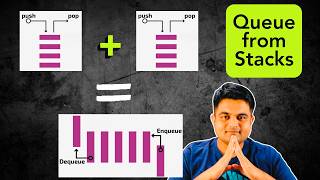




codestorywithMIK 22 mins
Implement Queue using Stacks | Amortised O(1) | Leetcode 232 | Google
Eric Programming 10 mins
[Java] Leetcode 232. Implement Queue using Stacks [Stack & Queue #2]
Ayushi Sharma 12 mins
Implement Queue using Stacks | Leetcode 232 | Queues & Stack
Engineering Digest 15 mins
LeetCode 232: Implement Queue using Stacks
Sleepy Cracker 6 mins
LeetCode 232 | Implement Queue using Stacks | Java
Aryan Mittal 14 mins
232. Implement Queue using Stacks | Stack & Queue
Srk Codes 7 mins
Implement Queue Using Stacks | Leetcode 232 Explained in Telugu | O(1) | srkcodes
LeetCodeWithMonu 13 mins
232. Implement Queue using Stacks - LeetCode Blind 75 - JavaScript
TechWithSaumya 12 mins
Implement Queue using Stacks || Understand the algorithm
Programming Live with Larry 14 mins
Daily Leetcode #990: Dec 16, 2022 - 232. Implement Queue using Stacks
Coding with Tamilarasan 12 mins
232. Implement Queue using Stacks | Leetcode | Stack | DSA
Destination FAANG 10 mins
Implement Queue using Stacks: 232 - google interview question
Mayur Programming Club 21 mins
232. Implement Queue using Stacks | January | Java | C++
CodeFreaks 9 mins
232 || Implement Queue using Stacks || Leetcode Daily Challenge
Vizuara 12 mins
Implement Queue using Stacks | Leetcode 232
Abdullah Arshed 7 mins
232. Implement Queue using Stacks | Leetcode | Python
Alpha-Code 9 mins
LeetCode 232 - Implement Queue using Stacks - Python
Programming Live with Larry 6 mins
Daily Leetcode #1399: Jan 29, 2024 - 232. Implement Queue using Stacks
Lit Code 9 mins
HOW TO Implement Queue using Stacks - Leetcode 232
Code Harmony 24 mins
Solving LeetCode 232 Implement Queue using Stacks | Queue | Stack | Design Problem | Amazon | Apple
20 videos
did my crawler come up with invalid videos ? drop me a line.
Similar Problems
- problem 225: Implement Stack using Queues
1 similar problem
Solved On The Same Day
5 easy
- problem 231: Power of Two
- problem 258: Add Digits
- problem 268: Missing Number
- problem 326: Power of Three
- problem 338: Counting Bits
6 solutions
August 12, 2023
Extra
There are a few extra pages giving you some insights into my setup:
- Tech Stack - my development environment and tools
- AI - how AI helped me create this website (NOT solving the problems)
- Progress - progression over time
- Quality - code quality