Python 2325.py
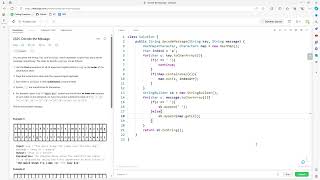
class Solution:
    def decodeMessage(self, key: str, message: str) -> str:
        mapping = { " ": " " }
        next    = "a"
        for k in key:
            if k not in mapping:
                mapping[k] = next
                next = chr(ord(next) + 1)

        return "".join(mapping[c] for c in message)
Difficulty
This problem is ranked as
and has an acceptance rate of about 86% (100k+ submissions).
Typical patterns to solve this problem:
easy
medium
hard
and has an acceptance rate of about 86% (100k+ submissions).
Typical patterns to solve this problem:
- Hash Table
- String
I solved 663 easy, 1250 medium and 309 hard problems
AI Disclaimer
Every single line of code was written by me, 100% from scratch, between August 2023 and August 2024.
However, two years later I set up this website and used various AI tools to generate most of the walkthrough / explanations below.
See this dedicated page for more details.
However, two years later I set up this website and used various AI tools to generate most of the walkthrough / explanations below.
See this dedicated page for more details.
Code Walkthrough
Overview
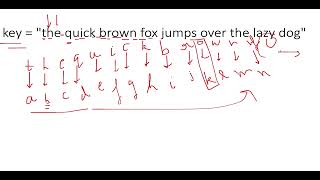
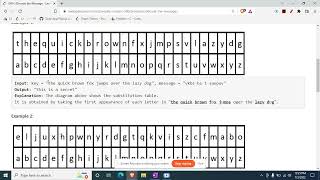
The provided implementation defines a Solution class with a single method decodeMessage. The method receives two strings: key, which supplies a substitution cipher, and message, the text to be decoded. The core idea is to construct a mapping from each distinct character in key to successive letters of the English alphabet, preserving spaces, and then translate message using that mapping.
Key Steps
The first important step is the initialization of the substitution dictionary. The code creates a dictionary called mapping that already contains an entry for the space character, mapping it to itself. This ensures that whitespace is retained unchanged during decoding.
mapping = { " ": " " }Next, a variable named next is set to the character 'a'. This variable tracks the next alphabetic character to assign in the mapping.
next = "a"The method then iterates over each character k in the key string. For every character that has not yet been added to mapping, the code assigns the current value of next as its substitution and then advances next to the following alphabetic character by converting it to its Unicode code point, incrementing, and converting back to a character.
for k in key:
    if k not in mapping:
        mapping[k] = next
        next = chr(ord(next) + 1)
After the mapping is fully built, the method constructs the decoded output. It does this by joining together the mapped values for each character c in message. The generator expression mapping[c] for c in message looks up each character directly in the dictionary, guaranteeing O(1) access per character.
return "".join(mapping[c] for c in message)Edge Cases Handled
The code explicitly includes a mapping for the space character, which means any spaces present in message are reproduced verbatim in the output. This handling prevents a KeyError that would otherwise occur if a space appeared in message but was not present in key.
Because the mapping is built only from characters that appear in key, any character in message that does not exist in key (other than space) would raise an exception. However, the problem specification guarantees that message contains only characters that are present in key or spaces, so the implementation safely assumes the lookup will always succeed.
The iteration over key uses a simple containment check (if k not in mapping). This ensures that repeated characters in key do not cause the mapping to be overwritten, preserving the first occurrence's assignment. Consequently, the cipher respects the order of first appearance, which is essential for a deterministic decoding.
Performance Optimizations
The construction of the mapping leverages a dictionary, providing constant-time insertion and lookup. By checking if k not in mapping before insertion, the code avoids unnecessary assignments for duplicate characters, reducing the number of operations proportional to the length of key.
The use of chr(ord(next) + 1) to advance the substitution character is a lightweight arithmetic operation that avoids more complex data structures or look-up tables. Because the alphabet is traversed sequentially, the code does not need to compute the position of each character repeatedly.
Finally, the decoding step uses a generator expression inside str.join. This pattern builds the result string in a single pass without creating intermediate lists, minimizing memory overhead and taking advantage of the efficient concatenation logic of str.join.
written by openai gpt
ELI5 - Simplified Explanation
Imagine you have a secret code made of letters. Usually, a is the first letter, b is the second, and so on. This code uses a special key to mix everything up.
Think of this code like a magical translator machine. First, it looks at the key you provided. It starts with the letter a and gives it a new secret identity based on the first letter it finds in the key. Then it moves to the next letter, b, and gives it the secret identity of the second letter in the key. It keeps doing this until all the letters from the key have a new secret partner.
The machine remembers these secret partners in a little list. Once it has finished reading the whole key, it looks at the message you want to decode. For every letter in that message, it looks at its little list to find the secret partner. It takes that partner and builds a brand new message, piece by piece, until the secret is finally revealed.
written by google gemini
Code Quality
Several LLMs ranked my code quality on a scale from 1 (very poor) to 10 (outstanding):
n = 26
|
median = 7.5
|
μ = 7.31
|
σ = 1.49
Complexity Analysis
Time: linear
As a rule of thumb, the maximum input size for one second execution time is
As a rule of thumb, the maximum input size for one second execution time is
- factorial: up to 10 elements
- exponential: up to 20 elements
- polynomial: a few thousand elements
- loglinear: up to 100,000 elements
- linear: a few million elements
- logarithmic: a billion elements
- constant: practically unlimited
generated automatically
Other Solutions
I wrote a basic crawler to find other solutions to that problem.
Obviously, I did that after I solved the problem myself.
In general, AlgoMonster and WalkCCC solutions are high-quality and always worth a look.
I haven't checked most of the other solutions, but they might be helpful as well.
And of course, the LeetCode forum is always a good place (or even the best) to look for alternative approaches.
(click on a column header to sort the table)
| author | ||||||||||
|---|---|---|---|---|---|---|---|---|---|---|
| author | solutions | |||||||||
| www | AlgoMonster | Python | Java | C++ | TS | |||||
| WalkCCC | Python | Java | C++ | |||||||
| leetcode.ca | Python | Java | C++ | C | Go | Rust | TS | |||
| Progiez | Python | Java | C++ | |||||||
| github | chandansgowda | Python | ||||||||
| charles-wangkai | Java | |||||||||
| DimitrisJim | C | |||||||||
| everthis | JS | |||||||||
| fartem | Ruby | |||||||||
| fsq | C++ | |||||||||
| JoshCrozier | JS | |||||||||
| lkwq007 | Python | |||||||||
| varunu28 | Java | |||||||||
| AlgoMonster | C++, Python, Java, TypeScript | |||||||||
| WalkCCC | C++, Python, Java | |||||||||
| leetcode.ca | C, C++, Go, Java, Python, Rust, TypeScript | |||||||||
| Progiez | C++, Java, Python | |||||||||
| chandansgowda | Python | |||||||||
| charles-wangkai | Java | |||||||||
| DimitrisJim | C | |||||||||
| everthis | JavaScript | |||||||||
| fartem | Ruby | |||||||||
| fsq | C++ | |||||||||
| JoshCrozier | JavaScript | |||||||||
| lkwq007 | Python | |||||||||
| varunu28 | Java |
26 links
|
13 authors
|
9 languages
Videos
These are a few popular YouTube videos for this problem:

Coding Decoded 7 mins
Weekly Contest 300 | Leetcode 2325 Decode the Message | Easy DP
Ashutosh sharma 8 mins
2325 Decode the Message Leetcode |Leetcode Weekly Contest 300 Decode the Message
Programming Live with Larry 6 mins
2325. Decode the Message (Leetcode Easy)
Dominik Ilja 8 mins
LeetCode 2325 - Decode the Message (JavaScript)
Sleepy Cracker 9 mins
LeetCode 2325 | Decode the Message | Java
AlgorithmicIQ 18 mins
Leetcode 2325 Decode the Message - 92% Faster On Performance Solution Explained
6 videos
did my crawler come up with invalid videos ? drop me a line.
Solved On The Same Day
3 easy
- problem 1588: Sum of All Odd Length Subarrays
- problem 2367: Number of Arithmetic Triplets
- problem 2974: Minimum Number Game
- problem 2428: Maximum Sum of an Hourglass
5 solutions
December 24, 2023
Extra
There are a few extra pages giving you some insights into my setup:
- Tech Stack - my development environment and tools
- AI - how AI helped me create this website (NOT solving the problems)
- Progress - progression over time
- Quality - code quality