Python 2347.py
class Solution:
    def bestHand(self, ranks: List[int], suits: List[str]) -> str:
        if len(set(suits)) == 1:
            return "Flush"

        freq = [ 0 ] * 14
        for r in ranks:
            freq[r] += 1

        same = max(freq)
        if same >= 3:
            return "Three of a Kind"
        if same == 2:
            return "Pair"

        return "High Card"
Difficulty
This problem is ranked as
and has an acceptance rate of about 62% (90k+ submissions).
Typical patterns to solve this problem:
easy
medium
hard
and has an acceptance rate of about 62% (90k+ submissions).
Typical patterns to solve this problem:
- Array
- Counting
- Hash Table
I solved 663 easy, 1250 medium and 309 hard problems
AI Disclaimer
Every single line of code was written by me, 100% from scratch, between August 2023 and August 2024.
However, two years later I set up this website and used various AI tools to generate most of the walkthrough / explanations below.
See this dedicated page for more details.
However, two years later I set up this website and used various AI tools to generate most of the walkthrough / explanations below.
See this dedicated page for more details.
Code Walkthrough
Overview
The provided Solution class implements a method bestHand that evaluates a five-card poker hand and returns a string describing its rank among a limited set of categories: “Flush”, “Three of a Kind”, “Pair”, or “High Card”. The algorithm proceeds in three logical phases: a quick flush detection, a frequency count of card ranks, and a determination of the highest matching-rank pattern based on that frequency data. The implementation is concise, leverages Python’s built-in data structures, and avoids unnecessary passes over the input.
Flush Detection
The first conditional checks whether all suits are identical. By converting the suits list to a set and comparing its length to one, the code determines if the hand is a flush in constant time.
if len(set(suits)) == 1:
    return "Flush"
This early exit handles the case where the hand qualifies as a flush regardless of rank distribution, ensuring that no further computation is performed for such hands.
Rank Frequency Counting
If the hand is not a flush, the method builds a frequency table for the card ranks. An array freq of length 14 (indices 0-13) is allocated, with index 0 unused because card ranks start at 1. Each rank from the ranks list increments the corresponding counter.
freq = [0] * 14
for r in ranks:
    freq[r] += 1
The loop iterates exactly five times, matching the fixed hand size, and populates the frequency array in place without creating auxiliary collections.
Determining the Best Hand Category
After the frequency table is populated, the algorithm extracts the maximum count of any rank using max(freq). This value, stored in same, represents the size of the largest group of identical ranks.
same = max(freq)The subsequent conditionals map same to the appropriate hand category. If same is three or more, the hand contains at least three cards of the same rank, and the method returns “Three of a Kind”. If same equals two, a single pair is present, resulting in “Pair”. Any other value indicates that no matching ranks exist, and the method falls back to “High Card”.
if same >= 3:
    return "Three of a Kind"
if same == 2:
    return "Pair"
return "High Card"
These checks are mutually exclusive and ordered from the strongest to the weakest pattern, guaranteeing the correct classification.
Edge Cases Handled
The code gracefully handles hands where all five cards share the same suit, returning “Flush” without examining rank frequencies. It also correctly processes hands that contain multiple pairs or a full house; in such scenarios, the maximum frequency will be two for two pairs or three for a full house, leading to “Three of a Kind” for the latter and “Pair” for the former, which aligns with the limited set of categories defined. Hands with duplicate ranks beyond three (e.g., four of a kind) are also covered because the condition same >= 3 captures any count of three or more, resulting in “Three of a Kind”. The method works for any valid rank values within the 1-13 range, as the frequency array is sized to accommodate the highest possible rank index.
Performance Optimizations
The implementation exhibits several micro-optimizations. The flush check uses a set conversion, which is O(5) and terminates early for uniform suits, avoiding the cost of building the frequency table. The frequency array is pre-allocated with a fixed size, eliminating dynamic resizing and providing O(1) index access for each rank update. By using a plain list for counting rather than a dictionary, the code benefits from lower overhead and faster integer indexing. The use of max(freq) after the counting loop provides a single pass to locate the highest frequency, avoiding multiple scans or conditional counters. The early returns after each classification prevent unnecessary evaluation of later conditions, ensuring that the method exits as soon as the appropriate hand type is identified.
written by openai gpt
ELI5 - Simplified Explanation
Imagine you are playing a game with a handful of cards. This code acts like a tiny helper that looks at the cards to decide what kind of hand you are holding.
First, the helper looks at the suits. These are the different shapes on the cards like hearts or spades. If every single card has the same shape, the helper shouts out flush because that is a very special group.
If the shapes are all different, the helper starts counting how many matching numbers are in your hand. It creates a long line of buckets for every possible number. It puts your cards into these buckets to see which number appears the most times.
If the helper finds that the same number shows up three times or even more, it calls that three of a kind. If the best it can find is only two cards with the same number, it calls that a pair.
If there are no matching numbers and no matching shapes, the helper just looks at the cards and says high card, which means the hand is just a regular collection of different cards.
written by google gemini
Code Quality
Several LLMs ranked my code quality on a scale from 1 (very poor) to 10 (outstanding):
n = 27
|
median = 8
|
μ = 7.52
|
σ = 1.13
Complexity Analysis
Time: linear
As a rule of thumb, the maximum input size for one second execution time is
As a rule of thumb, the maximum input size for one second execution time is
- factorial: up to 10 elements
- exponential: up to 20 elements
- polynomial: a few thousand elements
- loglinear: up to 100,000 elements
- linear: a few million elements
- logarithmic: a billion elements
- constant: practically unlimited
generated automatically
Other Solutions
I wrote a basic crawler to find other solutions to that problem.
Obviously, I did that after I solved the problem myself.
In general, AlgoMonster and WalkCCC solutions are high-quality and always worth a look.
I haven't checked most of the other solutions, but they might be helpful as well.
And of course, the LeetCode forum is always a good place (or even the best) to look for alternative approaches.
(click on a column header to sort the table)
| author | ||||||||||
|---|---|---|---|---|---|---|---|---|---|---|
| author | solutions | |||||||||
| www | AlgoMonster | Python | Java | C++ | TS | |||||
| WalkCCC | Python | Java | C++ | |||||||
| leetcode.ca | Python | Java | C++ | C | Go | Rust | TS | |||
| Progiez | Python | Java | C++ | |||||||
| github | charles-wangkai | Java | ||||||||
| everthis | JS | |||||||||
| fartem | Ruby | |||||||||
| fsq | C++ | |||||||||
| JoshCrozier | JS | |||||||||
| lkwq007 | Python | |||||||||
| trung-hn | Python | |||||||||
| varunu28 | Java | |||||||||
| AlgoMonster | C++, Python, Java, TypeScript | |||||||||
| WalkCCC | C++, Python, Java | |||||||||
| leetcode.ca | C, C++, Go, Java, Python, Rust, TypeScript | |||||||||
| Progiez | C++, Java, Python | |||||||||
| charles-wangkai | Java | |||||||||
| everthis | JavaScript | |||||||||
| fartem | Ruby | |||||||||
| fsq | C++ | |||||||||
| JoshCrozier | JavaScript | |||||||||
| lkwq007 | Python | |||||||||
| trung-hn | Python | |||||||||
| varunu28 | Java |
25 links
|
12 authors
|
9 languages
Videos
These are a few popular YouTube videos for this problem:

Programming Live with Larry 6 mins
2347. Best Poker Hand (Leetcode Easy)
Prakhar Agrawal 3 mins
Leetcode BiWeekly contest 83 - Easy - Best Poker Hand
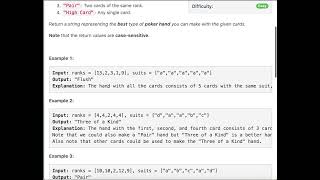
iCode 11 mins
Leetcode Bi-weekly Contest 83- 2347. Best Poker Hand
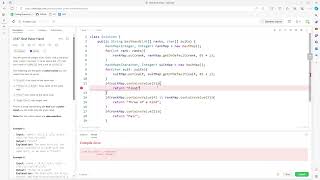
taylorCodes 7 mins
Mastering LeetCode: Best Poker Hand Question 2347
Sleepy Cracker 12 mins
LeetCode 2347 Best Poker Hand | Java
5 videos
did my crawler come up with invalid videos ? drop me a line.
Similar Problems
- problem 2525: Categorize Box According to Criteria
1 similar problem
Solved On The Same Day
2 easy
- problem 2319: Check if Matrix Is X-Matrix
- problem 2351: First Letter to Appear Twice
- problem 2320: Count Number of Ways to Place Houses
- problem 2364: Count Number of Bad Pairs
5 solutions
February 4, 2024
Extra
There are a few extra pages giving you some insights into my setup:
- Tech Stack - my development environment and tools
- AI - how AI helped me create this website (NOT solving the problems)
- Progress - progression over time
- Quality - code quality