Python 2411.py
class Solution:
    def smallestSubarrays(self, nums: List[int]) -> List[int]:
        # actually used bits
        high = max(nums)
        bits = 1
        while (1 << bits) - 1 < high:
            bits += 1

        need = defaultdict(list) # indexes where this bit isn't set
        last = []                # last index which set a bit
        have = []                # already set bits
        for i, n in enumerate(nums):
            have.append(n)
            last.append(i)

            for bit in range(bits):
                mask = 1 << bit
                if n & mask:
                    # longer subarrays
                    for x in need[bit]:
                        # double check
                        if (have[x] | n) != have[x]:
                            last[x]  = i
                            have[x] |= n
                    need[bit].clear()
                else:
                    # these bits could be ORed
                    need[bit].append(i)

        # distance to last change
        return [ l - i + 1 for i, l in enumerate(last) ]
31 lines
|
1105 bytes
|
submitted April 7, 2024
|
GitHub
34% comment ratio
|
tab size 4
|
low complexity
Difficulty
This problem is ranked as
and has an acceptance rate of about 62% (100k+ submissions).
Typical patterns to solve this problem:
easy
medium
hard
and has an acceptance rate of about 62% (100k+ submissions).
Typical patterns to solve this problem:
- Array
- Binary Search
- Bit Manipulation
- Sliding Window
I solved 663 easy, 1250 medium and 309 hard problems
AI Disclaimer
Every single line of code was written by me, 100% from scratch, between August 2023 and August 2024.
However, two years later I set up this website and used various AI tools to generate most of the walkthrough / explanations below.
See this dedicated page for more details.
However, two years later I set up this website and used various AI tools to generate most of the walkthrough / explanations below.
See this dedicated page for more details.
Code Walkthrough
Overview
The provided Solution class implements a method smallestSubarrays that, for each position in the input list nums, returns the length of the shortest sub-array ending at that position whose bitwise OR equals the OR of the entire prefix up to that point. The algorithm proceeds in a single forward pass, maintaining per-bit state that allows it to extend previously seen sub-arrays only when necessary. By tracking the most recent index where each bit became “stable,” the method can compute the required lengths directly without revisiting earlier elements.
Determining the Bit Width
The first phase computes the number of bits required to represent the largest value in nums.
high = max(nums)
bits = 1
while (1 << bits) - 1 < high:
    bits += 1
This loop increments bits until a mask of bits ones is at least as large as high. The result is the smallest integer bits such that every number in the array fits within that many bits. This ensures that subsequent loops iterate only over relevant bit positions, avoiding unnecessary work for higher, unused bits.
Data Structures for Tracking State
Three parallel structures are created:
need- a dictionary mapping each bit to a list of indices where that bit has not yet been set in the cumulative OR.last- a list wherelast[i]stores the most recent index that contributed a new bit to the OR for the sub-array ending ati.have- a list wherehave[i]holds the current OR value for the sub-array ending ati.
need = defaultdict(list)   # indexes where this bit isn't set
last = []                   # last index which set a bit
have = []                   # already set bits
These structures grow in lockstep with the enumeration of nums, preserving a per-position view of the evolving OR.
Main Loop - Updating Per-Bit Information
The core of the algorithm iterates over each element n together with its index i. For each element, the current value is appended to have and its index to last. Then every bit position from 0 to bits-1 is examined.
for i, n in enumerate(nums):
    have.append(n)
    last.append(i)

    for bit in range(bits):
        mask = 1 << bit
        if n & mask:
            # longer subarrays
            for x in need[bit]:
                # double check
                if (have[x] | n) != have[x]:
                    last[x]  = i
                    have[x] |= n
            need[bit].clear()
        else:
            # these bits could be ORed
            need[bit].append(i)
When the current number n contains the bit mask, the algorithm knows that any earlier sub-array that was still waiting for this bit can now be satisfied. It iterates over the indices stored in need[bit]. For each such index x, it verifies whether adding n actually changes the OR value ((have[x] | n) != have[x]). If a change occurs, last[x] is updated to the current index i, and have[x] is OR-ed with n. After processing, the list for that bit is cleared because the pending requirement has been resolved.
If n does not contain the bit, the index i is appended to need[bit], indicating that sub-arrays ending at i are still missing this particular bit and may need to be extended further.
Computing the Result
After the forward pass, each entry in last represents the farthest index that contributed a new bit to the OR for the sub-array ending at the corresponding position. The final result is derived by subtracting the start index from the end index and adding one to obtain a length.
return [ l - i + 1 for i, l in enumerate(last) ]Because last[i] is always at least i, the expression yields a positive integer length for every position.
Edge Cases Handled
When all numbers in nums are zero, high becomes zero, and the while loop for determining bits terminates immediately with bits equal to one. The inner loop still iterates over a single bit position, and because no number ever sets that bit, every index is repeatedly added to need[0]. Since the condition n & mask never holds, last remains equal to the index itself, and the final lengths are all 1, correctly reflecting that each element forms a minimal sub-array.
If the input contains numbers with varying bit lengths, the initial calculation of bits guarantees that the loop covers exactly the necessary range. For example, an array [1, 8, 3] has a maximum value of 8 (binary 1000), leading to bits = 4. The algorithm then processes bits 0 through 3, ensuring that the high-order bit of 8 is considered while lower bits are handled for the other elements.
When a number introduces multiple new bits simultaneously, the inner loop processes each bit independently. The nested iteration over need[bit] for each set bit ensures that all pending indices are updated in a single pass, correctly handling the case where a single element resolves several outstanding requirements.
Performance Optimizations
The algorithm avoids recomputing the OR for every possible sub-array by maintaining incremental OR values in have. Updating have[x] only when a new bit is actually added prevents redundant work. The use of defaultdict(list) for need provides O(1) amortized insertion and clearing of pending indices, and the explicit clear() call discards processed entries without creating new list objects.
By limiting the outer bit loop to the exact number of bits required (bits), the method prevents unnecessary iteration over irrelevant higher bits, which could otherwise dominate runtime for large integer values. The inner loop over need[bit] processes each index at most once per bit, because after an index is removed from need[bit] it will never be revisited for that bit. This ensures that the total work across all bits remains proportional to the number of indices, rather than quadratic in the length of the input.
The final list comprehension that builds the answer runs in linear time and leverages Python’s efficient C-level iteration, contributing negligible overhead compared to the main processing loop.
Overall, the design achieves a single forward traversal with per-bit bookkeeping that scales gracefully with both the size of the input and the magnitude of the numbers involved.
written by openai gpt
ELI5 - Simplified Explanation
Imagine you have a long row of building blocks, and each block has a secret number written on it. You want to pick a small section of these blocks to make the biggest possible number by combining all the blocks in that section together.
First, the computer looks at the biggest number in the whole row to see how many bits, or little tiny switches, it needs to represent all the numbers. It keeps track of where certain switches are turned on as it walks down the row of blocks.
When the computer looks at each block, it checks if the block helps turn on any of these switches. If a block has a switch already turned on, the computer marks that spot as a good place to stop for any previous sections that were still waiting for that switch to wake up. It remembers where the very last important switch was turned on for every starting position.
By knowing exactly where the last needed switch appeared, the computer can tell how far away that point is from where it started. This distance tells you the shortest slice of blocks you need to grab to reach the maximum possible value.
written by google gemini
Code Quality
Several LLMs ranked my code quality on a scale from 1 (very poor) to 10 (outstanding):
n = 27
|
median = 5
|
μ = 5.07
|
σ = 1.56
Complexity Analysis
not analyzed yet
Other Solutions
I wrote a basic crawler to find other solutions to that problem.
Obviously, I did that after I solved the problem myself.
In general, AlgoMonster and WalkCCC solutions are high-quality and always worth a look.
I haven't checked most of the other solutions, but they might be helpful as well.
And of course, the LeetCode forum is always a good place (or even the best) to look for alternative approaches.
(click on a column header to sort the table)
| author | ||||||||
|---|---|---|---|---|---|---|---|---|
| author | solutions | |||||||
| www | AlgoMonster | Java | C++ | Python | TS | |||
| WalkCCC | Java | C++ | Python | |||||
| leetcode.ca | Java | C++ | Go | Python | Rust | TS | ||
| Progiez | Java | C++ | Python | |||||
| github | charles-wangkai | Java | ||||||
| everthis | JS | |||||||
| fsq | C++ | |||||||
| JoshCrozier | JS | |||||||
| varunu28 | Java | |||||||
| wisdompeak | C++ | |||||||
| AlgoMonster | C++, Python, Java, TypeScript | |||||||
| WalkCCC | C++, Python, Java | |||||||
| leetcode.ca | C++, Go, Java, Python, Rust, TypeScript | |||||||
| Progiez | C++, Java, Python | |||||||
| charles-wangkai | Java | |||||||
| everthis | JavaScript | |||||||
| fsq | C++ | |||||||
| JoshCrozier | JavaScript | |||||||
| varunu28 | Java | |||||||
| wisdompeak | C++ |
22 links
|
10 authors
|
7 languages
Videos
These are a few popular YouTube videos for this problem:

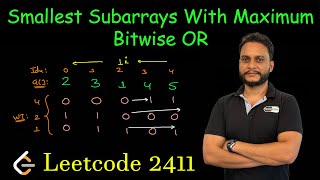



codestorywithMIK 44 mins
Smallest Subarrays With Maximum Bitwise OR | Detailed Explanation | Leetcode 2411 | codestorywithMIK
Techdose 23 mins
Smallest Subarrays With Maximum Bitwise OR | Leetcode 2411
Leetcode Daily 7 mins
2411. Smallest Subarrays With Maximum Bitwise OR | Leetcode Daily - Python
Programming Live with Larry 23 mins
2411. Smallest Subarrays With Maximum Bitwise OR (Leetcode Medium)
Programming Live with Larry 23 mins
Daily Leetcode #1946: Jul 29, 2025 - 2411. Smallest Subarrays With Maximum Bitwise OR
Eye on AI and DSA 30 mins
2411. Smallest Subarrays With Maximum Bitwise OR | Leetcode Daily Challenge | Bit Manipulation
impoldev 11 mins
Smallest Subarrays With Maximum Bitwise OR | LeetCode 2411 - Python
7 videos
did my crawler come up with invalid videos ? drop me a line.
Similar Problems
- problem 898: Bitwise ORs of Subarrays
- problem 2419: Longest Subarray With Maximum Bitwise AND
2 similar problems
Solved On The Same Day
2 medium
- problem 2134: Minimum Swaps to Group All 1's Together II
- problem 2381: Shifting Letters II
3 solutions
April 7, 2024
Extra
There are a few extra pages giving you some insights into my setup:
- Tech Stack - my development environment and tools
- AI - how AI helped me create this website (NOT solving the problems)
- Progress - progression over time
- Quality - code quality