Python 2449.py
class Solution:
    def makeSimilar(self, nums: List[int], target: List[int]) -> int:
        # "similar" means that the arrays are equal if sorted
        # changing by +2/-2 keeps the parity (odd will stay odd, even will stay even)

        result = 0
        for parity in ( 0, 1 ):
            # sorting keeps the absolute difference low
            one = sorted(n for n in nums   if (n & 1) == parity)
            two = sorted(t for t in target if (t & 1) == parity)

            result += sum(abs(a - b) >> 1 for a, b in zip(one, two))

        return result >> 1
14 lines
|
584 bytes
|
submitted July 13, 2024
|
GitHub
37% comment ratio
|
tab size 4
|
low complexity
Difficulty
This problem is ranked as
and has an acceptance rate of about 61% (20k+ submissions).
Typical patterns to solve this problem:
easy
medium
hard
and has an acceptance rate of about 61% (20k+ submissions).
Typical patterns to solve this problem:
- Array
- Greedy
- Sorting
I solved 663 easy, 1250 medium and 309 hard problems
AI Disclaimer
Every single line of code was written by me, 100% from scratch, between August 2023 and August 2024.
However, two years later I set up this website and used various AI tools to generate most of the walkthrough / explanations below.
See this dedicated page for more details.
However, two years later I set up this website and used various AI tools to generate most of the walkthrough / explanations below.
See this dedicated page for more details.
Code Walkthrough
Overview
The makeSimilar method computes the minimum number of operations required to transform one integer list (nums) into another (target) when the only allowed operation is adding or subtracting 2 from any element. Because adding or subtracting 2 preserves the parity of a number, the algorithm works separately on odd and even elements, aligns them by sorting, and aggregates the half-distance between matched pairs. The final result is halved once more to account for the fact that each operation changes two units of distance.
Key Steps
The method begins by initializing an accumulator for the total operation count.
result = 0It then iterates over the two possible parity values, 0 for even and 1 for odd.
for parity in (0, 1):Within each iteration, the code extracts the subset of numbers from nums that share the current parity, sorts them, and stores the result in one. The extraction uses a generator expression combined with a bitwise-and test to check parity.
one = sorted(n for n in nums if (n & 1) == parity)A parallel extraction and sorting is performed on target, producing the list two.
two = sorted(t for t in target if (t & 1) == parity)The two sorted parity-matched lists are then zipped together, and for each pair the absolute difference is computed, shifted right by one bit (equivalent to integer division by 2), and summed. This sum represents the number of “half-steps” needed for the current parity group and is added to the running total.
result += sum(abs(a - b) >> 1 for a, b in zip(one, two))After processing both parity groups, the accumulated total is shifted right once more, halving it to obtain the final count of allowed ±2 operations.
return result >> 1Edge Cases Handled
When either input list is empty, the generator expressions produce empty sequences, the sorted calls return empty lists, and the zip operation yields no pairs. Consequently, the sum contributes zero and the function correctly returns 0.
If all elements share the same parity, the loop still iterates twice, but for the parity lacking elements the corresponding one and two lists are empty, leading to a zero contribution for that iteration.
The use of abs ensures that the direction of the difference (whether nums element is larger or smaller than the matching target element) does not affect the count, handling cases where elements need to be increased or decreased.
Large integer values are safely processed because the arithmetic operations are performed using Python’s arbitrary-precision integers, and the right-shift operator works correctly for any non-negative integer result of abs(a - b).
Performance Optimizations
The algorithm limits work to the necessary parity groups, avoiding any mixing of odd and even numbers that would never be convertible under the allowed operation. By sorting each parity-specific subset independently, the code reduces the amount of data that each sort must handle, which can be beneficial when one parity dominates the input.
Generator expressions inside the sorted calls avoid the creation of intermediate full-size lists before sorting, yielding elements on-the-fly and thus reducing temporary memory pressure.
Bitwise operations are employed for both parity checking (n & 1) and division by two (>> 1). These operations are faster than their arithmetic counterparts (% 2 and // 2) and avoid the overhead of function calls.
Finally, the aggregation of differences uses a single sum over a generator expression, which iterates once over the zipped pairs without constructing an intermediate list of differences. This streamlines the computation and keeps the runtime overhead minimal.
written by openai gpt
ELI5 - Simplified Explanation
Imagine two toy boxes filled with blocks that have numbers written on them. Some blocks are even numbers and some are odd numbers. The goal is to make the boxes look exactly the same by changing the numbers on the blocks.
Changing a number by two is like putting a block on a special tray that keeps it either even or odd. Because of this, the even blocks can only ever turn into other even blocks, and the odd blocks can only turn into other odd blocks.
First, the blocks are sorted from smallest to largest to see which ones match up best. All of the even blocks are lined up, and all of the odd blocks are lined up separately.
Next, the difference between each pair of blocks is measured. Since the numbers only change by two, the distance between them is divided by two to see how many turns it takes to make them match. These small steps are added together until every block has a partner that is its identical twin. All the work is added up to find the total number of turns needed to get everything to match perfectly.
written by google gemini
Code Quality
Several LLMs ranked my code quality on a scale from 1 (very poor) to 10 (outstanding):
n = 27
|
median = 8
|
μ = 7.70
|
σ = 1.33
Complexity Analysis
Time: loglinear
As a rule of thumb, the maximum input size for one second execution time is
As a rule of thumb, the maximum input size for one second execution time is
- factorial: up to 10 elements
- exponential: up to 20 elements
- polynomial: a few thousand elements
- loglinear: up to 100,000 elements
- linear: a few million elements
- logarithmic: a billion elements
- constant: practically unlimited
generated automatically
Other Solutions
I wrote a basic crawler to find other solutions to that problem.
Obviously, I did that after I solved the problem myself.
In general, AlgoMonster and WalkCCC solutions are high-quality and always worth a look.
I haven't checked most of the other solutions, but they might be helpful as well.
And of course, the LeetCode forum is always a good place (or even the best) to look for alternative approaches.
(click on a column header to sort the table)
| author | |||||||
|---|---|---|---|---|---|---|---|
| author | solutions | ||||||
| www | AlgoMonster | C++ | Java | Python | TS | ||
| WalkCCC | C++ | Java | Python | ||||
| leetcode.ca | C++ | Java | Go | Python | TS | ||
| Progiez | C++ | Java | Python | ||||
| github | charles-wangkai | Java | |||||
| everthis | JS | ||||||
| fsq | C++ | ||||||
| JoshCrozier | JS | ||||||
| wisdompeak | C++ | ||||||
| AlgoMonster | C++, Python, Java, TypeScript | ||||||
| WalkCCC | C++, Python, Java | ||||||
| leetcode.ca | C++, Go, Java, Python, TypeScript | ||||||
| Progiez | C++, Java, Python | ||||||
| charles-wangkai | Java | ||||||
| everthis | JavaScript | ||||||
| fsq | C++ | ||||||
| JoshCrozier | JavaScript | ||||||
| wisdompeak | C++ |
20 links
|
9 authors
|
6 languages
Videos
These are a few popular YouTube videos for this problem:
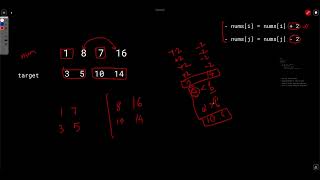

ThinkCode 9 mins
Leetcode 2449 Minimum Number of Operations to Make Arrays Similar
codingMohan 20 mins
Weekly Contest 316 | 2449. Minimum Number of Operations to Make Arrays Similar
Prakhar Agrawal 13 mins
Leetcode Weekly contest 316 - Hard - Minimum Number of Operations to Make Arrays Similar
Algorithms Casts 15 mins
Leetcode 2449. Minimum Number of Operations to Make Arrays Similar
Ashutosh sharma 12 mins
2449 Minimum Number of Operations to Make Arrays Similar | Leetcode Weekly contest 316
Code-Yao 12 mins
leetcode 2449. Minimum Number of Operations to Make Arrays Similar - observe invariant quantities
6 videos
did my crawler come up with invalid videos ? drop me a line.
Similar Problems
- problem 1551: Minimum Operations to Make Array Equal
- problem 2541: Minimum Operations to Make Array Equal II
- problem 2561: Rearranging Fruits
3 similar problems
Solved On The Same Day
1 easy
- problem 3178: Find the Child Who Has the Ball After K Seconds
- problem 2750: Ways to Split Array Into Good Subarrays
- problem 2762: Continuous Subarrays
- problem 2779: Maximum Beauty of an Array After Applying Operation
- problem 1095: Find in Mountain Array
- problem 1293: Shortest Path in a Grid with Obstacles Elimination
7 solutions
July 13, 2024
Extra
There are a few extra pages giving you some insights into my setup:
- Tech Stack - my development environment and tools
- AI - how AI helped me create this website (NOT solving the problems)
- Progress - progression over time
- Quality - code quality