Python 2525.py
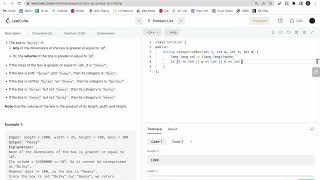
class Solution:
    def categorizeBox(self, length: int, width: int, height: int, mass: int) -> str:
        bulky  = length >= 10**4
        bulky |= width  >= 10**4
        bulky |= height >= 10**4
        bulky |= (length * width * height) >= 10**9

        heavy  = mass >= 100

        if heavy and bulky:
            return "Both"
        if (not heavy) and (not bulky):
            return "Neither"
        if bulky and not heavy:
            return "Bulky"
        #if heavy and not bulky:
        return "Heavy"
17 lines
|
538 bytes
|
submitted October 11, 2023
|
GitHub
7% comment ratio
|
tab size 4
|
low complexity
Difficulty
This problem is ranked as
and has an acceptance rate of about 39% (100k+ submissions).
Typical patterns to solve this problem:
easy
medium
hard
and has an acceptance rate of about 39% (100k+ submissions).
Typical patterns to solve this problem:
- Math
I solved 663 easy, 1250 medium and 309 hard problems
AI Disclaimer
Every single line of code was written by me, 100% from scratch, between August 2023 and August 2024.
However, two years later I set up this website and used various AI tools to generate most of the walkthrough / explanations below.
See this dedicated page for more details.
However, two years later I set up this website and used various AI tools to generate most of the walkthrough / explanations below.
See this dedicated page for more details.
Code Walkthrough
Overview
The provided Solution class implements a single method categorizeBox that receives four integer parameters describing a box: its three dimensions (length, width, height) and its mass. The method determines whether the box is Bulky, Heavy, Both, or Neither based on predefined thresholds. The implementation follows a straightforward decision-making process: first it evaluates two boolean conditions-bulky and heavy-and then returns a string that reflects the combination of those conditions.
Key Steps
Determining the “bulky” condition
The code defines a box as bulky when any single dimension meets or exceeds ten thousand units, or when the overall volume reaches one billion cubic units. This is expressed through a series of logical OR assignments that progressively accumulate the result in the bulky variable.
bulky  = length >= 10**4
bulky |= width  >= 10**4
bulky |= height >= 10**4
bulky |= (length * width * height) >= 10**9
The use of the compound assignment operator |= allows the condition to be built incrementally without creating additional temporary variables.
Determining the “heavy” condition
A box is considered heavy if its mass is at least one hundred units. This is a single comparison that yields a boolean value stored in heavy.
heavy = mass >= 100Selecting the appropriate category
After both boolean flags are computed, the method evaluates their combination using a series of if statements. The order of checks guarantees that the most specific category (“Both”) is returned first, followed by the mutually exclusive cases.
if heavy and bulky:
    return "Both"
if (not heavy) and (not bulky):
    return "Neither"
if bulky and not heavy:
    return "Bulky"
# if heavy and not bulky:
return "Heavy"
The final return statement handles the remaining scenario where the box is heavy but not bulky, relying on the fact that all other possibilities have already been excluded.
Edge Cases Handled
The implementation gracefully manages several boundary conditions:
- When a dimension is exactly ten thousand, the
>=comparison classifies the box as bulky, ensuring the threshold is inclusive. - When the volume calculation yields exactly one billion, the volume check also classifies the box as bulky, covering the case where none of the individual dimensions reach the size limit but the combined volume does.
- A mass value of exactly one hundred triggers the heavy classification, again using an inclusive comparison.
- The logical flow correctly distinguishes a box that meets both size and weight thresholds, returning “Both” rather than a single attribute.
- The final unconditional
return "Heavy"captures the scenario where the box is heavy but fails all bulky criteria, including the case where the volume multiplication could overflow typical 32-bit integer ranges; Python’s arbitrary-precision integers prevent overflow, so the comparison remains reliable.
Performance Optimizations
The method is optimized for speed and minimal memory usage:
- Boolean flags are computed once and reused, avoiding repeated evaluation of the same expressions in the conditional branches.
- The use of compound assignment (
|=) for the bulky condition reduces the number of temporary boolean objects that would otherwise be created if each comparison were stored separately. - The volume calculation is performed only once, and the result is used directly in the comparison, preventing redundant multiplication.
- The decision tree is arranged so that the most restrictive condition (“Both”) is evaluated first; this can short-circuit further checks for boxes that satisfy both criteria, saving a few logical operations in common cases where boxes are both bulky and heavy.
- The final
returnstatement eliminates the need for an explicitelseclause, allowing the interpreter to exit the function as soon as a matching condition is found, which contributes to a slight reduction in branching overhead.
written by openai gpt
ELI5 - Simplified Explanation
Imagine there is a magical box that needs to be sorted based on its size and how much it weighs. The box is called bulky if it is either very long, very wide, very tall, or if all those dimensions together make it take up a massive amount of space. The box is called heavy if it weighs one hundred units or more.
The program checks the side lengths to see if any of them are at least ten thousand. It also multiplies the length, width, and height together to see if the total space inside the box is at least one billion. If any of those things are true, the box gets a label saying it is bulky. Then, the program checks if the weight is one hundred or more to see if the box should get a label saying it is heavy.
After checking these two things, the code looks at both labels at the same time. If the box is both bulky and heavy, it gets called both. If the box is neither bulky nor heavy, it gets called neither. If the box is only bulky, it gets called bulky. If the box is only heavy, it gets called heavy. It is just like sorting toys into different bins based on their size and weight.
written by google gemini
Code Quality
Several LLMs ranked my code quality on a scale from 1 (very poor) to 10 (outstanding):
n = 27
|
median = 7
|
μ = 7.52
|
σ = 1.13
Complexity Analysis
Time: constant
As a rule of thumb, the maximum input size for one second execution time is
As a rule of thumb, the maximum input size for one second execution time is
- factorial: up to 10 elements
- exponential: up to 20 elements
- polynomial: a few thousand elements
- loglinear: up to 100,000 elements
- linear: a few million elements
- logarithmic: a billion elements
- constant: practically unlimited
generated automatically
Other Solutions
I wrote a basic crawler to find other solutions to that problem.
Obviously, I did that after I solved the problem myself.
In general, AlgoMonster and WalkCCC solutions are high-quality and always worth a look.
I haven't checked most of the other solutions, but they might be helpful as well.
And of course, the LeetCode forum is always a good place (or even the best) to look for alternative approaches.
(click on a column header to sort the table)
| author | ||||||||
|---|---|---|---|---|---|---|---|---|
| author | solutions | |||||||
| www | AlgoMonster | Java | C++ | Python | TS | |||
| WalkCCC | Java | C++ | Python | |||||
| leetcode.ca | Java | Go | C++ | Python | Rust | TS | ||
| Progiez | Java | C++ | Python | |||||
| github | charles-wangkai | Java | ||||||
| fartem | Ruby | |||||||
| fsq | C++ | |||||||
| muhammadfarhankt | Go | |||||||
| varunu28 | Java | |||||||
| AlgoMonster | C++, Python, Java, TypeScript | |||||||
| WalkCCC | C++, Python, Java | |||||||
| leetcode.ca | C++, Go, Java, Python, Rust, TypeScript | |||||||
| Progiez | C++, Java, Python | |||||||
| charles-wangkai | Java | |||||||
| fartem | Ruby | |||||||
| fsq | C++ | |||||||
| muhammadfarhankt | Go | |||||||
| varunu28 | Java |
21 links
|
9 authors
|
7 languages
Videos
These are a few popular YouTube videos for this problem:




Fisher Coder 10 mins
LeetCode 2525. Categorize Box According to Criteria - Interview Prep Ep 129
Tech Courses 4 mins
Categorize Box According to Criteria | Leetcode 2525 | Leetcode BiWeekly Contest 95
Deep Tech 4 mins
2525 Categorize Box According to Criteria | LeetCode | C++
Arsalan Ahmed 7 mins
2525. Categorize Box According to Criteria with Python | Best Explanation | Leetcode with Python
Arsalan Ahmed 7 mins
2525. Categorize Box According to Criteria with JavaScript | Best Explanation | Leetcode with JS
5 videos
did my crawler come up with invalid videos ? drop me a line.
Similar Problems
- problem 2347: Best Poker Hand
1 similar problem
Solved On The Same Day
13 easy
- problem 859: Buddy Strings
- problem 914: X of a Kind in a Deck of Cards
- problem 925: Long Pressed Name
- problem 1346: Check If N and Its Double Exist
- problem 1805: Number of Different Integers in a String
- problem 1909: Remove One Element to Make the Array Strictly Increasing
- problem 2047: Number of Valid Words in a Sentence
- problem 2469: Convert the Temperature
- problem 2591: Distribute Money to Maximum Children
- problem 2614: Prime In Diagonal
- problem 2660: Determine the Winner of a Bowling Game
- problem 2760: Longest Even Odd Subarray With Threshold
- problem 2765: Longest Alternating Subarray
- problem 1255: Maximum Score Words Formed by Letters
- problem 2251: Number of Flowers in Full Bloom
16 solutions
October 11, 2023
Extra
There are a few extra pages giving you some insights into my setup:
- Tech Stack - my development environment and tools
- AI - how AI helped me create this website (NOT solving the problems)
- Progress - progression over time
- Quality - code quality