Python 2596.py
class Solution:
    def checkValidGrid(self, grid: List[List[int]]) -> bool:
        size = len(grid)

        # start in upper-left corner
        if grid[0][0] != 0:
            return False

        moves = []
        for y in range(size):
            for x in range(size):
                moves.append(( grid[y][x], x, y))
        moves.sort() # ordered by move number

        for i in range(1, len(moves)):
            # verify move number
            if moves[i][0] != moves[i - 1][0] + 1:
                return False

            # 2 step into one direction and 1 in another
            dx = abs(moves[i][1] - moves[i - 1][1])
            dy = abs(moves[i][2] - moves[i - 1][2])
            if dx + dy != 3 or dx * dy != 2:
                return False

        return True
26 lines
|
809 bytes
|
submitted December 20, 2023
|
GitHub
22% comment ratio
|
tab size 4
|
low complexity
Difficulty
This problem is ranked as
and has an acceptance rate of about 62% (90k+ submissions).
Typical patterns to solve this problem:
easy
medium
hard
and has an acceptance rate of about 62% (90k+ submissions).
Typical patterns to solve this problem:
- Array
- Breadth First Search
- Depth First Search
- Matrix
- Simulation
I solved 663 easy, 1250 medium and 309 hard problems
AI Disclaimer
Every single line of code was written by me, 100% from scratch, between August 2023 and August 2024.
However, two years later I set up this website and used various AI tools to generate most of the walkthrough / explanations below.
See this dedicated page for more details.
However, two years later I set up this website and used various AI tools to generate most of the walkthrough / explanations below.
See this dedicated page for more details.
Code Walkthrough
Overview
The provided Solution.checkValidGrid method determines whether a square matrix of integers represents a valid sequence of moves for a knight on a chessboard. The grid must contain every integer from 0 up to size*size-1 exactly once, start with 0 in the upper-left corner, and each successive pair of positions must correspond to a legal knight move (two squares in one direction and one square in the orthogonal direction). The function returns True only when all these constraints are satisfied.
Input Validation
The first logical gate checks that the grid is not empty and that the required starting condition holds. The code accesses grid[0][0] and immediately returns False if the value is not 0. This guards against malformed inputs where the tour does not begin at the prescribed origin.
size = len(grid)

# start in upper-left corner
if grid[0][0] != 0:
    return False
Collecting Moves
The algorithm iterates over every cell, extracting the move number together with its coordinates. Each entry is stored as a three-element tuple (move_number, x, y). By appending directly to a list, the code builds a flat representation of the board that can later be sorted.
moves = []
for y in range(size):
    for x in range(size):
        moves.append((grid[y][x], x, y))
Ordering by Move Number
After the full collection, the list is sorted in ascending order of the move number. Because the first element of each tuple is the move identifier, Python’s default tuple comparison yields the desired ordering without additional key functions. This single sort operation establishes the exact sequence in which the knight is supposed to travel.
moves.sort() # ordered by move numberVerifying Sequential Numbers
The core loop starts at the second element (index 1) and checks that each move number is exactly one greater than its predecessor. If any gap or duplicate appears, the function aborts with False. This ensures that the grid contains a complete, uninterrupted series from 0 to size*size-1.
for i in range(1, len(moves)):
    # verify move number
    if moves[i][0] != moves[i - 1][0] + 1:
        return False
Validating Knight Geometry
For each consecutive pair, the code computes the absolute differences in the x- and y-coordinates. A legal knight move satisfies two conditions simultaneously: the Manhattan distance (dx + dy) must equal 3, and the product (dx * dy) must equal 2. The first condition guarantees that the total displacement is three squares, while the second confirms that the move is split 2-plus-1 rather than 3-plus-0. If either condition fails, the sequence is invalid.
    # 2 step into one direction and 1 in another
    dx = abs(moves[i][1] - moves[i - 1][1])
    dy = abs(moves[i][2] - moves[i - 1][2])
    if dx + dy != 3 or dx * dy != 2:
        return False
Final Result
If the loop completes without triggering any early return, every cell has been visited in the correct order and each transition respects the knight’s movement rules. The method then returns True, signalling a valid tour.
return TrueEdge Cases Handled
The implementation explicitly addresses several boundary conditions. An empty grid would cause size to be zero; attempting to read grid[0][0] would raise an exception, but the problem constraints guarantee a non-empty square, so the check for the starting cell suffices. Grids where the initial cell is not 0 are rejected immediately, covering the case where the tour does not begin at the required corner. Gaps in the numbering sequence, duplicate numbers, or out-of-range values are caught by the sequential number verification step. Finally, any move that does not conform to the 2-plus-1 pattern-whether because the knight jumps too far, moves straight, or stays in place-is detected by the geometric test.
Performance Optimizations
The algorithm achieves efficiency through a few deliberate choices. By flattening the board into a list of tuples and sorting once, it avoids repeated lookups or auxiliary data structures such as hash maps. The sorting step runs in O(n log n) time where n is the number of cells, but it is the only non-linear operation; subsequent checks are linear scans. The use of simple arithmetic (abs, addition, multiplication) for the knight-move validation eliminates the need for more complex conditional branches or pre-computed move tables. Early returns on the first failure prevent unnecessary processing of the remainder of the grid, which is especially beneficial for large boards with early violations.
written by openai gpt
ELI5 - Simplified Explanation
Imagine a giant square board filled with many little numbered squares. This game is all about following a special knight piece that jumps around on the board. The goal is to see if the knight has made a perfect trip where every number from zero to the end is touched in the right order.
First, the code looks at the very top corner of the board to make sure the number zero is sitting right there. If the zero is not in the corner, then the game did not start correctly. After that, the code gathers up all the numbers and where they are sitting on the board. It sorts them into a neat line so that zero is first, then one is next, then two, and so on.
Now it is time to check the jumps. The code looks at each pair of numbers in the line one by one. It confirms that the next number is exactly one higher than the one before it. If someone tried to skip a number, the game would stop.
Finally, the code checks the shape of the jumps. A knight piece moves in a very specific L-shape. It has to move two squares in one direction and one square in the other. The code calculates how far across and how far up or down the knight traveled between each jump. If those numbers do not add up to the special L-shape movement, it means the knight took a silly path that is not allowed. If all the steps and jumps are perfect until the end, then the move path is valid.
written by google gemini
Code Quality
Several LLMs ranked my code quality on a scale from 1 (very poor) to 10 (outstanding):
n = 27
|
median = 7
|
μ = 7.11
|
σ = 0.92
Complexity Analysis
Time: polynomial
As a rule of thumb, the maximum input size for one second execution time is
As a rule of thumb, the maximum input size for one second execution time is
- factorial: up to 10 elements
- exponential: up to 20 elements
- polynomial: a few thousand elements
- loglinear: up to 100,000 elements
- linear: a few million elements
- logarithmic: a billion elements
- constant: practically unlimited
generated automatically
Other Solutions
I wrote a basic crawler to find other solutions to that problem.
Obviously, I did that after I solved the problem myself.
In general, AlgoMonster and WalkCCC solutions are high-quality and always worth a look.
I haven't checked most of the other solutions, but they might be helpful as well.
And of course, the LeetCode forum is always a good place (or even the best) to look for alternative approaches.
(click on a column header to sort the table)
| author | |||||||
|---|---|---|---|---|---|---|---|
| author | solutions | ||||||
| www | AlgoMonster | Java | C++ | Python | TS | ||
| WalkCCC | Java | C++ | Python | ||||
| leetcode.ca | Java | C++ | Go | Python | TS | ||
| Progiez | Java | C++ | Python | ||||
| github | charles-wangkai | Java | |||||
| fsq | C++ | ||||||
| JoshCrozier | JS | ||||||
| AlgoMonster | C++, Python, Java, TypeScript | ||||||
| WalkCCC | C++, Python, Java | ||||||
| leetcode.ca | C++, Go, Java, Python, TypeScript | ||||||
| Progiez | C++, Java, Python | ||||||
| charles-wangkai | Java | ||||||
| fsq | C++ | ||||||
| JoshCrozier | JavaScript |
18 links
|
7 authors
|
6 languages
Videos
These are a few popular YouTube videos for this problem:

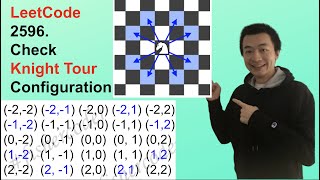





Bro Coders 7 mins
2596. Check Knight Tour Configuration | Weekly Contest 337 | LeetCode 2596
Fisher Coder 11 mins
LeetCode 2596. Check Knight Tour Configuration - Interview Prep Ep 139
Joyjit Codes 5 mins
6322. Check Knight Tour Configuration - LEETCODE WEEKLY CONTEST 337 (Logic explained in details)
Sourin Majumdar 11 mins
2596. Check Knight Tour Configuration - JAVA (Weekly Contest 337)
Prakhar Agrawal 7 mins
Leetcode Weekly contest 337 - Medium - Check Knight Tour Configuration
Programming Live with Larry 12 mins
2596. Check Knight Tour Configuration (Leetcode Medium)
Vishwas aithal 10 mins
Check Knight Tour Configuration | #6322 || Leetcode | Weekly contest 337 || English
Code-Yao 15 mins
leetcode 2596. Check Knight Tour Configuration - direct check
8 videos
did my crawler come up with invalid videos ? drop me a line.
Solved On The Same Day
7 easy
- problem 1752: Check if Array Is Sorted and Rotated
- problem 1791: Find Center of Star Graph
- problem 1971: Find if Path Exists in Graph
- problem 1984: Minimum Difference Between Highest and Lowest of K Scores
- problem 2446: Determine if Two Events Have Conflict
- problem 2706: Buy Two Chocolates
- problem 2839: Check if Strings Can be Made Equal With Operations I
- problem 684: Redundant Connection
- problem 1008: Construct Binary Search Tree from Preorder Traversal
- problem 1026: Maximum Difference Between Node and Ancestor
- problem 1034: Coloring A Border
- problem 1625: Lexicographically Smallest String After Applying Operations
- problem 1765: Map of Highest Peak
- problem 2192: All Ancestors of a Node in a Directed Acyclic Graph
- problem 2477: Minimum Fuel Cost to Report to the Capital
- problem 2492: Minimum Score of a Path Between Two Cities
- problem 2658: Maximum Number of Fish in a Grid
- problem 827: Making A Large Island
- problem 1036: Escape a Large Maze
20 solutions
December 20, 2023
Extra
There are a few extra pages giving you some insights into my setup:
- Tech Stack - my development environment and tools
- AI - how AI helped me create this website (NOT solving the problems)
- Progress - progression over time
- Quality - code quality