Python 2606.py
class Solution:
    def maximumCostSubstring(self, s: str, chars: str, vals: List[int]) -> int:
        result = 0

        # map all chars to a value
        cost = { }
        for i in range(26):           # default value
            cost[chr(ord("a") + i)] = i + 1
        for c, v in zip(chars, vals): # special value
            cost[c] = v

        # https://en.wikipedia.org/wiki/Maximum_subarray_problem
        current = 0
        for c in s:
            current += cost[c]
            if current < 0:
                current = 0 # restart if negative
            result  = max(result, current)

        return result
20 lines
|
647 bytes
|
submitted February 21, 2024
|
GitHub
33% comment ratio
|
tab size 4
|
low complexity
Difficulty
This problem is ranked as
and has an acceptance rate of about 58% (50k+ submissions).
Typical patterns to solve this problem:
easy
medium
hard
and has an acceptance rate of about 58% (50k+ submissions).
Typical patterns to solve this problem:
- Array
- Dynamic Programming
- Hash Table
- String
I solved 663 easy, 1250 medium and 309 hard problems
AI Disclaimer
Every single line of code was written by me, 100% from scratch, between August 2023 and August 2024.
However, two years later I set up this website and used various AI tools to generate most of the walkthrough / explanations below.
See this dedicated page for more details.
However, two years later I set up this website and used various AI tools to generate most of the walkthrough / explanations below.
See this dedicated page for more details.
Code Walkthrough
Overview
The provided implementation computes the maximum total “cost” of any contiguous substring of the input string s. Each character is assigned a numeric value: by default the letters 'a'-'z' receive values 1-26, and a separate mapping supplied by chars and vals can override those defaults. The algorithm then scans s once, applying a classic maximum-subarray (Kadane) technique to accumulate the best possible sum while discarding any prefix that would reduce the total.
Mapping characters to costs
The first phase builds a dictionary that translates every lower-case letter into its numeric contribution.
cost = {}
for i in range(26):                     # default values 1..26
    cost[chr(ord('a') + i)] = i + 1
for c, v in zip(chars, vals):           # override with special values
    cost[c] = v
The loop over the alphabet guarantees that every possible character in s has an entry, so later look-ups never raise a KeyError. The second loop replaces the default entry for any character that appears in chars, ensuring that the special values take precedence.
Edge handling in the mapping
If chars contains duplicate entries, the later occurrence in the zip iteration overwrites the earlier one, leaving the last supplied value as the effective cost. An empty chars list leaves the default mapping untouched, which is a valid scenario. Because the dictionary is built before processing s, the lookup cost during the main scan is O(1) per character.
Scanning the string with Kadane’s method
After the cost table is ready, the algorithm iterates through s, maintaining a running sum current.
current = 0
for c in s:
    current += cost[c]
    if current < 0:
        current = 0                     # discard negative prefix
    result = max(result, current)
At each step the character’s cost is added to current. If the accumulated sum becomes negative, it is reset to zero, effectively starting a new candidate substring after the current position. The variable result records the greatest sum observed so far.
Edge handling in the scan
When all characters have non-positive costs, the reset logic forces current back to zero each iteration, and result remains zero. Consequently the function returns zero for inputs where no positive-cost substring exists, which matches the conventional definition of the maximum subarray sum when empty subarrays are allowed. If the string is empty, the loop body never executes and the function returns the initial result value of zero, handling the empty-string edge case gracefully.
Performance optimizations
The code exhibits several deliberate choices that keep execution fast:
- The cost dictionary is populated once before the main loop, avoiding repeated conditional checks or recomputation of default values during the scan.
- Direct dictionary look-ups (
cost[c]) provide constant-time access, eliminating the need for conditional branches that would arise from a series ofif-elifstatements. - The Kadane loop uses only a few scalar variables (
current,result) and updates them in place, minimizing memory allocation and keeping the CPU cache usage tight. - Resetting
currentto zero instead of creating a new variable avoids extra object creation and leverages Python’s integer reuse for small values.
These choices together ensure that the algorithm runs in linear time relative to the length of s while using only a small, fixed amount of auxiliary space for the dictionary and a handful of integers.
written by openai gpt
ELI5 - Simplified Explanation
Imagine you have a long train of colorful alphabet blocks. Each block has a number written on it, and some of those numbers are special because you decided what they should be. The goal is to find the longest stretch of blocks that gives you the highest total score possible.
First, you make a list that remembers what number belongs to every letter in the alphabet. Normally, the letter a is worth one, b is worth two, and so on until z, but if you have a special letter in your list, you change its value to whatever you want.
After you know the value of every letter, you walk along your train of blocks one by one. You keep a running total of the numbers you see. Every time you pick up a new block, you add its value to your total. If your total ever drops below zero, it means the blocks you are currently holding are making your score worse, so you drop them all and start fresh with a total of zero. As you walk, you always keep track of the biggest total score you have seen so far. By the time you reach the end of the train, that biggest score you saved is the answer.
written by google gemini
Code Quality
Several LLMs ranked my code quality on a scale from 1 (very poor) to 10 (outstanding):
n = 26
|
median = 8
|
μ = 7.69
|
σ = 1.32
Complexity Analysis
Time: linear
As a rule of thumb, the maximum input size for one second execution time is
As a rule of thumb, the maximum input size for one second execution time is
- factorial: up to 10 elements
- exponential: up to 20 elements
- polynomial: a few thousand elements
- loglinear: up to 100,000 elements
- linear: a few million elements
- logarithmic: a billion elements
- constant: practically unlimited
generated automatically
Other Solutions
I wrote a basic crawler to find other solutions to that problem.
Obviously, I did that after I solved the problem myself.
In general, AlgoMonster and WalkCCC solutions are high-quality and always worth a look.
I haven't checked most of the other solutions, but they might be helpful as well.
And of course, the LeetCode forum is always a good place (or even the best) to look for alternative approaches.
(click on a column header to sort the table)
| author | |||||||
|---|---|---|---|---|---|---|---|
| author | solutions | ||||||
| www | AlgoMonster | Java | C++ | Python | TS | ||
| WalkCCC | Java | C++ | Python | ||||
| leetcode.ca | Java | C++ | Go | Python | TS | ||
| Progiez | Java | C++ | Python | ||||
| github | charles-wangkai | Java | |||||
| fsq | C++ | ||||||
| JoshCrozier | JS | ||||||
| varunu28 | Java | ||||||
| AlgoMonster | C++, Python, Java, TypeScript | ||||||
| WalkCCC | C++, Python, Java | ||||||
| leetcode.ca | C++, Go, Java, Python, TypeScript | ||||||
| Progiez | C++, Java, Python | ||||||
| charles-wangkai | Java | ||||||
| fsq | C++ | ||||||
| JoshCrozier | JavaScript | ||||||
| varunu28 | Java |
19 links
|
8 authors
|
6 languages
Videos
These are a few popular YouTube videos for this problem:
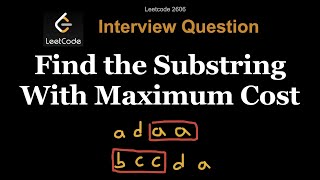
Algorithms Casts 12 mins
Leetcode 2606: Find the Substring With Maximum Cost
Programming Live with Larry 5 mins
2606. Find the Substring With Maximum Cost (Leetcode Medium)
Code Coder 11 mins
2606.|| Find the Substring With Maximum Cost || Beweekly contest 101 || leetcode
Compl3x 19 mins
LeetCode | 2606. Find the Substring With Maximum Cost | Kadane Algorithm
Code-Yao 12 mins
leetcode 2606. Find the Substring With Maximum Cost - largest subarray sum, DP or Kadane
5 videos
did my crawler come up with invalid videos ? drop me a line.
Similar Problems
- problem 53: Maximum Subarray
1 similar problem
Solved On The Same Day
2 easy
- problem 2643: Row With Maximum Ones
- problem 2651: Calculate Delayed Arrival Time
- problem 2683: Neighboring Bitwise XOR
- problem 2608: Shortest Cycle in a Graph
5 solutions
February 21, 2024
Extra
There are a few extra pages giving you some insights into my setup:
- Tech Stack - my development environment and tools
- AI - how AI helped me create this website (NOT solving the problems)
- Progress - progression over time
- Quality - code quality