Python 0274.py
class Solution:
    def hIndex(self, citations: List[int]) -> int:
        citations.sort(reverse = True)
        h = 0
        while h < len(citations) and citations[h] >= h + 1:
            h += 1

        return h
Difficulty
This problem is ranked as
and has an acceptance rate of about 42% (2+ million submissions).
Typical patterns to solve this problem:
easy
medium
hard
and has an acceptance rate of about 42% (2+ million submissions).
Typical patterns to solve this problem:
- Array
- Counting Sort
- Sorting
I solved 663 easy, 1250 medium and 309 hard problems
AI Disclaimer
Every single line of code was written by me, 100% from scratch, between August 2023 and August 2024.
However, two years later I set up this website and used various AI tools to generate most of the walkthrough / explanations below.
See this dedicated page for more details.
However, two years later I set up this website and used various AI tools to generate most of the walkthrough / explanations below.
See this dedicated page for more details.
Code Walkthrough
Overview
The provided implementation computes the h-index for a researcher given a list of citation counts. The algorithm follows a straightforward approach: it first orders the citation numbers in descending order, then iterates through the sorted list while a simple condition holds, and finally returns the count of papers that satisfy the h-index definition. The code is concise, uses only built-in list operations, and avoids any external dependencies.
Key Steps
The first operation prepares the data for linear scanning by sorting it in non-increasing order.
citations.sort(reverse = True)Sorting places the most-cited papers at the beginning of the list, which aligns the index of each element with the potential h-index value. After sorting, the algorithm initializes a counter that will represent the current candidate for the h-index.
h = 0A while loop then walks through the sorted list. The loop condition checks two things: that the counter has not exceeded the length of the list, and that the citation count at the current position is at least the candidate h-index plus one.
while h < len(citations) and citations[h] >= h + 1:
    h += 1
Inside the loop the counter is incremented, effectively advancing to the next paper and raising the candidate h-index. When the loop terminates, the counter holds the maximum value that satisfies the h-index condition, and it is returned.
return hEdge Cases Handled
The loop condition h < len(citations) guarantees that the algorithm never attempts to access an index beyond the bounds of the list, so an empty citation list is safely processed. In that scenario the initial value of h remains zero and the method returns zero, which correctly reflects that no papers have citations.
When all citation counts are zero, the sorted list still contains zeros, and the condition citations[h] >= h + 1 fails immediately because 0 >= 1 is false. The loop does not execute, leaving h at zero, which matches the definition of an h-index of zero.
If the citation counts are strictly decreasing and each value is at least the position index plus one, the loop will iterate through the entire list. For example, with citations [5,4,3,2,1] the condition holds for each element, and h ends up equal to the length of the list, yielding an h-index equal to the total number of papers.
When there are duplicate citation values, the sorted order still groups equal values together, and the condition correctly evaluates each position independently. For instance, with citations [3,3,3,0] the loop stops after the third element because the fourth element fails the condition, resulting in an h-index of three, which is accurate.
Performance Optimizations
The algorithm leverages the built-in list.sort method with the reverse=True flag, which is implemented in C and provides an efficient in-place sort. By sorting in descending order, the subsequent linear scan can stop as soon as the h-index condition fails, avoiding unnecessary comparisons for the tail of the list.
The use of a single integer counter h eliminates the need for auxiliary data structures such as auxiliary arrays or hash maps. This minimal memory footprint ensures that the method operates with constant extra space beyond the input list.
The loop condition combines the boundary check and the citation comparison in a single logical expression, allowing the interpreter to short-circuit evaluation. As soon as h reaches the length of the list, the second part of the condition is not evaluated, preventing an out-of-range access.
Because the algorithm stops early when the condition fails, the average number of iterations can be significantly lower than the list length for skewed citation distributions, providing a practical speed advantage on typical data sets.
written by openai gpt
ELI5 - Simplified Explanation
Imagine a bookshelf full of storybooks, and each book has a little number written on the cover to show how many times other friends have borrowed it. To find out how popular these books are, start by shuffling them around so the stories with the most borrowed counts are at the very front of the shelf.
Think of a tiny robot that starts at the first book and walks down the line. For every book the robot passes, it adds one to its counter. The robot keeps walking as long as the book it is looking at has been borrowed at least as many times as the number of books the robot has already counted. It is like the robot is checking if there is a group of books that all have a matching level of popularity. Once the robot finds a book that is not quite popular enough to keep the pattern going, it stops walking and remembers how many steps it took.
written by google gemini
Code Quality
Several LLMs ranked my code quality on a scale from 1 (very poor) to 10 (outstanding):
n = 27
|
median = 8
|
μ = 8.04
|
σ = 0.79
Complexity Analysis
Time: loglinear
As a rule of thumb, the maximum input size for one second execution time is
As a rule of thumb, the maximum input size for one second execution time is
- factorial: up to 10 elements
- exponential: up to 20 elements
- polynomial: a few thousand elements
- loglinear: up to 100,000 elements
- linear: a few million elements
- logarithmic: a billion elements
- constant: practically unlimited
generated automatically
Other Solutions
I wrote a basic crawler to find other solutions to that problem.
Obviously, I did that after I solved the problem myself.
In general, AlgoMonster and WalkCCC solutions are high-quality and always worth a look.
I haven't checked most of the other solutions, but they might be helpful as well.
And of course, the LeetCode forum is always a good place (or even the best) to look for alternative approaches.
(click on a column header to sort the table)
| author | ||||||||||
|---|---|---|---|---|---|---|---|---|---|---|
| author | solutions | |||||||||
| www | AlgoMonster | C++ | Python | Java | TS | |||||
| WalkCCC | C++ | Python | Java | |||||||
| leetcode.ca | C++ | Python | Java | Rust | Go | TS | ||||
| LeetcodeHelp | C++ | Python | Java | |||||||
| MemoryLimitExceeded | C++ | Python | ||||||||
| Progiez | C++ | Python | Java | |||||||
| github | aylei | Rust | ||||||||
| BigEggStudy | C# | |||||||||
| black-shadows | C++ | |||||||||
| charles-wangkai | Java | |||||||||
| chenyanzhe | C++ | |||||||||
| everthis | JS | |||||||||
| fengvyi | C++ | |||||||||
| gouthampradhan | Java | |||||||||
| halfrost | Go | |||||||||
| haoel | C++ | |||||||||
| JoshCrozier | JS | |||||||||
| keineahnung2345 | C++ | |||||||||
| lennylxx | C | |||||||||
| linouk23 | C++ | |||||||||
| lkwq007 | Python | |||||||||
| MacJim | C++ | |||||||||
| qiyuangong | Python | |||||||||
| ruoru | Rust | |||||||||
| suxrobGM | C# | |||||||||
| trung-hn | Python | |||||||||
| varunu28 | Java | |||||||||
| vli02 | C | |||||||||
| wisdompeak | C++ | |||||||||
| YuriSpiridonov | Python | |||||||||
| AlgoMonster | C++, Python, Java, TypeScript | |||||||||
| WalkCCC | C++, Python, Java | |||||||||
| leetcode.ca | C++, Go, Java, Python, Rust, TypeScript | |||||||||
| LeetcodeHelp | C++, Java, Python | |||||||||
| MemoryLimitExceeded | Python, C++ | |||||||||
| Progiez | C++, Java, Python | |||||||||
| aylei | Rust | |||||||||
| BigEggStudy | C# | |||||||||
| black-shadows | C++, C++ | |||||||||
| charles-wangkai | Java | |||||||||
| chenyanzhe | C++ | |||||||||
| everthis | JavaScript | |||||||||
| fengvyi | C++ | |||||||||
| gouthampradhan | Java | |||||||||
| halfrost | Go | |||||||||
| haoel | C++ | |||||||||
| JoshCrozier | JavaScript | |||||||||
| keineahnung2345 | C++ | |||||||||
| lennylxx | C | |||||||||
| linouk23 | C++ | |||||||||
| lkwq007 | Python | |||||||||
| MacJim | C++ | |||||||||
| qiyuangong | Python | |||||||||
| ruoru | Rust | |||||||||
| suxrobGM | C# | |||||||||
| trung-hn | Python | |||||||||
| varunu28 | Java | |||||||||
| vli02 | C | |||||||||
| wisdompeak | C++ | |||||||||
| YuriSpiridonov | Python |
45 links
|
30 authors
|
9 languages
Videos
These are a few popular YouTube videos for this problem:








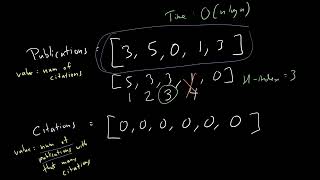



Knowledge Center 12 mins
H-Index | LeetCode 274 | C++, Java, Python
Coding Sphere 10 mins
274. H-Index || Java || Leetcode || Hindi
Sai Anish Malla 6 mins
H-Index | Leet code 274 | Theory explained + Python code
AlgorithmHQ 12 mins
274. H-Index | Leetcode | Medium | Java | Top Interview 150 | FAANG Interview Question
Algorithms Made Easy 5 mins
H-Index | Day 11 Sorting & Count Sort | [ August LeetCoding Challenge ] [ Leetcode #274 ] [ 2020 ]
Code Scribbler 10 mins
LeetCode 274: H-Index | Java Solution | Sorting & Counting
Software Interviews Prep 13 mins
Leetcode | Top Interview 150 | Medium | 274. H-Index | Time: O(N) | Javascript
algobest - Computer Science 3 mins
H-Index - LeetCode 274 - Java Solution
Code Scribbler 10 mins
LeetCode 274: H-Index | Python Solution | Sorting & Counting Approach
Software Interviews Prep 10 mins
274. H-Index | Counting | O(N) | Leetcode
JomaClass 11 mins
H-Index (Leetcode 274) | LeetCode Tutorial
Programming Live with Larry 8 mins
Daily Leetcode #133: Aug 11, 2020 - 274. H-Index
Code Scribbler 10 mins
LeetCode 274: H-Index | C# Solution | Sorting & Counting
Software Interviews Prep 10 mins
274. H-Index | Sorting | O(NLOGN) | Leetcode
iOSxBank 13 mins
Day 191: LeetCode Problem 274. H-Index - Swift
Ghumman Tech 8 mins
Leetcode Question 274 "H-Index" in Java
16 videos
did my crawler come up with invalid videos ? drop me a line.
Similar Problems
- problem 275: H-Index II
1 similar problem
Solved On The Same Day
6 easy
- problem 110: Balanced Binary Tree
- problem 111: Minimum Depth of Binary Tree
- problem 118: Pascal's Triangle
- problem 119: Pascal's Triangle II
- problem 228: Summary Ranges
- problem 530: Minimum Absolute Difference in BST
- problem 82: Remove Duplicates from Sorted List II
- problem 102: Binary Tree Level Order Traversal
- problem 103: Binary Tree Zigzag Level Order Traversal
- problem 105: Construct Binary Tree from Preorder and Inorder Traversal
- problem 106: Construct Binary Tree from Inorder and Postorder Traversal
- problem 107: Binary Tree Level Order Traversal II
- problem 109: Convert Sorted List to Binary Search Tree
- problem 117: Populating Next Right Pointers in Each Node II
- problem 128: Longest Consecutive Sequence
- problem 138: Copy List with Random Pointer
- problem 150: Evaluate Reverse Polish Notation
- problem 155: Min Stack
- problem 209: Minimum Size Subarray Sum
- problem 380: Insert Delete GetRandom O(1)
- problem 427: Construct Quad Tree
- problem 452: Minimum Number of Arrows to Burst Balloons
- problem 30: Substring with Concatenation of All Words
- problem 37: Sudoku Solver
- problem 44: Wildcard Matching
- problem 1326: Minimum Number of Taps to Open to Water a Garden
27 solutions
August 31, 2023
Extra
There are a few extra pages giving you some insights into my setup:
- Tech Stack - my development environment and tools
- AI - how AI helped me create this website (NOT solving the problems)
- Progress - progression over time
- Quality - code quality