Python 2780.py
class Solution:
    def minimumIndex(self, nums: List[int]) -> int:
        size = len(nums)
        dominant = None

        freq = defaultdict(int)
        for n in nums:
            freq[n] += 1
            if freq[n] * 2 > size:
                dominant = n

        left  = 0
        right = freq[dominant]
        for i, n in enumerate(nums):
            # split after i
            pos = i + 1
            if n == dominant:
                # shift a dominant element from right to left partition
                left  += 1
                right -= 1
                if left * 2 > pos and right * 2 > (size - pos):
                    return pos - 1
        return -1
23 lines
|
697 bytes
|
submitted December 11, 2023
|
GitHub
10% comment ratio
|
tab size 4
|
low complexity
Difficulty
This problem is ranked as
and has an acceptance rate of about 76% (100k+ submissions).
easy
medium
hard
and has an acceptance rate of about 76% (100k+ submissions).
I solved 663 easy, 1250 medium and 309 hard problems
AI Disclaimer
Every single line of code was written by me, 100% from scratch, between August 2023 and August 2024.
However, two years later I set up this website and used various AI tools to generate most of the walkthrough / explanations below.
See this dedicated page for more details.
However, two years later I set up this website and used various AI tools to generate most of the walkthrough / explanations below.
See this dedicated page for more details.
Code Walkthrough
Overview
The minimumIndex method receives a list of integers and returns the smallest index at which the list can be split into two non-empty parts such that a value that is dominant (appears more than half the time in the whole list) remains dominant in both resulting partitions. If no such split exists the method returns -1.
Key Steps
Determine the dominant element
The algorithm first builds a frequency map for all values. While populating the map it checks whether any count has already crossed the majority threshold (size / 2). The first value that satisfies this condition is recorded as the dominant element.
size = len(nums)
dominant = None
freq = defaultdict(int)
for n in nums:
    freq[n] += 1
    if freq[n] * 2 > size:
        dominant = n
Initialise partition counters
Two counters are prepared: left tracks how many dominant elements have been moved to the left partition, and right holds the remaining count of the dominant element that is still in the right partition. right is initialised with the total frequency of the dominant value.
left  = 0
right = freq[dominant]
Scan to locate the split position
The method iterates over the list while maintaining the current split position (pos = i + 1). Whenever the current element equals the dominant value, the counters are updated to reflect the transfer of that element from the right side to the left side. After each transfer the algorithm checks whether the dominant element now exceeds half of the elements in both partitions. If the condition holds, the index just before the split (pos - 1) is returned immediately.
for i, n in enumerate(nums):
    pos = i + 1
    if n == dominant:
        left  += 1
        right -= 1
        if left * 2 > pos and right * 2 > (size - pos):
            return pos - 1
If the loop finishes without finding a valid split, the method returns -1.
return -1Edge Cases Handled
When the input list contains no element that appears more than half the time, the variable dominant remains None. In that situation the subsequent logic never satisfies the split condition, and the method correctly falls through to return -1.
If the dominant element occupies the entire list, the initial right counter equals size. The first iteration moves one occurrence to the left side, and the condition left * 2 > pos becomes true only after enough dominant elements have been transferred to make the left partition a strict majority of its own size. The algorithm therefore handles cases where the split must occur deep into the array.
When the list length is one, the loop never produces a split because a split would create an empty partition; the method returns -1, which aligns with the requirement for non-empty parts.
The code also gracefully handles an empty list: size becomes 0, the frequency loop does nothing, dominant stays None, and the final return yields -1.
Performance Optimizations
The solution performs a single pass to compute frequencies and identify the dominant element, avoiding a second full scan for that purpose. The subsequent scan that searches for the split updates counters in constant time per element, allowing an early exit as soon as a valid split is detected. By storing only the total count of the dominant element and two integer counters, the algorithm uses a minimal amount of additional memory regardless of input size. The arithmetic checks (left * 2 > pos and right * 2 > (size - pos)) are simple integer operations, ensuring fast evaluation without the overhead of division or floating-point calculations.
written by openai gpt
ELI5 - Simplified Explanation
Imagine a long train made of many colorful blocks. Some colors appear much more often than others. The code first looks through the whole train to find the color that shows up most frequently, which is called the dominant color.
Once that color is found, the code starts walking along the train from the very front to the back. It thinks about cutting the train into two smaller pieces at every spot it passes. As it moves, it keeps track of how many blocks of the dominant color are in the left piece and how many are in the right piece.
When the code cuts the train, it checks two things at once. It looks at the left piece to see if the dominant color makes up more than half of that section. At the same time, it looks at the right piece to see if the dominant color also makes up more than half of that section. If both sides have enough of that special color, the code has found the perfect spot for the cut. If it reaches the end of the train and cannot find a spot where both sides have enough of the color, it lets everyone know that no such split exists.
written by google gemini
Code Quality
Several LLMs ranked my code quality on a scale from 1 (very poor) to 10 (outstanding):
n = 27
|
median = 8
|
μ = 7.19
|
σ = 1.47
Complexity Analysis
Time: linear
As a rule of thumb, the maximum input size for one second execution time is
As a rule of thumb, the maximum input size for one second execution time is
- factorial: up to 10 elements
- exponential: up to 20 elements
- polynomial: a few thousand elements
- loglinear: up to 100,000 elements
- linear: a few million elements
- logarithmic: a billion elements
- constant: practically unlimited
generated automatically
Other Solutions
I wrote a basic crawler to find other solutions to that problem.
Obviously, I did that after I solved the problem myself.
In general, AlgoMonster and WalkCCC solutions are high-quality and always worth a look.
I haven't checked most of the other solutions, but they might be helpful as well.
And of course, the LeetCode forum is always a good place (or even the best) to look for alternative approaches.
(click on a column header to sort the table)
| author | |||||||||
|---|---|---|---|---|---|---|---|---|---|
| author | solutions | ||||||||
| www | AlgoMonster | Java | C++ | Python | TS | ||||
| WalkCCC | Java | C++ | Python | ||||||
| leetcode.ca | Java | C++ | Go | Python | TS | ||||
| Progiez | Java | C++ | Python | ||||||
| github | charles-wangkai | Java | |||||||
| everthis | JS | ||||||||
| fsq | Rust | ||||||||
| JoshCrozier | JS | ||||||||
| Shamik07 | Dart | ||||||||
| AlgoMonster | C++, Python, Java, TypeScript | ||||||||
| WalkCCC | C++, Python, Java | ||||||||
| leetcode.ca | C++, Go, Java, Python, TypeScript | ||||||||
| Progiez | C++, Java, Python | ||||||||
| charles-wangkai | Java | ||||||||
| everthis | JavaScript | ||||||||
| fsq | Rust | ||||||||
| JoshCrozier | JavaScript | ||||||||
| Shamik07 | Dart |
20 links
|
9 authors
|
8 languages
Videos
These are a few popular YouTube videos for this problem:




Techdose 17 mins
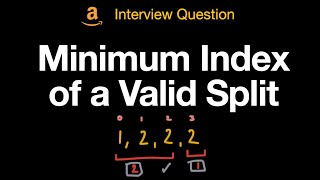
Minimum Index of a Valid Split | Leetcode 2780
Aryan Mittal 20 mins
2780. Minimum Index of a Valid Split | Boyer-Moore Majority Voting Algorithm
Tech Courses 14 mins
Minimum Index of a Valid Split | Leetcode 2780 | Majority Element | C++
Programming Live with Larry 13 mins
2780. Minimum Index of a Valid Split (Leetcode Medium)
Programming Live with Larry 10 mins
Daily Leetcode #1822: Mar 27, 2025 - 2780. Minimum Index of a Valid Split
Algorithms Casts 16 mins
Minimum Index of a Valid Split - Leetcode 2780 | Weekly Contest 354
Alejandro Iglesias Llobet 43 mins
Daily LeetCode Challenge (Day 254): Minimum Index of a Valid Split
7 videos
did my crawler come up with invalid videos ? drop me a line.
Similar Problems
- problem 915: Partition Array into Disjoint Intervals
1 similar problem
Solved On The Same Day
7 easy
- problem 1287: Element Appearing More Than 25% In Sorted Array
- problem 2363: Merge Similar Items
- problem 2418: Sort the People
- problem 2441: Largest Positive Integer That Exists With Its Negative
- problem 2506: Count Pairs Of Similar Strings
- problem 2716: Minimize String Length
- problem 2744: Find Maximum Number of String Pairs
- problem 2374: Node With Highest Edge Score
- problem 2442: Count Number of Distinct Integers After Reverse Operations
- problem 2491: Divide Players Into Teams of Equal Skill
- problem 2554: Maximum Number of Integers to Choose From a Range I
- problem 2933: High-Access Employees
13 solutions
December 11, 2023
Extra
There are a few extra pages giving you some insights into my setup:
- Tech Stack - my development environment and tools
- AI - how AI helped me create this website (NOT solving the problems)
- Progress - progression over time
- Quality - code quality