Python 2946.py
class Solution:
    def areSimilar(self, mat: List[List[int]], k: int) -> bool:
        width = len(mat[0])
        if k % width == 0: # full rotations
            return True

        for i, row in enumerate(mat):
            for x in range(width):
                if i & 1: # odd
                    if row[x] != row[(x + k) % width]:
                        return False
                else:     # even
                    if row[x] != row[(x - k) % width]:
                        return False

        return True
16 lines
|
536 bytes
|
submitted February 23, 2024
|
GitHub
21% comment ratio
|
tab size 4
|
low complexity
Difficulty
This problem is ranked as
and has an acceptance rate of about 58% (40k+ submissions).
Typical patterns to solve this problem:
easy
medium
hard
and has an acceptance rate of about 58% (40k+ submissions).
Typical patterns to solve this problem:
- Array
- Math
- Matrix
- Simulation
I solved 663 easy, 1250 medium and 309 hard problems
AI Disclaimer
Every single line of code was written by me, 100% from scratch, between August 2023 and August 2024.
However, two years later I set up this website and used various AI tools to generate most of the walkthrough / explanations below.
See this dedicated page for more details.
However, two years later I set up this website and used various AI tools to generate most of the walkthrough / explanations below.
See this dedicated page for more details.
Code Walkthrough
Overview
The provided Solution.areSimilar method determines whether every row of a two-dimensional integer matrix satisfies a specific rotational similarity condition. The condition depends on the row index: rows with an odd index must match their own values after a rightward shift of k positions, while rows with an even index must match after a leftward shift of k positions. The method returns True only when all rows meet their respective criteria.
Key Steps
Determine matrix width and handle trivial full rotations
The first operation extracts the number of columns from the first row and stores it in width. A quick check follows: if k is an exact multiple of width, any rotation brings the row back to its original configuration, making the similarity condition automatically satisfied for every row. In this case the method returns True without further processing.
width = len(mat[0])
if k % width == 0:  # full rotations
    return True
Iterate over rows and columns while distinguishing parity
The method proceeds with a double loop. The outer loop enumerates each row together with its index i. The inner loop walks through each column position x. The parity of the row index (i & 1) decides which direction the rotation should be applied for the current row.
for i, row in enumerate(mat):
    for x in range(width):
        if i & 1:  # odd
            ...
        else:     # even
            ...
Compare elements using the appropriate offset
For odd rows the element at column x must equal the element that appears k positions to the right, which is accessed via (x + k) % width. For even rows the element must equal the one k positions to the left, accessed via (x - k) % width. If any comparison fails, the method returns False immediately, aborting further checks.
if i & 1:  # odd
    if row[x] != row[(x + k) % width]:
        return False
else:     # even
    if row[x] != row[(x - k) % width]:
        return False
Conclude after successful verification of all rows
If the loops complete without triggering a mismatch, the method reaches the final statement and returns True, indicating that every row conforms to its required rotational similarity.
return TrueEdge Cases Handled
The implementation explicitly addresses the situation where the rotation distance k equals a full cycle of the row length. By checking k % width == 0, it treats any multiple of the row width as a no-op rotation, guaranteeing a True result without examining the matrix contents.
When k is zero, the modulo operation still yields zero, and the comparison reduces to row[x] != row[x], which never triggers a mismatch, so the method correctly returns True for any matrix.
The parity test i & 1 correctly distinguishes between odd and even row indices, ensuring that the direction of the offset aligns with the specification for each row type. The modulo arithmetic (x + k) % width and (x - k) % width safely wraps indices around the row boundaries, handling cases where the offset would otherwise exceed the column range or become negative.
Performance Optimizations
The early exit on full rotations (k % width == 0) eliminates the need for any per-element work when the answer is known a priori, saving time for large matrices with trivial rotation distances.
The use of a bitwise AND (i & 1) to test row parity is marginally faster than a modulo operation, reducing overhead inside the innermost loop.
Modulo operations are performed only once per element comparison, and the indices are computed directly inside the conditional checks, avoiding the creation of auxiliary data structures or temporary lists.
The method returns False at the first detected mismatch, preventing unnecessary iteration over the remaining rows and columns once the similarity condition is violated. This short-circuit behavior provides a best-case performance gain when the matrix fails the test early.
written by openai gpt
ELI5 - Simplified Explanation
Think of the grid as a collection of rows filled with colorful blocks. Every single row is like a little train, and the code follows a set of rules to see if moving these trains around leaves them looking exactly the same as they did at the start.
First, the code checks how wide the trains are. If the number of shifts is a perfect match for the length of the row, the trains end up in their original spots, which means they are definitely similar.
Next, the code looks at every single row one by one. It uses the row number to decide which way to shift the blocks. If the row number is odd, it slides the blocks to the left. If the row number is even, it slides the blocks to the right.
As it slides them, it checks to see if the block at the new spot is the same color as the block at the old spot. If it finds even one block that does not match after the shuffle, then the trains are not similar. If it finishes checking every block in every row and finds that everything matches perfectly, then the grid is considered similar after the movement.
written by google gemini
Code Quality
Several LLMs ranked my code quality on a scale from 1 (very poor) to 10 (outstanding):
n = 26
|
median = 7.5
|
μ = 7.12
|
σ = 1.62
Complexity Analysis
Time: polynomial
As a rule of thumb, the maximum input size for one second execution time is
As a rule of thumb, the maximum input size for one second execution time is
- factorial: up to 10 elements
- exponential: up to 20 elements
- polynomial: a few thousand elements
- loglinear: up to 100,000 elements
- linear: a few million elements
- logarithmic: a billion elements
- constant: practically unlimited
generated automatically
Other Solutions
I wrote a basic crawler to find other solutions to that problem.
Obviously, I did that after I solved the problem myself.
In general, AlgoMonster and WalkCCC solutions are high-quality and always worth a look.
I haven't checked most of the other solutions, but they might be helpful as well.
And of course, the LeetCode forum is always a good place (or even the best) to look for alternative approaches.
(click on a column header to sort the table)
| author | ||||||||
|---|---|---|---|---|---|---|---|---|
| author | solutions | |||||||
| www | AlgoMonster | Java | C++ | Python | TS | |||
| WalkCCC | Java | C++ | Python | |||||
| leetcode.ca | Java | C++ | Go | Python | Rust | TS | ||
| Progiez | Java | C++ | Python | |||||
| github | charles-wangkai | Java | ||||||
| everthis | JS | |||||||
| fsq | C++ | |||||||
| JoshCrozier | JS | |||||||
| varunu28 | Java | |||||||
| withaarzoo | C++ | |||||||
| AlgoMonster | C++, Python, Java, TypeScript | |||||||
| WalkCCC | C++, Python, Java | |||||||
| leetcode.ca | C++, Go, Java, Python, Rust, TypeScript | |||||||
| Progiez | C++, Java, Python | |||||||
| charles-wangkai | Java | |||||||
| everthis | JavaScript | |||||||
| fsq | C++ | |||||||
| JoshCrozier | JavaScript | |||||||
| varunu28 | Java | |||||||
| withaarzoo | C++ |
22 links
|
10 authors
|
7 languages
Videos
These are a few popular YouTube videos for this problem:


codestorywithMIK 25 mins
Matrix Similarity After Cyclic Shifts | 2 Simple Approaches | Leetcode 2946 | codestorywithMIK
Programming Live with Larry 6 mins
Daily Leetcode #2187: Mar 27, 2026 - 2946. Matrix Similarity After Cyclic Shifts
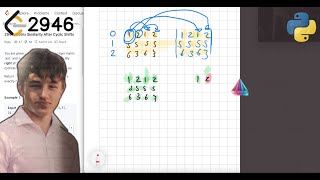
Leetcode Daily 4 mins
2946. Matrix Similarity After Cyclic Shifts | Leetcode Daily - Python
Elite Code 8 mins
Leetcode 2946. Matrix Similarity After Cyclic Shifts
Programming Live with Larry 7 mins
2946. Matrix Similarity After Cyclic Shifts (Leetcode Easy)
Cakot Coding 8 mins
Leetcode | 2946. Matrix Similarity After Cyclic Shifts | Java | Simple trick
Developer Coder 22 mins
Matrix Similarity After Cyclic Shifts | LeetCode 2946 | Java Code | Developer Coder
ExpertFunda 16 mins
Leetcode 2946. Matrix Similarity After Cyclic Shifts
Sleepy Cracker 3 mins
LeetCode 2946 | Matrix Similarity After Cyclic Shifts | Java
Algo Andre 10 mins
Matrix Similarity After Cyclic Shifts (LeetCode 2946)
10 videos
did my crawler come up with invalid videos ? drop me a line.
Solved On The Same Day
9 easy
- problem 1619: Mean of Array After Removing Some Elements
- problem 2248: Intersection of Multiple Arrays
- problem 2255: Count Prefixes of a Given String
- problem 2303: Calculate Amount Paid in Taxes
- problem 2475: Number of Unequal Triplets in Array
- problem 2490: Circular Sentence
- problem 2496: Maximum Value of a String in an Array
- problem 2788: Split Strings by Separator
- problem 2900: Longest Unequal Adjacent Groups Subsequence I
10 solutions
February 23, 2024
Extra
There are a few extra pages giving you some insights into my setup:
- Tech Stack - my development environment and tools
- AI - how AI helped me create this website (NOT solving the problems)
- Progress - progression over time
- Quality - code quality