Python 3028.py
class Solution:
    def returnToBoundaryCount(self, nums: List[int]) -> int:
        return sum(not sum(nums[ : i + 1]) for i in range(len(nums)))
Difficulty
This problem is ranked as
and has an acceptance rate of about 74% (100k+ submissions).
Typical patterns to solve this problem:
easy
medium
hard
and has an acceptance rate of about 74% (100k+ submissions).
Typical patterns to solve this problem:
- Array
- Prefix Sum
- Simulation
I solved 663 easy, 1250 medium and 309 hard problems
AI Disclaimer
Every single line of code was written by me, 100% from scratch, between August 2023 and August 2024.
However, two years later I set up this website and used various AI tools to generate most of the walkthrough / explanations below.
See this dedicated page for more details.
However, two years later I set up this website and used various AI tools to generate most of the walkthrough / explanations below.
See this dedicated page for more details.
Code Walkthrough
Overview
The provided implementation defines a single method returnToBoundaryCount inside a Solution class. The method receives a list of integers and returns an integer representing how many initial segments (prefixes) of the list have a total sum equal to zero. The logic is expressed in a compact one-liner that combines Python’s built-in sum function with a generator expression.
Key Steps and Corresponding Code
The core computation can be broken down into three conceptual steps, each reflected in a fragment of the original code.
1. Iterating Over All Prefix Endpoints
for i in range(len(nums)):
    # i is the index of the last element of the current prefix
The range(len(nums)) construct produces a sequence of indices from 0 to len(nums) - 1. Each index i marks the end of a prefix nums[:i+1]. By iterating over every possible i, the method examines every prefix of the input list.
2. Computing the Sum of a Prefix and Converting to a Boolean
not sum(nums[: i + 1])For each prefix, sum(nums[: i + 1]) calculates the arithmetic total of the elements from the start of the list up to and including position i. The not operator then converts the numeric result to a Boolean: it yields True (which behaves as 1 in arithmetic contexts) when the prefix sum is exactly zero, and False (0) otherwise. This Boolean conversion is the mechanism that flags a “boundary” prefix.
3. Aggregating the Boolean Flags
sum(not sum(nums[: i + 1]) for i in range(len(nums)))The outer sum aggregates the sequence of Boolean values produced by the generator expression. Because True contributes 1 and False contributes 0, the final result is the count of prefixes whose sum is zero.
Edge Cases Handled
The implementation gracefully handles several edge conditions without additional code.
When the input list is empty, len(nums) is 0, so the generator produces no elements. The outer sum therefore returns 0, correctly indicating that there are no prefixes to evaluate.
If the list contains only zeros, every prefix sum evaluates to zero. The generator yields True for each index, and the outer sum returns the length of the list, reflecting that all possible prefixes satisfy the boundary condition.
Mixed positive and negative values are also accommodated. The sum function correctly aggregates any combination of integers, and the not operator only triggers on an exact zero total, ensuring that only true boundary prefixes are counted.
Performance Optimizations Observed
The code leverages several built-in features of Python that contribute to efficient execution.
The use of a generator expression (... for i in range(len(nums))) avoids the creation of an intermediate list of Boolean values. The generator yields each Boolean on demand, allowing the outer sum to consume values directly from the iterator.
Both the inner and outer sum calls are implemented in C within the Python runtime. This means that the arithmetic accumulation and Boolean conversion are performed at native speed, reducing interpreter overhead compared to a manually coded loop.
The slicing operation nums[: i + 1] creates a new list for each prefix, which could be costly for very large inputs. However, Python’s slice implementation is highly optimized, and the overall one-liner keeps the code path short, minimizing function call overhead.
By embedding the Boolean conversion (not) directly in the generator, the method eliminates the need for a separate conditional check or counter variable, streamlining the control flow and keeping the memory footprint minimal.
written by openai gpt
ELI5 - Simplified Explanation
Imagine you have a long row of numbered toy blocks. Some blocks have big positive numbers on them, and some have negative numbers that act like holes in the ground. You start at a spot called zero, which is just like a starting line for a race.
As you walk along the row, you pick up every block one by one and keep track of your new position. For every block you pick up, you add its number to the total value of all the blocks you have gathered so far. After you add a block, you check to see if your total has gone back to zero, which is the starting line.
If you find that your total is exactly zero, it means you have made your way back to the boundary line again. This code look at every step of your journey, keeps a running total of the blocks, and counts every time your total lands perfectly back on that starting line.
written by google gemini
Code Quality
Several LLMs ranked my code quality on a scale from 1 (very poor) to 10 (outstanding):
n = 27
|
median = 5
|
μ = 4.96
|
σ = 2.43
Complexity Analysis
Time: polynomial
As a rule of thumb, the maximum input size for one second execution time is
As a rule of thumb, the maximum input size for one second execution time is
- factorial: up to 10 elements
- exponential: up to 20 elements
- polynomial: a few thousand elements
- loglinear: up to 100,000 elements
- linear: a few million elements
- logarithmic: a billion elements
- constant: practically unlimited
generated automatically
Other Solutions
I wrote a basic crawler to find other solutions to that problem.
Obviously, I did that after I solved the problem myself.
In general, AlgoMonster and WalkCCC solutions are high-quality and always worth a look.
I haven't checked most of the other solutions, but they might be helpful as well.
And of course, the LeetCode forum is always a good place (or even the best) to look for alternative approaches.
(click on a column header to sort the table)
| author | |||||||
|---|---|---|---|---|---|---|---|
| author | solutions | ||||||
| www | AlgoMonster | Java | C++ | Python | TS | ||
| WalkCCC | Java | C++ | Python | ||||
| leetcode.ca | Java | Go | C++ | Python | TS | ||
| Progiez | Java | C++ | Python | ||||
| github | charles-wangkai | Java | |||||
| fsq | C++ | ||||||
| JoshCrozier | JS | ||||||
| muhammadfarhankt | Go | ||||||
| varunu28 | Java | ||||||
| AlgoMonster | C++, Python, Java, TypeScript | ||||||
| WalkCCC | C++, Python, Java | ||||||
| leetcode.ca | C++, Go, Java, Python, TypeScript | ||||||
| Progiez | C++, Java, Python | ||||||
| charles-wangkai | Java | ||||||
| fsq | C++ | ||||||
| JoshCrozier | JavaScript | ||||||
| muhammadfarhankt | Go | ||||||
| varunu28 | Java |
20 links
|
9 authors
|
6 languages
Videos
These are a few popular YouTube videos for this problem:


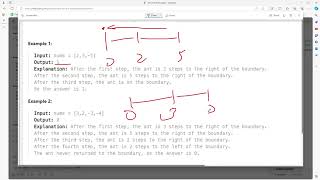
Aryan Mittal 4 mins
3028. Ant on the Boundary | Arrays | Weekly Contest 383
CheatCode Ninja 3 mins
Ant On The Boundary - Python - Leetcode 3028
Programming Live with Larry 3 mins
3028. Ant on the Boundary (Leetcode Easy)
Elite Code 9 mins
Leetcode 3028. Ant on the Boundary
Komal Pal 9 mins
Leetcode 3028 || Ant on the Boundary || Weekly Contest || Easy
Sleepy Cracker 3 mins
#LeetCode 3028 | Ant on the Boundary #Java
6 videos
did my crawler come up with invalid videos ? drop me a line.
Solved On The Same Day
1 easy
- problem 3065: Minimum Operations to Exceed Threshold Value I
- problem 3006: Find Beautiful Indices in the Given Array I
- problem 3015: Count the Number of Houses at a Certain Distance I
- problem 3016: Minimum Number of Pushes to Type Word II
- problem 3066: Minimum Operations to Exceed Threshold Value II
6 solutions
March 18, 2024
Extra
There are a few extra pages giving you some insights into my setup:
- Tech Stack - my development environment and tools
- AI - how AI helped me create this website (NOT solving the problems)
- Progress - progression over time
- Quality - code quality