Python 3042.py
class Solution:
    def countPrefixSuffixPairs(self, words: List[str]) -> int:
        result = 0
        size = len(words)

        for i in range(size):
            for j in range(i + 1, size):
                result += words[j].startswith(words[i]) and words[j].endswith(words[i])

        return result
Difficulty
This problem is ranked as
and has an acceptance rate of about 78% (200k+ submissions).
Typical patterns to solve this problem:
easy
medium
hard
and has an acceptance rate of about 78% (200k+ submissions).
Typical patterns to solve this problem:
- Array
- Hash Function
- Rolling Hash
- String
- String Matching
- Trie
I solved 663 easy, 1250 medium and 309 hard problems
AI Disclaimer
Every single line of code was written by me, 100% from scratch, between August 2023 and August 2024.
However, two years later I set up this website and used various AI tools to generate most of the walkthrough / explanations below.
See this dedicated page for more details.
However, two years later I set up this website and used various AI tools to generate most of the walkthrough / explanations below.
See this dedicated page for more details.
Code Walkthrough
Overview
The provided implementation defines a Solution class with a single method countPrefixSuffixPairs. The method receives a list of strings and returns the number of unordered pairs (i, j) where the string at index j both starts with and ends with the string at index i. The algorithm iterates over all possible pairs using a double-loop and leverages Python’s built-in string methods to perform the prefix and suffix checks.
Key Steps
Initialization
The method begins by creating a counter result set to zero and storing the length of the input list in size.
result = 0
size = len(words)
Pair Generation
Two nested for loops generate every ordered pair where the second index is greater than the first, guaranteeing that each unordered pair is examined exactly once.
for i in range(size):
    for j in range(i + 1, size):
        ...
Prefix-and-Suffix Test
Inside the inner loop the expression
words[j].startswith(words[i]) and words[j].endswith(words[i])evaluates to a Boolean value. In Python, True is equivalent to 1 and False to 0. Adding this Boolean directly to result increments the counter only when both conditions hold.
result += words[j].startswith(words[i]) and words[j].endswith(words[i])Return
After all pairs have been examined, the accumulated count is returned.
return resultEdge Cases Handled
When the input list is empty or contains a single element, size becomes 0 or 1. The outer loop runs zero times, so the method returns 0 without entering the inner loop.
If any string in the list is empty (""), the startswith and endswith checks treat the empty string as a universal prefix and suffix. Consequently, every other string will satisfy both conditions with the empty string, and the algorithm correctly counts those pairs.
When two strings are identical, the inner loop still treats them as distinct indices (i < j). Since a string trivially starts and ends with itself, the pair contributes 1 to the result, matching the intended definition of a pair of different positions.
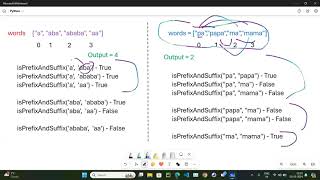
The code also gracefully handles strings where the prefix and suffix overlap (e.g., "aba" with "a"). The built-in methods correctly identify both the start and end positions, so the pair is counted when appropriate.
Performance Optimizations Observed
The implementation relies on Python’s highly optimized C-level string methods startswith and endswith. These functions perform early termination as soon as a mismatch is found, avoiding unnecessary character comparisons for long strings that differ early.
By storing len(words) in the local variable size, the code prevents repeated attribute lookups inside the loop, reducing overhead.
The use of the Boolean-to-integer conversion in the statement result += condition eliminates an explicit if block, allowing the interpreter to execute a single addition operation per pair. This micro-optimization reduces branch misprediction costs in tight loops.
Finally, the double-loop iterates only over pairs where j > i, halving the number of comparisons relative to a naïve double iteration over all ordered pairs. This ensures that each unordered pair is considered exactly once, cutting the total work in half.
written by openai gpt
ELI5 - Simplified Explanation
Imagine you have a big basket full of word cards. This code looks at every single pair of cards in that basket to see if they fit together in a special way.
First, the code picks one card from the basket. Then, it looks at every other card that comes after the first one. It checks two things. It looks to see if the second card starts with the same letters as the first card. Then it also looks to see if that same second card ends with those exact same letters too.
If a pair of cards fits both of those rules, a counter goes up by one. The code keeps doing this for every possible pair in the basket until it has checked all of them. Each time it finds a matching pair, the counter gets bigger, keeping track of how many pairs act like twins in that special way.
written by google gemini
Code Quality
Several LLMs ranked my code quality on a scale from 1 (very poor) to 10 (outstanding):
n = 26
|
median = 7
|
μ = 6.73
|
σ = 1.09
Complexity Analysis
Time: polynomial
As a rule of thumb, the maximum input size for one second execution time is
As a rule of thumb, the maximum input size for one second execution time is
- factorial: up to 10 elements
- exponential: up to 20 elements
- polynomial: a few thousand elements
- loglinear: up to 100,000 elements
- linear: a few million elements
- logarithmic: a billion elements
- constant: practically unlimited
generated automatically
Other Solutions
I wrote a basic crawler to find other solutions to that problem.
Obviously, I did that after I solved the problem myself.
In general, AlgoMonster and WalkCCC solutions are high-quality and always worth a look.
I haven't checked most of the other solutions, but they might be helpful as well.
And of course, the LeetCode forum is always a good place (or even the best) to look for alternative approaches.
(click on a column header to sort the table)
| author | ||||||||
|---|---|---|---|---|---|---|---|---|
| author | solutions | |||||||
| www | AlgoMonster | Java | C++ | Python | TS | |||
| WalkCCC | Java | C++ | Python | |||||
| leetcode.ca | Java | C++ | Go | Python | TS | |||
| Progiez | Java | C++ | Python | |||||
| github | charles-wangkai | Java | ||||||
| everthis | JS | |||||||
| fsq | C++ | |||||||
| JoshCrozier | JS | |||||||
| Shamik07 | Dart | |||||||
| varunu28 | Java | |||||||
| withaarzoo | C++ | |||||||
| AlgoMonster | C++, Python, Java, TypeScript | |||||||
| WalkCCC | C++, Python, Java | |||||||
| leetcode.ca | C++, Go, Java, Python, TypeScript | |||||||
| Progiez | C++, Java, Python | |||||||
| charles-wangkai | Java | |||||||
| everthis | JavaScript | |||||||
| fsq | C++ | |||||||
| JoshCrozier | JavaScript | |||||||
| Shamik07 | Dart | |||||||
| varunu28 | Java | |||||||
| withaarzoo | C++ |
22 links
|
11 authors
|
7 languages
Videos
These are a few popular YouTube videos for this problem:
NeetCodeIO 21 mins
Count Prefix and Suffix Pairs I & II - Leetcode 3042 & 3045 - Python
codestorywithMIK 43 mins
Count Prefix and Suffix Pairs I | Brute Force | Trie | Leetcode 3042 | codestorywithMIK
Ayushi Sharma 12 mins
Count Prefix and Suffix Pairs I | Leetcode 3042
Programming Live with Larry 4 mins
Daily Leetcode #1744: Jan 08, 2025 - 3042. Count Prefix and Suffix Pairs I
Sumanshu Nankana 16 mins
Leetcode # 3042 Count Prefix and Suffix Pairs I (Python)
Code Harmony 10 mins
LeetCode 3042 Count Prefix and Suffix Pairs I | Easy | String Matching | Asked in Uber
Code With K5KC 6 mins
Count Prefix and Suffix Pairs I - Leetcode 3042 - Java
7 videos
did my crawler come up with invalid videos ? drop me a line.
Similar Problems
- problem 211: Design Add and Search Words Data Structure
1 similar problem
Solved On The Same Day
5 medium
- problem 3084: Count Substrings Starting and Ending with Given Character
- problem 3092: Most Frequent IDs
- problem 3096: Minimum Levels to Gain More Points
- problem 3100: Water Bottles II
- problem 3107: Minimum Operations to Make Median of Array Equal to K
6 solutions
April 26, 2024
Extra
There are a few extra pages giving you some insights into my setup:
- Tech Stack - my development environment and tools
- AI - how AI helped me create this website (NOT solving the problems)
- Progress - progression over time
- Quality - code quality