Python 0307.py
class NumArray:

    def __init__(self, nums: List[int]):
        self.data = nums
        self.partial = defaultdict(int)
        self.bucketsize = 100
        for i in range(len(nums)):
            bucket = i // self.bucketsize
            self.partial[bucket] += nums[i]

    def update(self, index: int, val: int) -> None:
        diff = val - self.data[index]
        self.data[index] = val

        bucket = index // self.bucketsize
        self.partial[bucket] += diff

    def sumRange(self, left: int, right: int) -> int:
        result = 0

        # brute-force small ranges
        if right - left < 2*self.bucketsize:
            for i in range(left, right + 1):
                result += self.data[i]
            return result

        # sum until reaching a new bucket
        while left % self.bucketsize != 0:
            result += self.data[left]
            left   += 1

        bucketLeft  = left  // self.bucketsize
        bucketRight = right // self.bucketsize

        # fast summing of buckets
        for b in range(bucketLeft, bucketRight):
            result += self.partial[b]
            left   += self.bucketsize

        # last bucket
        while left <= right:
            result += self.data[left]
            left   += 1

        return result
45 lines
|
1326 bytes
|
submitted September 5, 2023
|
GitHub
12% comment ratio
|
tab size 4
|
low complexity
Difficulty
This problem is ranked as
and has an acceptance rate of about 43% (800k+ submissions).
Typical patterns to solve this problem:
easy
medium
hard
and has an acceptance rate of about 43% (800k+ submissions).
Typical patterns to solve this problem:
- Array
- Binary Indexed Tree
- Design
- Divide And Conquer
- Segment Tree
I solved 663 easy, 1250 medium and 309 hard problems
AI Disclaimer
Every single line of code was written by me, 100% from scratch, between August 2023 and August 2024.
However, two years later I set up this website and used various AI tools to generate most of the walkthrough / explanations below.
See this dedicated page for more details.
However, two years later I set up this website and used various AI tools to generate most of the walkthrough / explanations below.
See this dedicated page for more details.
Code Walkthrough
Overview
The class implements a mutable integer array that supports point updates and range-sum queries. It partitions the underlying data into fixed-size buckets and maintains a running total for each bucket. By combining direct element access for the edges of a query with pre-computed bucket totals for the interior, the implementation achieves fast query performance while keeping updates inexpensive.
Initialization
When an instance is created, the constructor stores the original list in self.data. It also creates a dictionary self.partial that maps a bucket index to the sum of all elements that belong to that bucket. The bucket size is fixed at 100, so the bucket index for element i is computed as i // self.bucketsize. The loop iterates over every element, adds the element to the appropriate bucket total, and therefore builds the auxiliary structure in a single linear pass.
self.data = nums
self.partial = defaultdict(int)
self.bucketsize = 100
for i in range(len(nums)):
    bucket = i // self.bucketsize
    self.partial[bucket] += nums[i]
Update Operation
The update method replaces the value at a given index with a new value. It first computes the difference between the new value and the current value, stores the new value back into self.data, and then adjusts the pre-computed bucket sum by the same difference. Because only one bucket is affected, the update runs in constant time.
diff = val - self.data[index]
self.data[index] = val
bucket = index // self.bucketsize
self.partial[bucket] += diff
Range-Sum Query
The sumRange method returns the sum of elements between left and right inclusive. It handles three distinct phases:
-
Small-range shortcut - If the interval length is less than twice the bucket size, the method falls back to a simple loop over the elements. This avoids the overhead of bucket arithmetic for short ranges.
if right - left < 2*self.bucketsize: for i in range(left, right + 1): result += self.data[i] return result -
Alignment to bucket boundaries - The method advances
leftuntil it lands on the start of a bucket, adding each stepped-over element directly to the result. This guarantees that the subsequent bucket-wise loop starts at a clean bucket boundary.while left % self.bucketsize != 0: result += self.data[left] left += 1 -
Fast bucket accumulation - With
leftnow aligned, the method computes the bucket indices for the left and right ends. It then iterates over all full buckets that lie completely inside the query interval, adding the pre-computed bucket sums fromself.partial. After processing these interior buckets, any remaining elements in the final partial bucket are summed individually.bucketLeft = left // self.bucketsize bucketRight = right // self.bucketsize for b in range(bucketLeft, bucketRight): result += self.partial[b] left += self.bucketsize while left <= right: result += self.data[left] left += 1
The method finally returns the accumulated result.
Edge Cases Handled
The implementation gracefully deals with queries that start or end exactly on a bucket boundary. The alignment loop stops immediately when left is already aligned, so no extra work is performed. When right falls inside the same bucket as left after alignment, the bucket loop is skipped because bucketLeft equals bucketRight, and the trailing while-loop processes the remaining elements correctly. The small-range shortcut also covers the situation where the entire interval fits within a single bucket, ensuring that the algorithm never attempts to read beyond the array bounds.
If the query range consists of a single element (left == right), the small-range condition is satisfied and the method returns that element directly. The update logic similarly works for the first or last element of a bucket because the bucket index calculation uses integer division, which maps any valid index to the correct bucket.
Performance Optimizations
The core optimization is the use of fixed-size buckets with pre-computed sums. By storing a sum per bucket, the algorithm reduces the number of element-wise additions required for large intervals. The bucket size of 100 strikes a balance: it keeps the number of buckets modest, limiting the memory overhead of self.partial, while still providing a noticeable reduction in per-query work compared to a naïve linear scan.
The early-exit for small ranges avoids the overhead of bucket calculations when they would not provide a benefit. This conditional path ensures that short queries run in pure O(k) time where k is the length of the interval, without the constant-time cost of bucket alignment and loop setup.
Updates are performed in constant time because only a single bucket total needs to be adjusted. The use of a defaultdict(int) for self.partial eliminates the need for explicit existence checks when updating bucket sums, further streamlining the update path.
Overall, the combination of bucketed aggregation, boundary alignment, and a short-range shortcut yields an implementation that scales well for both frequent updates and frequent large range queries.
written by openai gpt
ELI5 - Simplified Explanation
Imagine a very long row of numbered toy boxes. Each box has a single number written on it. To keep things organized, these boxes are grouped together into sets of one hundred boxes. Every group has a special sticker on the outside that tells the total sum of all the numbers inside those one hundred boxes.
When someone asks to find the sum of all the numbers between two spots in the row, the code looks at how far apart those spots are. If the spots are close together, the code just walks down the line, looks at each individual box, and adds up the numbers one by one.
If the spots are far apart, the code does something clever to be faster. It looks at the individual boxes at the very beginning until it reaches the edge of a group. Then, instead of counting every single box one by one, it looks at the special sticker on the outside of each full group and adds the whole total at once. This saves a lot of time because it does not have to check every single box. Once it reaches the last few boxes at the end, it counts those individually just like at the start.
If a number inside one of the boxes ever changes, the code first updates that specific number in the main list. Then, it figures out which group that box belongs to and updates the special sticker to match the new sum. This way, the information is always ready to go for the next time someone asks for a sum.
written by google gemini
Code Quality
Several LLMs ranked my code quality on a scale from 1 (very poor) to 10 (outstanding):
n = 26
|
median = 7
|
μ = 6.85
|
σ = 1.20
Complexity Analysis
not analyzed yet
Other Solutions
I wrote a basic crawler to find other solutions to that problem.
Obviously, I did that after I solved the problem myself.
In general, AlgoMonster and WalkCCC solutions are high-quality and always worth a look.
I haven't checked most of the other solutions, but they might be helpful as well.
And of course, the LeetCode forum is always a good place (or even the best) to look for alternative approaches.
(click on a column header to sort the table)
| author | |||||||||
|---|---|---|---|---|---|---|---|---|---|
| author | solutions | ||||||||
| www | AlgoMonster | C++ | Python | Java | TS | ||||
| WalkCCC | C++ | Python | Java | ||||||
| leetcode.ca | C++ | Python | Java | Go | C# | TS | |||
| LeetcodeHelp | C++ | Python | Java | ||||||
| MemoryLimitExceeded | C++ | Python | |||||||
| Progiez | C++ | Python | Java | ||||||
| github | aylei | Rust | |||||||
| black-shadows | C++ | ||||||||
| charles-wangkai | Java | ||||||||
| everthis | JS | ||||||||
| fengvyi | C++ | ||||||||
| Garvit244 | Python | ||||||||
| halfrost | Go | ||||||||
| haoel | C++ | ||||||||
| JoshCrozier | JS | ||||||||
| keineahnung2345 | C++ | ||||||||
| linouk23 | C++ | ||||||||
| lkwq007 | Python | ||||||||
| qiyuangong | Python | ||||||||
| ruoru | Rust | ||||||||
| suxrobGM | C# | ||||||||
| trung-hn | Python | ||||||||
| varunu28 | Java | ||||||||
| vthwang | Java | ||||||||
| wisdompeak | C++ | ||||||||
| YuriSpiridonov | Python | ||||||||
| zfang399 | C++ | ||||||||
| AlgoMonster | C++, Python, Java, TypeScript | ||||||||
| WalkCCC | C++, Python, Java | ||||||||
| leetcode.ca | C++, C#, Go, Java, Python, TypeScript | ||||||||
| LeetcodeHelp | C++, Java, Python | ||||||||
| MemoryLimitExceeded | Python, C++ | ||||||||
| Progiez | C++, Java, Python | ||||||||
| aylei | Rust | ||||||||
| black-shadows | C++, C++ | ||||||||
| charles-wangkai | Java | ||||||||
| everthis | JavaScript | ||||||||
| fengvyi | C++ | ||||||||
| Garvit244 | Python | ||||||||
| halfrost | Go | ||||||||
| haoel | C++ | ||||||||
| JoshCrozier | JavaScript | ||||||||
| keineahnung2345 | C++ | ||||||||
| linouk23 | C++ | ||||||||
| lkwq007 | Python | ||||||||
| qiyuangong | Python | ||||||||
| ruoru | Rust | ||||||||
| suxrobGM | C# | ||||||||
| trung-hn | Python | ||||||||
| varunu28 | Java | ||||||||
| vthwang | Java | ||||||||
| wisdompeak | C++ | ||||||||
| YuriSpiridonov | Python | ||||||||
| zfang399 | C++ |
42 links
|
27 authors
|
8 languages
Videos
These are a few popular YouTube videos for this problem:










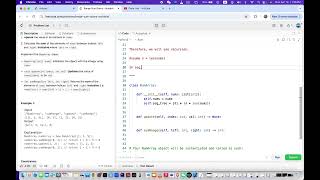
Techdose 27 mins
Range Sum Query - Mutable | Leetcode 307 | Segment tree construction and update
codestorywithMIK 18 mins
Range Sum Query - Mutable | Leetcode 307 | Segment Tree Concepts & Qns | Video 8 | codestorywithMIK
Coding Decoded 16 mins
Segment Tree Basics Range Sum Query - Mutable | Leetcode 307 | Live coding session
Ayushi Sharma 31 mins
Range Sum Query - Mutable🔥🔥 | Leetcode June Challenge | Leetcode 307 | C++ | Segment Tree | Hindi
Happy Coding 34 mins
LeetCode 307. Range Sum Query - Mutable
Nideesh Terapalli 30 mins
Fenwick Tree (BIT Tree) Leetcode 307 | Range Sum Query - Mutable
Timothy H Chang 9 mins
Leetcode - Range Sum Query - Mutable (Python)
happygirlzt 17 mins
Segment Tree LeetCode 307. Range Sum Query - Mutable Explanation and Solution
happygirlzt 18 mins
【线段树/Segment Tree】LeetCode 307. Range Sum Query - Mutable Chinese Version 中文解释
Programming Live with Larry 8 mins
Daily Leetcode #852: Jul 31, 2022 - 307. Range Sum Query - Mutable
Coders Camp 22 mins
Range Sum Query - Mutable | LeetCode 307 | Coders Camp
happygirlzt 17 mins
树状数组 binary indexed tree 307. Range Sum Query - Mutable
Programming Live with Larry 25 mins
Daily Leetcode #444: Jun 18, 2021 - 307. Range Sum Query - Mutable
yeetcode 16 mins
307. (Medium) Range Sum Query (Mutable) - Daily Leetcode (Day 81)
Web Fusion with Bharadwaj 25 mins
Leetcode 307. Range Sum Query - Mutable [ Segment Tree ] [ JAVASCRIPT ].
Ghumman Tech 18 mins
Leetcode Question 307 "Range Sum Query - Mutable" in Java
Web Fusion with Bharadwaj 32 mins
97. Leetcode 307. Range Sum Query - Mutable : Javascript
Sleepy Cracker 20 mins
LeetCode 307 | Range Sum Query - Mutable | Segment Tree | Java
Code-Yao 31 mins
leetcode 307 Range Sum Query Mutable | segment tree
19 videos
did my crawler come up with invalid videos ? drop me a line.
Similar Problems
- problem 303: Range Sum Query - Immutable
- problem 308: Range Sum Query 2D - Mutable
2 similar problems
Solved On The Same Day
6 easy
- problem 168: Excel Sheet Column Title
- problem 171: Excel Sheet Column Number
- problem 506: Relative Ranks
- problem 561: Array Partition
- problem 628: Maximum Product of Three Numbers
- problem 908: Smallest Range I
- problem 306: Additive Number
- problem 378: Kth Smallest Element in a Sorted Matrix
- problem 692: Top K Frequent Words
- problem 720: Longest Word in Dictionary
- problem 910: Smallest Range II
12 solutions
September 5, 2023
Extra
There are a few extra pages giving you some insights into my setup:
- Tech Stack - my development environment and tools
- AI - how AI helped me create this website (NOT solving the problems)
- Progress - progression over time
- Quality - code quality