C++ 0031.cpp
class Solution {
public:
    void nextPermutation(vector<int>& nums) {
        next_permutation(nums.begin(), nums.end());
    }
};
Difficulty
This problem is ranked as
and has an acceptance rate of about 46% (5+ million submissions).
Typical patterns to solve this problem:
easy
medium
hard
and has an acceptance rate of about 46% (5+ million submissions).
Typical patterns to solve this problem:
- Array
- Two Pointers
I solved 663 easy, 1250 medium and 309 hard problems
AI Disclaimer
Every single line of code was written by me, 100% from scratch, between August 2023 and August 2024.
However, two years later I set up this website and used various AI tools to generate most of the walkthrough / explanations below.
See this dedicated page for more details.
Code Walkthrough
Overview
The provided implementation defines a Solution class with a single public member function nextPermutation. The function receives a reference to a vector<int> and delegates the entire operation to the C++ Standard Library algorithm std::next_permutation. By leveraging this well-tested routine, the code achieves the required permutation transformation with minimal custom logic.
Key Steps
The core of the algorithm is a single call to std::next_permutation. This call rearranges the elements of the input range into the next lexicographically greater permutation. If such a permutation does not exist because the current arrangement is the highest possible order, the algorithm transforms the range into the lowest (sorted ascending) order.
void nextPermutation(vector<int>& nums) {
    next_permutation(nums.begin(), nums.end());
}
The function signature uses a non-const reference, allowing the algorithm to modify the original container directly. The use of nums.begin() and nums.end() supplies the exact range to be processed.
Edge Cases Handled
When the input vector is empty, the range supplied to std::next_permutation is empty as well. The standard algorithm detects the empty range and performs no modifications, leaving the vector unchanged. A single-element vector also falls under the same logic: there is no alternative ordering, so the algorithm leaves the element as-is.
If the vector is already sorted in descending order, representing the maximal permutation, std::next_permutation reverses the entire range, producing a sorted ascending order. This behavior satisfies the requirement that the next permutation of the highest arrangement wraps around to the lowest.
When duplicate values are present, the algorithm treats equal elements as indistinguishable, ensuring that the next permutation respects the multiset ordering. The resulting arrangement is the smallest lexicographic change that respects the existing duplicates.
Performance Optimizations
By delegating to std::next_permutation, the implementation inherits the algorithmic optimizations of the standard library. The routine operates in-place, requiring no additional dynamic memory allocations beyond the original container. It performs a single linear scan from the end to locate the pivot element, followed by a reverse operation on the suffix, both of which are executed with tight loops and minimal branching. The use of iterators (begin() and end()) enables the compiler to generate efficient pointer arithmetic, further reducing overhead.
Because the function does not introduce any auxiliary data structures or explicit copying, the overall runtime is bounded by the intrinsic cost of the standard algorithm, which is highly tuned for typical hardware caches and branch prediction patterns. This results in a fast, low-memory-footprint solution for generating the next permutation.
written by openai gpt
ELI5 - Simplified Explanation
Imagine you have a row of wooden blocks, each with a different number painted on it. You are playing a game where you want to arrange these blocks in a specific order to make a new number. Think of the blocks as a secret code that you are trying to unscramble.
The code works like a tiny helpful robot that looks at the blocks you have right now. It knows every possible way those blocks could be lined up. When you ask the robot to perform this task, it looks at the order of your blocks and quickly swaps them around to find the very next pattern in the sequence. It is just like flipping to the next page in a book of patterns to see what comes right after the one you are looking at. The blocks will move into different spots so that they spell out a brand new, slightly larger number than the one you started with.
written by google gemini
Code Quality
Several LLMs ranked my code quality on a scale from 1 (very poor) to 10 (outstanding):
n = 28
|
median = 8
|
μ = 6.82
|
σ = 2.95
Complexity Analysis
Time: linear
As a rule of thumb, the maximum input size for one second execution time is
As a rule of thumb, the maximum input size for one second execution time is
- factorial: up to 10 elements
- exponential: up to 20 elements
- polynomial: a few thousand elements
- loglinear: up to 100,000 elements
- linear: a few million elements
- logarithmic: a billion elements
- constant: practically unlimited
generated automatically
Other Solutions
I wrote a basic crawler to find other solutions to that problem.
Obviously, I did that after I solved the problem myself.
In general, AlgoMonster and WalkCCC solutions are high-quality and always worth a look.
I haven't checked most of the other solutions, but they might be helpful as well.
And of course, the LeetCode forum is always a good place (or even the best) to look for alternative approaches.
(click on a column header to sort the table)
| author | ||||||||||||
|---|---|---|---|---|---|---|---|---|---|---|---|---|
| author | solutions | |||||||||||
| www | AlgoMonster | C++ | Python | Java | TS | |||||||
| WalkCCC | C++ | Python | Java | |||||||||
| leetcode.ca | C++ | Python | C# | JS | Java | Go | PHP | TS | ||||
| LeetcodeHelp | C++ | Python | Java | |||||||||
| MemoryLimitExceeded | C++ | Python | ||||||||||
| Progiez | C++ | Python | Java | |||||||||
| github | AdelDaniel | Dart | ||||||||||
| aylei | Rust | |||||||||||
| begeekmyfriend | C | |||||||||||
| BigEggStudy | C# | |||||||||||
| black-shadows | C++ | |||||||||||
| charles-wangkai | Java | |||||||||||
| chenyanzhe | C++ | |||||||||||
| Dijkstra-Edu | C++ | |||||||||||
| DimitrisJim | C | |||||||||||
| everthis | JS | |||||||||||
| FelixFan1122 | C# | |||||||||||
| fengvyi | C++ | |||||||||||
| fpdjsns | C++ | |||||||||||
| gaosq0604 | Python | |||||||||||
| Garvit244 | Python | |||||||||||
| halfrost | Go | |||||||||||
| haoel | C++ | |||||||||||
| JoshCrozier | JS | |||||||||||
| keineahnung2345 | C++ | |||||||||||
| lennylxx | C | |||||||||||
| linouk23 | C++ | |||||||||||
| lkwq007 | Python | |||||||||||
| luangong | C++ | |||||||||||
| MacJim | C++ | |||||||||||
| qiyuangong | Python | |||||||||||
| ruoru | Rust | |||||||||||
| shreymehul | C# | |||||||||||
| suxrobGM | C# | |||||||||||
| varunu28 | Java | |||||||||||
| vli02 | C | |||||||||||
| wisdompeak | C++ | |||||||||||
| XiaotaoGuo | C++ | |||||||||||
| zfang399 | C++ | |||||||||||
| AlgoMonster | C++, Python, Java, TypeScript | |||||||||||
| WalkCCC | C++, Python, Java | |||||||||||
| leetcode.ca | C++, C#, Go, Java, JavaScript, PHP, Python, TypeScript | |||||||||||
| LeetcodeHelp | C++, Java, Python | |||||||||||
| MemoryLimitExceeded | Python, C++ | |||||||||||
| Progiez | C++, Java, Python | |||||||||||
| AdelDaniel | Dart | |||||||||||
| aylei | Rust | |||||||||||
| begeekmyfriend | C | |||||||||||
| BigEggStudy | C# | |||||||||||
| black-shadows | C++, C++ | |||||||||||
| charles-wangkai | Java | |||||||||||
| chenyanzhe | C++ | |||||||||||
| Dijkstra-Edu | C++ | |||||||||||
| DimitrisJim | C | |||||||||||
| everthis | JavaScript | |||||||||||
| FelixFan1122 | C# | |||||||||||
| fengvyi | C++ | |||||||||||
| fpdjsns | C++ | |||||||||||
| gaosq0604 | Python | |||||||||||
| Garvit244 | Python | |||||||||||
| halfrost | Go | |||||||||||
| haoel | C++ | |||||||||||
| JoshCrozier | JavaScript | |||||||||||
| keineahnung2345 | C++ | |||||||||||
| lennylxx | C | |||||||||||
| linouk23 | C++ | |||||||||||
| lkwq007 | Python | |||||||||||
| luangong | C++ | |||||||||||
| MacJim | C++ | |||||||||||
| qiyuangong | Python | |||||||||||
| ruoru | Rust | |||||||||||
| shreymehul | C# | |||||||||||
| suxrobGM | C# | |||||||||||
| varunu28 | Java | |||||||||||
| vli02 | C | |||||||||||
| wisdompeak | C++ | |||||||||||
| XiaotaoGuo | C++ | |||||||||||
| zfang399 | C++ |
56 links
|
39 authors
|
11 languages
Videos
These are a few popular YouTube videos for this problem:











Ayushi Sharma 15 mins
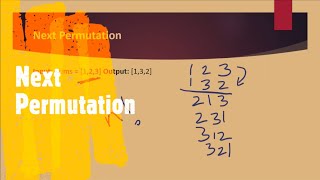
Next Permutation 🔥🔥| Array | Love Babbar DSA Sheet | Leetcode 31 | Amazon | Google
Sai Anish Malla 20 mins
Next Permutation | Leet code 31 | Theory explained + Python code
Professor Oakes 5 mins
Next Permutation Python Solution - LeetCode #31
Eric Programming 12 mins
[Java] Leetcode 31. Next Permutation [Array #11]
happygirlzt 8 mins
LeetCode 31. Next Permutation Explanation and Solution
happygirlzt 6 mins
LeetCode 31. Next Permutation 中文解释 Chinese Version
Coding Decoded 16 mins
Next Permutation | Leetcode 31
Code With Zi 14 mins
LeetCode: 31. Next Permutation (Visualized)
LC Bear 11 mins
Leetcode 31 - Next Permutation (JAVA Solution Explained!)
WorkWithGoogler 21 mins
Microsoft Coding Interview Question | Leetcode 31 | Next Permutation
Programming Live with Larry 19 mins
Daily Leetcode #733: Apr 03, 2022 - 31. Next Permutation
Study Placement 15 mins
Leetcode 31 🔥 Next Permutation | Optimal Approach + Dry Run | Java Solution
Coders Camp 14 mins
Next Permutation | LeetCode 31 | Coders Camp
Happy Coding 15 mins
LeetCode 31. Next Permutation
Programming Live with Larry 22 mins
Daily Leetcode #306: Jan 31, 2021 - 31. Next Permutation
Programming Live with Larry 35 mins
31. Next Permutation (Leetcode Medium)
iOSxBank 16 mins
DAY 297: LeetCode Problem 31. Next Permutation - Swift
Ghumman Tech 6 mins
Leetcode Question 31 "Next Permutation" in Javascript
Komal Pal 23 mins
31. Next Permutation || Leetcode Medium || Cpp
ExtremeProgrammer 4 mins
No Sound Leetcode 31: Next permutation
20 videos
did my crawler come up with invalid videos ? drop me a line.
Similar Problems
- problem 46: Permutations
- problem 1850: Minimum Adjacent Swaps to Reach the Kth Smallest Number
2 similar problems
Solved On The Same Day
19 easy
- problem 1: Two Sum
- problem 9: Palindrome Number
- problem 14: Longest Common Prefix
- problem 20: Valid Parentheses
- problem 26: Remove Duplicates from Sorted Array
- problem 27: Remove Element
- problem 83: Remove Duplicates from Sorted List
- problem 88: Merge Sorted Array
- problem 94: Binary Tree Inorder Traversal
- problem 100: Same Tree
- problem 104: Maximum Depth of Binary Tree
- problem 121: Best Time to Buy and Sell Stock
- problem 136: Single Number
- problem 141: Linked List Cycle
- problem 169: Majority Element
- problem 190: Reverse Bits
- problem 226: Invert Binary Tree
- problem 234: Palindrome Linked List
- problem 1114: Print in Order
- problem 3: Longest Substring Without Repeating Characters
- problem 7: Reverse Integer
- problem 8: String to Integer (atoi)
- problem 11: Container With Most Water
- problem 12: Integer to Roman
- problem 15: 3Sum
- problem 17: Letter Combinations of a Phone Number
- problem 22: Generate Parentheses
- problem 36: Valid Sudoku
- problem 39: Combination Sum
- problem 40: Combination Sum II
- problem 45: Jump Game II
- problem 46: Permutations
- problem 47: Permutations II
- problem 48: Rotate Image
- problem 49: Group Anagrams
- problem 55: Jump Game
- problem 59: Spiral Matrix II
- problem 75: Sort Colors
- problem 77: Combinations
- problem 91: Decode Ways
- problem 95: Unique Binary Search Trees II
- problem 96: Unique Binary Search Trees
- problem 134: Gas Station
- problem 164: Maximum Gap
- problem 189: Rotate Array
- problem 215: Kth Largest Element in an Array
- problem 238: Product of Array Except Self
- problem 287: Find the Duplicate Number
- problem 322: Coin Change
- problem 347: Top K Frequent Elements
- problem 377: Combination Sum IV
- problem 438: Find All Anagrams in a String
- problem 474: Ones and Zeroes
- problem 518: Coin Change II
- problem 526: Beautiful Arrangement
- problem 763: Partition Labels
- problem 983: Minimum Cost For Tickets
- problem 994: Rotting Oranges
- problem 1027: Longest Arithmetic Subsequence
- problem 2140: Solving Questions With Brainpower
- problem 2466: Count Ways To Build Good Strings
- problem 4: Median of Two Sorted Arrays
- problem 41: First Missing Positive
64 solutions
August 8, 2023
Extra
There are a few extra pages giving you some insights into my setup:
- Tech Stack - my development environment and tools
- AI - how AI helped me create this website (NOT solving the problems)
- Progress - progression over time
- Quality - code quality