Python 3226.py
class Solution:
    def minChanges(self, n: int, k: int) -> int:
        result = 0
        while n or k:
            have = n & 1
            need = k & 1
            if have != need:
                if need:
                    return -1
                else:
                    result += 1

            n >>= 1
            k >>= 1

        return result
Difficulty
This problem is ranked as
and has an acceptance rate of about 64% (80k+ submissions).
Typical patterns to solve this problem:
easy
medium
hard
and has an acceptance rate of about 64% (80k+ submissions).
Typical patterns to solve this problem:
- Bit Manipulation
I solved 663 easy, 1250 medium and 309 hard problems
AI Disclaimer
Every single line of code was written by me, 100% from scratch, between August 2023 and August 2024.
However, two years later I set up this website and used various AI tools to generate most of the walkthrough / explanations below.
See this dedicated page for more details.
However, two years later I set up this website and used various AI tools to generate most of the walkthrough / explanations below.
See this dedicated page for more details.
Code Walkthrough
Overview
The minChanges method determines the minimum number of bit-wise modifications required to transform the binary representation of an integer n into that of another integer k. It processes the two numbers simultaneously from the least-significant bit upward, counting mismatches that can be resolved by clearing a set bit in n. If a required bit is set in k but not present in n, the method signals impossibility by returning -1. The algorithm terminates when both numbers have been fully examined.
Key Steps
Initialization
The method starts by creating a counter result set to zero. This variable accumulates the number of bits that must be cleared in n to match k.
result = 0Loop Over Bits
A while loop continues as long as either n or k still contains set bits. This ensures that all positions, including those beyond the most significant set bit of the smaller number, are examined.
while n or k:Extract Current Bits
Inside the loop, the least-significant bit of each number is isolated using a bitwise AND with 1. The variables have and need represent the current bits of n and k, respectively.
have = n & 1
need = k & 1
Compare Bits and Update Counter
If the bits differ, the method distinguishes two scenarios:
- When
needis1andhaveis0, the required bit cannot be created by any operation allowed in this context, so the function returns-1immediately. - When
needis0andhaveis1, the extra set bit inncan be cleared, and the counterresultis incremented.
if have != need:
    if need:
        return -1
    else:
        result += 1
Shift to Next Bit
Both numbers are right-shifted by one position to bring the next higher bit into the least-significant position. This prepares the loop for the subsequent iteration.
n >>= 1
k >>= 1
Return Result
After all bits have been processed, the accumulated count in result is returned, representing the minimal number of clear-operations needed.
return resultEdge Cases Handled
The implementation gracefully handles several boundary conditions:
- Zero Inputs - When both
nandkare zero, the loop body never executes and the method returns0, indicating no changes are required. - Different Lengths - If
khas more bits thann, the loop continues untilkis exhausted. Encountering a1inkwherenhas already become zero triggers the early-1return, correctly indicating impossibility. - Trailing Zeros - Bits beyond the most significant set bit of both numbers are implicitly zero; the loop terminates once both numbers are fully shifted out, avoiding unnecessary iterations.
- Immediate Impossibility - The moment a required
1inkcannot be satisfied byn, the function exits early, preventing further unnecessary computation.
Performance Optimizations
The algorithm operates directly on the binary representation without allocating auxiliary data structures, which minimizes memory overhead. Bitwise operations (&, >>) are executed in constant time on primitive integer types, making each iteration extremely fast. The early exit on an unsatisfiable bit (return -1) prevents the loop from traversing the remaining higher-order bits, saving cycles in cases where the transformation is impossible. By using a single integer counter and updating it in place, the method avoids the cost of function calls or complex state management.
Overall, the solution delivers a tight, low-level implementation that leverages the efficiency of native bitwise manipulation.
written by openai gpt
ELI5 - Simplified Explanation
Imagine you have two towers made of colorful blocks. The blocks represent numbers, and each block can either be a zero or a one. The goal is to see if you can turn the first tower into the second tower by only taking blocks away from the first one.
A little tool looks at the bottom block of each tower one by one. If the blocks are the same, that is perfect, so the tool moves on to the next pair. If the blocks are different, it checks if you can fix it. If the first tower has a zero but the second tower needs a one, that is impossible because you can only remove blocks, not add them. If that happens, the process stops. If the first tower has a one but the second tower needs a zero, you simply remove that one block from the first tower and count it as a change.
After checking each pair of blocks, the tool shuffles the towers upward to look at the next pair higher up. This continues until all the blocks have been checked. The final count of all the removed blocks is the total number of changes made.
written by google gemini
Code Quality
Several LLMs ranked my code quality on a scale from 1 (very poor) to 10 (outstanding):
n = 27
|
median = 7
|
μ = 7.04
|
σ = 1.88
Complexity Analysis
Time: logarithmic
As a rule of thumb, the maximum input size for one second execution time is
As a rule of thumb, the maximum input size for one second execution time is
- factorial: up to 10 elements
- exponential: up to 20 elements
- polynomial: a few thousand elements
- loglinear: up to 100,000 elements
- linear: a few million elements
- logarithmic: a billion elements
- constant: practically unlimited
generated automatically
Other Solutions
I wrote a basic crawler to find other solutions to that problem.
Obviously, I did that after I solved the problem myself.
In general, AlgoMonster and WalkCCC solutions are high-quality and always worth a look.
I haven't checked most of the other solutions, but they might be helpful as well.
And of course, the LeetCode forum is always a good place (or even the best) to look for alternative approaches.
(click on a column header to sort the table)
| author | |||||||||
|---|---|---|---|---|---|---|---|---|---|
| author | solutions | ||||||||
| www | AlgoMonster | Java | C++ | Python | TS | ||||
| WalkCCC | Java | C++ | Python | ||||||
| leetcode.ca | Java | C++ | C# | Go | Python | Rust | TS | ||
| Progiez | Java | C++ | Python | ||||||
| github | charles-wangkai | Java | |||||||
| everthis | JS | ||||||||
| fsq | C++ | ||||||||
| AlgoMonster | C++, Python, Java, TypeScript | ||||||||
| WalkCCC | C++, Python, Java | ||||||||
| leetcode.ca | C++, C#, Go, Java, Python, Rust, TypeScript | ||||||||
| Progiez | C++, Java, Python | ||||||||
| charles-wangkai | Java | ||||||||
| everthis | JavaScript | ||||||||
| fsq | C++ |
20 links
|
7 authors
|
8 languages
Videos
These are a few popular YouTube videos for this problem:



Developer Coder 10 mins
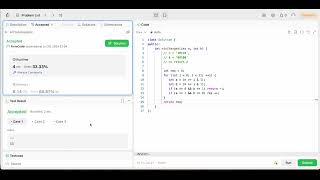
Number of Bit Changes to Make Two Integers Equal | Leetcode weekly-contest-407 | Java Solution
Programming Live with Larry 4 mins
3226. Number of Bit Changes to Make Two Integers Equal (Leetcode Easy)
leetcode blind 75 6 mins
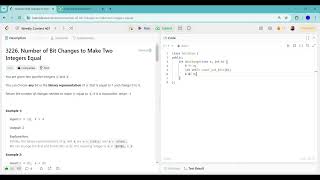
leetcode 3226 : numbers of bit changes to make two integers equal: python solution
Quasar 3 mins
Leetcode 3226. Number of Bit Changes to Make Two Integers Equal | C
Coder on A Farm 6 mins
3226. Number of Bit Changes to Make Two Integers Equal (leetcode easy)
EngineerCorner 9 mins
Leetcode 3226. Number of Bit Changes to Make Two Integers Equal
ExpertFunda 11 mins
Leetcode 3226. Number of Bit Changes to Make Two Integers Equal
7 videos
did my crawler come up with invalid videos ? drop me a line.
Solved On The Same Day
1 easy
- problem 3158: Find the XOR of Numbers Which Appear Twice
2 solutions
July 26, 2024
Extra
There are a few extra pages giving you some insights into my setup:
- Tech Stack - my development environment and tools
- AI - how AI helped me create this website (NOT solving the problems)
- Progress - progression over time
- Quality - code quality