Python 0372.py
class Solution:
    def superPow(self, a: int, b: List[int]) -> int:
        # nothing's forbidden, therefore Python should do the hard work ;-)
        exponent = 0
        for x in b:
            exponent *= 10
            exponent += x

        return pow(a, exponent, 1337) # it's powmod
9 lines
|
301 bytes
|
submitted August 20, 2023
|
GitHub
28% comment ratio
|
tab size 4
|
low complexity
Difficulty
This problem is ranked as
and has an acceptance rate of about 37% (200k+ submissions).
Typical patterns to solve this problem:
easy
medium
hard
and has an acceptance rate of about 37% (200k+ submissions).
Typical patterns to solve this problem:
- Divide And Conquer
- Math
I solved 663 easy, 1250 medium and 309 hard problems
AI Disclaimer
Every single line of code was written by me, 100% from scratch, between August 2023 and August 2024.
However, two years later I set up this website and used various AI tools to generate most of the walkthrough / explanations below.
See this dedicated page for more details.
Code Walkthrough
Overview
The provided implementation defines a class Solution with a single method superPow. The method receives an integer base a and a list of digits b that together represent a large exponent. The core responsibility of the method is to compute (a^{\text{exponent}} \bmod 1337) where the exponent is reconstructed from the digit list. The solution relies on Python’s built-in arbitrary-precision arithmetic and the three-argument form of pow to perform modular exponentiation efficiently.
Key Steps
Reconstructing the exponent
The first logical block iterates over the digit list b and builds the integer value of the exponent. The code initializes a variable exponent to zero. For each digit x in b, the current value of exponent is multiplied by ten and then the digit x is added. This mimics the manual conversion of a decimal representation stored as separate digits into a single integer.
exponent = 0
for x in b:
    exponent *= 10
    exponent += x
Performing modular exponentiation
After the exponent has been assembled, the method returns the result of pow(a, exponent, 1337). The three-argument version of pow computes the power under a modulus using an efficient algorithm (binary exponentiation) that avoids constructing the potentially astronomically large intermediate value of a**exponent. The constant modulus 1337 is hard-coded as required by the problem specification.
return pow(a, exponent, 1337) # it's powmodEdge Cases Handled
When the digit list b is empty, the loop that builds the exponent never executes, leaving exponent at its initial value of zero. Consequently the method computes pow(a, 0, 1337), which correctly yields 1 modulo 1337 for any non-zero base, matching the mathematical definition of any number raised to the zero power.
If the list b contains leading zeros, the multiplication-by-ten step preserves those zeros in the positional value, ensuring that the exponent reflects the exact decimal number intended by the digit sequence.
The use of Python’s built-in pow automatically accommodates very large values of a and exponent. Even when exponent exceeds typical integer limits, the modular exponentiation algorithm processes the bits of the exponent without overflow, delivering a correct result modulo 1337.
Performance Optimizations
The most significant optimization is the delegation of the heavy lifting to Python’s native pow function with three arguments. This built-in routine implements modular exponentiation using exponentiation by squaring, which reduces the number of multiplications dramatically compared to naïve repeated multiplication. By invoking pow directly, the code avoids explicit loops for exponentiation and benefits from the interpreter’s highly tuned C implementation.
Another subtle optimization lies in the construction of the exponent. By updating exponent in place with multiplication and addition, the code avoids creating intermediate strings or performing costly conversions. The arithmetic operations are performed on Python’s native integer type, which is optimized for large numbers and scales well with the size of the digit list.
Overall, the combination of in-place exponent reconstruction and the use of a built-in modular exponentiation routine yields a solution that runs efficiently even when the digit list represents an exponent with hundreds of digits.
written by openai gpt
ELI5 - Simplified Explanation
Imagine you have a big treasure box, and you want to pack it with lots of stars based on a special secret number. The first part of this code looks at a long list of numbers that act like a giant instructions manual for how many stars to add. It reads each number one by one and stitches them together to build one very large number. Think of it like putting together a long train made of individual blocks. Once the train is built, the code uses a magical math tool to figure out how many stars fit in the box. This tool takes the starting number and multiplies it over and over again until it reaches the total count from the long train. Because the number can get incredibly huge, the tool keeps everything tidy by only keeping track of the remainder whenever the pile gets bigger than thirteen hundred thirty-seven. It treats that special number like a fence and starts over every time it hits it to keep the counting easy.
written by google gemini
Code Quality
Several LLMs ranked my code quality on a scale from 1 (very poor) to 10 (outstanding):
n = 27
|
median = 7
|
μ = 6.37
|
σ = 2.18
Complexity Analysis
not analyzed yet
Other Solutions
I wrote a basic crawler to find other solutions to that problem.
Obviously, I did that after I solved the problem myself.
In general, AlgoMonster and WalkCCC solutions are high-quality and always worth a look.
I haven't checked most of the other solutions, but they might be helpful as well.
And of course, the LeetCode forum is always a good place (or even the best) to look for alternative approaches.
(click on a column header to sort the table)
| author | |||||||||
|---|---|---|---|---|---|---|---|---|---|
| author | solutions | ||||||||
| www | AlgoMonster | C++ | Python | Java | TS | ||||
| WalkCCC | C++ | Python | Java | ||||||
| leetcode.ca | C++ | Python | Java | Go | TS | ||||
| LeetcodeHelp | C++ | Python | Java | ||||||
| Progiez | C++ | Python | Java | ||||||
| github | black-shadows | C++ | |||||||
| charles-wangkai | Java | ||||||||
| everthis | JS | ||||||||
| halfrost | Go | ||||||||
| JoshCrozier | JS | ||||||||
| linouk23 | Python | ||||||||
| lkwq007 | Python | ||||||||
| lzl124631x | C++ | ||||||||
| qiyuangong | Python | ||||||||
| ruoru | Rust | ||||||||
| suxrobGM | C# | ||||||||
| zfang399 | C++ | ||||||||
| AlgoMonster | C++, Python, Java, TypeScript | ||||||||
| WalkCCC | C++, Python, Java | ||||||||
| leetcode.ca | C++, Go, Java, Python, TypeScript | ||||||||
| LeetcodeHelp | C++, Java, Python | ||||||||
| Progiez | C++, Java, Python | ||||||||
| black-shadows | C++, C++ | ||||||||
| charles-wangkai | Java | ||||||||
| everthis | JavaScript | ||||||||
| halfrost | Go | ||||||||
| JoshCrozier | JavaScript | ||||||||
| linouk23 | Python | ||||||||
| lkwq007 | Python | ||||||||
| lzl124631x | C++ | ||||||||
| qiyuangong | Python | ||||||||
| ruoru | Rust | ||||||||
| suxrobGM | C# | ||||||||
| zfang399 | C++ |
30 links
|
17 authors
|
8 languages
Videos
These are a few popular YouTube videos for this problem:

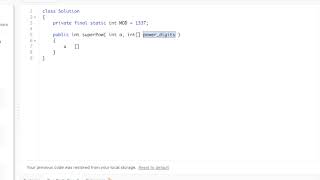
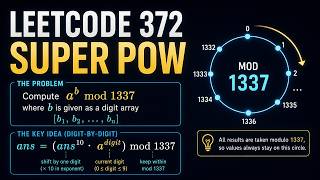

code Explainer 11 mins
372. Super Pow | LEETCODE MEDIUM | MODULAR ARITHMETIC
Kacy Codes 11 mins
Leetcode 372. Super Pow
Math Geeks 5 mins
Leetcode solving: 372. Super Pow
Ghumman Tech 7 mins
Leetcode Question 372 "Super Pow" in Java
leetcode blind 75 5 mins
LEETCODE 372:Unlocking Exponentiation: Mastering LeetCode's 372 - Super Pow
5 videos
did my crawler come up with invalid videos ? drop me a line.
Similar Problems
- problem 50: Pow(x, n)
1 similar problem
Solved On The Same Day
3 easy
- problem 160: Intersection of Two Linked Lists
- problem 303: Range Sum Query - Immutable
- problem 405: Convert a Number to Hexadecimal
- problem 343: Integer Break
5 solutions
August 20, 2023
Extra
There are a few extra pages giving you some insights into my setup:
- Tech Stack - my development environment and tools
- AI - how AI helped me create this website (NOT solving the problems)
- Progress - progression over time
- Quality - code quality