Python 0038.py
class Solution:
    @cache
    def step(self, s):
        result = ""
        pos   = 1
        count = 1
        while pos < len(s):
            if s[pos] == s[pos - 1]:
                count += 1
            else:
                result += str(count)
                result += s[pos - 1]
                count = 1
            pos += 1

        result += str(count)
        result += s[pos - 1]
        return result


    def countAndSay(self, n: int) -> str:
        s = "1"
        while n > 1:
            s = self.step(s)
            n -= 1
        return s
Difficulty
This problem is ranked as
and has an acceptance rate of about 63% (2+ million submissions).
Typical patterns to solve this problem:
easy
medium
hard
and has an acceptance rate of about 63% (2+ million submissions).
Typical patterns to solve this problem:
- String
I solved 663 easy, 1250 medium and 309 hard problems
AI Disclaimer
Every single line of code was written by me, 100% from scratch, between August 2023 and August 2024.
However, two years later I set up this website and used various AI tools to generate most of the walkthrough / explanations below.
See this dedicated page for more details.
However, two years later I set up this website and used various AI tools to generate most of the walkthrough / explanations below.
See this dedicated page for more details.
Code Walkthrough
Overview
The provided implementation defines a class Solution that generates the n-th term of the classic “count-and-say” sequence. The public method countAndSay drives the process by repeatedly invoking a helper method step, which transforms a given string into its next sequence element by counting consecutive identical characters and emitting the count followed by the character. The helper is memoized with @cache, allowing repeated calls with the same argument to retrieve a previously computed result instantly.
Core Algorithm
The algorithm follows the definition of the count-and-say sequence: start with the string "1" and, for each subsequent term, read off the digits of the current term, counting runs of identical digits. The countAndSay method initializes the sequence with "1" and iteratively applies step until the desired index is reached.
def countAndSay(self, n: int) -> str:
    s = "1"
    while n > 1:
        s = self.step(s)
        n -= 1
    return s
Each iteration reduces the remaining distance to the target term, guaranteeing termination when n reaches 1.
Step Function Details
The step method embodies the transformation logic. It walks through the input string s using an index pos that starts at 1, while maintaining a count of how many times the current character has been seen consecutively. When a character differs from its predecessor, the method appends the accumulated count and the previous character to the result string, then resets the count for the new character. After the loop finishes, the final run is appended.
def step(self, s):
    result = ""
    pos   = 1
    count = 1
    while pos < len(s):
        if s[pos] == s[pos - 1]:
            count += 1
        else:
            result += str(count)
            result += s[pos - 1]
            count = 1
        pos += 1

    result += str(count)
    result += s[pos - 1]
    return result
Key variables:
resultaccumulates the next term.postracks the current scanning position.countrecords the length of the current run of identical characters.
The loop condition pos < len(s) ensures that every character except the first is examined, while the final append outside the loop captures the last run, which would otherwise be omitted.
Edge Cases Handled
The implementation gracefully handles several edge conditions:
- Single-character input: When
sconsists of a single digit, the while loop body never executes becauseposstarts at 1 andlen(s)is also 1. The final two lines directly appendcount(which remains 1) and the sole character, yielding"11"as expected for the next term. - All identical characters: If the entire string is a uniform run (e.g.,
"111"), the innerifbranch incrementscounton each iteration. Noelsebranch is taken, and after the loop the final append emits the total count followed by the repeated character, correctly producing"31". - Alternating characters: For patterns like
"1212", each character differs from its predecessor, triggering theelsebranch on every iteration. The method emits a count of 1 for each character, resulting in"11121112"after processing, which aligns with the definition of the sequence. - Empty string: Although the public interface never supplies an empty string (the sequence always starts from
"1"), the logic would still avoid index errors because the loop condition prevents any access whenlen(s)is 0, and the final append would references[-1]. In practice, this scenario does not arise, so the code remains robust for its intended use.
Performance Optimizations
Two notable optimizations are present:
- Memoization via
@cache: Decoratingstepwith@cachestores the result of each distinct input string. In the context of the count-and-say sequence, each term is unique, so the cache primarily benefits repeated calls with the same argument, which could occur if the method is invoked independently outside the main loop. The memoization eliminates redundant recomputation for identical inputs, turning what would be a linear scan into a constant-time lookup for cached cases. - String concatenation strategy: The method builds the output by repeatedly using
+=on theresultstring. While Python strings are immutable, the concatenations occur in a tight loop where each addition appends a small, predictable fragment (a digit count and a character). This pattern benefits from CPython’s internal optimizations that occasionally reuse memory for short-lived strings, reducing allocation overhead compared to more fragmented approaches. Moreover, the algorithm avoids constructing intermediate lists or usingjoinon a large collection, keeping the memory footprint modest for each transformation step.
These choices collectively ensure that each transformation runs efficiently, with the memoization layer providing instant results for repeated inputs and the concatenation approach minimizing allocation churn during the sequential generation of terms.
written by openai gpt
ELI5 - Simplified Explanation
Imagine you have a magic bag full of number blocks. This code plays a game where it looks at the blocks and talks about them out loud. It starts with just one number one. When it looks at that one, it says there is one one, which makes the string become eleven. Next, it looks at the two ones and says there are two ones, so it becomes twenty-one. This game keeps going like that, with the code counting the same numbers lined up in a row and writing down how many it sees and then which number it is. The first part of the code acts like a helper that reads a line of numbers and counts them up, while the second part keeps repeating that helper until it has finished playing the game as many times as asked. It is just like reading a story where each page describes exactly what was on the page before it.
written by google gemini
Code Quality
Several LLMs ranked my code quality on a scale from 1 (very poor) to 10 (outstanding):
n = 29
|
median = 7
|
μ = 6.69
|
σ = 1.32
Complexity Analysis
not analyzed yet
Other Solutions
I wrote a basic crawler to find other solutions to that problem.
Obviously, I did that after I solved the problem myself.
In general, AlgoMonster and WalkCCC solutions are high-quality and always worth a look.
I haven't checked most of the other solutions, but they might be helpful as well.
And of course, the LeetCode forum is always a good place (or even the best) to look for alternative approaches.
(click on a column header to sort the table)
| author | |||||||||||||
|---|---|---|---|---|---|---|---|---|---|---|---|---|---|
| author | solutions | ||||||||||||
| www | AlgoMonster | C++ | Python | Java | TS | ||||||||
| WalkCCC | C++ | Python | Java | ||||||||||
| leetcode.ca | C++ | Python | Java | C# | Rust | JS | Go | PHP | TS | ||||
| LeetcodeHelp | C++ | Python | Java | ||||||||||
| MemoryLimitExceeded | C++ | Python | |||||||||||
| Progiez | C++ | Python | Java | ||||||||||
| github | aylei | Rust | |||||||||||
| begeekmyfriend | C | ||||||||||||
| BigEggStudy | C# | ||||||||||||
| black-shadows | C++ | ||||||||||||
| charles-wangkai | Java | ||||||||||||
| chenyanzhe | C++ | ||||||||||||
| everthis | JS | ||||||||||||
| fartem | Ruby | ||||||||||||
| FelixFan1122 | C# | ||||||||||||
| fengvyi | C++ | ||||||||||||
| gaosq0604 | Python | ||||||||||||
| Garvit244 | Python | ||||||||||||
| gouthampradhan | Java | ||||||||||||
| haoel | C++ | ||||||||||||
| JoshCrozier | JS | ||||||||||||
| keineahnung2345 | C++ | ||||||||||||
| lennylxx | C | ||||||||||||
| linouk23 | C++ | ||||||||||||
| lkwq007 | Python | ||||||||||||
| luangong | C++ | ||||||||||||
| qiyuangong | Python | ||||||||||||
| ruoru | Rust | ||||||||||||
| suxrobGM | C# | ||||||||||||
| varunu28 | Java | ||||||||||||
| vli02 | C | ||||||||||||
| vthwang | Java | ||||||||||||
| XiaotaoGuo | C++ | ||||||||||||
| yuanliu666 | Kotlin | ||||||||||||
| zfang399 | C++ | ||||||||||||
| AlgoMonster | C++, Python, Java, TypeScript | ||||||||||||
| WalkCCC | C++, Python, Java | ||||||||||||
| leetcode.ca | C++, C#, Go, Java, JavaScript, PHP, Python, Rust, TypeScript | ||||||||||||
| LeetcodeHelp | C++, Java, Python | ||||||||||||
| MemoryLimitExceeded | Python, C++ | ||||||||||||
| Progiez | C++, Java, Python | ||||||||||||
| aylei | Rust | ||||||||||||
| begeekmyfriend | C | ||||||||||||
| BigEggStudy | C# | ||||||||||||
| black-shadows | C++, C++ | ||||||||||||
| charles-wangkai | Java | ||||||||||||
| chenyanzhe | C++ | ||||||||||||
| everthis | JavaScript | ||||||||||||
| fartem | Ruby | ||||||||||||
| FelixFan1122 | C# | ||||||||||||
| fengvyi | C++ | ||||||||||||
| gaosq0604 | Python | ||||||||||||
| Garvit244 | Python | ||||||||||||
| gouthampradhan | Java | ||||||||||||
| haoel | C++ | ||||||||||||
| JoshCrozier | JavaScript | ||||||||||||
| keineahnung2345 | C++ | ||||||||||||
| lennylxx | C | ||||||||||||
| linouk23 | C++ | ||||||||||||
| lkwq007 | Python | ||||||||||||
| luangong | C++ | ||||||||||||
| qiyuangong | Python | ||||||||||||
| ruoru | Rust | ||||||||||||
| suxrobGM | C# | ||||||||||||
| varunu28 | Java | ||||||||||||
| vli02 | C | ||||||||||||
| vthwang | Java | ||||||||||||
| XiaotaoGuo | C++ | ||||||||||||
| yuanliu666 | Kotlin | ||||||||||||
| zfang399 | C++ |
53 links
|
35 authors
|
12 languages
Videos
These are a few popular YouTube videos for this problem:

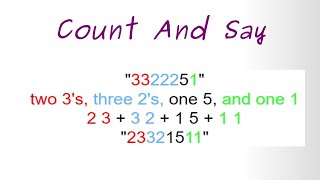

Ashish Kumar 9 mins
LeetCode 38 Count and Say
Terrible Whiteboard 19 mins
Count and Say | LeetCode 38 | Coding Interview Tutorial
Techdose 19 mins
Count and Say | Leetcode 38
Mastering Programming 8 mins
Count and Say - Leetcode 38 - Java
Game of Coders 7 mins
38. Count and Say - LeetCode Solution
Professor Oakes 4 mins
Count and Say Python Solution - LeetCode #38
Programming Live with Larry 6 mins
Daily Leetcode #931: Oct 18, 2022 - 38. Count and Say
StatLearn Tech 15 mins
Leetcode 38. Count and Say | Python Solution + Step-by-Step Explanation
CheatCode Ninja 6 mins
Count And Say | Recursion | Leetcode 38 | Python
Code Harmony 29 mins
LeetCode 38 Count and Say | String Encoding | Step-by-Step Explanation & Detailed Time Analysis
Programming Live with Larry 6 mins
Daily Leetcode #1844: Apr 18, 2025 - 38. Count and Say
Code With Zi 13 mins
LeetCode: 38. Count and Say (Visualized)
Algorithms Casts 17 mins
Leetcode 38: Count and Say
LeetCodeWithMonu 14 mins
38. Count and Say | LeetCode Daily Challenge | JavaScript
Ghumman Tech 4 mins
Leetcode Question 38 "Count and Say" in Javascript
R Sai Siddhu 9 mins
Count and Say LeetCode 38 LeetCode POTD LeetCode
Developer Coder 21 mins
Count and Say | LeetCode 38 | 2 approaches | Recursive | Iterative | Java Code | Developer Coder
Komal Pal 16 mins
38. Count and Say ||Leetcode Daily Medium || String|| CPP
iOSxBank 11 mins
Day 347: LeetCode Problem 38. Count and Say - Swift
Tim Huang 5 mins
Count and Say - Leetcode 38 - Python
20 videos
did my crawler come up with invalid videos ? drop me a line.
Similar Problems
- problem 271: Encode and Decode Strings
1 similar problem
Solved On The Same Day
2 easy
- problem 476: Number Complement
- problem 496: Next Greater Element I
- problem 6: Zigzag Conversion
- problem 147: Insertion Sort List
- problem 148: Sort List
- problem 494: Target Sum
- problem 498: Diagonal Traverse
8 solutions
August 16, 2023
Extra
There are a few extra pages giving you some insights into my setup:
- Tech Stack - my development environment and tools
- AI - how AI helped me create this website (NOT solving the problems)
- Progress - progression over time
- Quality - code quality