Python 0398.py
class Solution:
    def __init__(self, nums: List[int]):
        self.pos = defaultdict(list)
        for where, what in enumerate(nums):
            self.pos[what].append(where)

    def pick(self, target: int) -> int:
        return choice(self.pos[target])
Difficulty
This problem is ranked as
and has an acceptance rate of about 64% (400k+ submissions).
Typical patterns to solve this problem:
easy
medium
hard
and has an acceptance rate of about 64% (400k+ submissions).
Typical patterns to solve this problem:
- Hash Table
- Math
- Randomized
- Reservoir Sampling
I solved 663 easy, 1250 medium and 309 hard problems
AI Disclaimer
Every single line of code was written by me, 100% from scratch, between August 2023 and August 2024.
However, two years later I set up this website and used various AI tools to generate most of the walkthrough / explanations below.
See this dedicated page for more details.
However, two years later I set up this website and used various AI tools to generate most of the walkthrough / explanations below.
See this dedicated page for more details.
Code Walkthrough
Overview
The provided class implements a compact solution for selecting a random index of a given target value from an immutable list of integers. The constructor builds an auxiliary data structure that groups all positions of each distinct number, and the pick method retrieves a random position from the pre-computed group. By separating the preprocessing from the query, the design achieves constant-time random selection after a single linear pass over the input.
Initialization
During object creation the code iterates over the input list once, recording the index of each element in a dictionary whose keys are the element values and whose values are lists of indices. The use of defaultdict(list) eliminates the need for explicit existence checks before appending a new index.
class Solution:
    def __init__(self, nums: List[int]):
        self.pos = defaultdict(list)
        for where, what in enumerate(nums):
            self.pos[what].append(where)
The loop variable where holds the current index, while what holds the element at that index. Each index is appended to the list associated with its element value, producing a mapping such as {5: [0, 3, 7], 2: [1, 4]} for an example input. This preprocessing step runs once per instance and prepares the data for fast queries.
Random Selection
The pick method receives a target integer and returns a randomly chosen index from the list stored for that target. It relies on random.choice, which selects an element uniformly from a non-empty sequence.
    def pick(self, target: int) -> int:
        return choice(self.pos[target])
Because the dictionary entry for target is a list of all its occurrences, the method directly accesses the pre-computed list and delegates the randomness to the standard library. The call is a single dictionary lookup followed by a constant-time random selection.
Edge Cases Handled
When the input list contains multiple occurrences of the same value, the dictionary entry aggregates all corresponding indices, ensuring that pick can return any of them with equal probability. If a value appears only once, the list for that key contains a single element, and choice will always return that index, which is a correct deterministic outcome for the single-occurrence case. The use of defaultdict guarantees that the dictionary always returns a list object, so the code does not need to guard against missing keys during construction.
Performance Optimizations
The primary optimization is the separation of preprocessing from query time. By constructing the pos mapping in a single linear scan, the solution avoids repeated scans of the original list for each pick call. The dictionary provides O(1) average-case access to the list of indices for any target, and random.choice operates in O(1) on a Python list because it selects an element by index. The choice of defaultdict removes conditional logic for key initialization, reducing overhead in the construction loop. Together, these choices yield a highly efficient implementation for scenarios with many pick operations after a one-time setup.
written by openai gpt
ELI5 - Simplified Explanation
Imagine having a big collection of colorful building blocks in a box. Each block has a special number painted on it. This code starts by looking through the whole box and making a list of where every number is hiding. It keeps track of these spots in a special notebook so it remembers exactly which pile each number belongs to.
When it comes time to pick a specific number, the code opens that notebook to the right page. It sees all the different places where that number is hiding and selects one of those spots at random. It is just like reaching into a box and pulling out one toy when there are many identical ones waiting to be chosen.
written by google gemini
Code Quality
Several LLMs ranked my code quality on a scale from 1 (very poor) to 10 (outstanding):
n = 27
|
median = 7
|
μ = 7.15
|
σ = 1.84
Complexity Analysis
Time: linear
As a rule of thumb, the maximum input size for one second execution time is
As a rule of thumb, the maximum input size for one second execution time is
- factorial: up to 10 elements
- exponential: up to 20 elements
- polynomial: a few thousand elements
- loglinear: up to 100,000 elements
- linear: a few million elements
- logarithmic: a billion elements
- constant: practically unlimited
generated automatically
Other Solutions
I wrote a basic crawler to find other solutions to that problem.
Obviously, I did that after I solved the problem myself.
In general, AlgoMonster and WalkCCC solutions are high-quality and always worth a look.
I haven't checked most of the other solutions, but they might be helpful as well.
And of course, the LeetCode forum is always a good place (or even the best) to look for alternative approaches.
(click on a column header to sort the table)
| author | |||||||||||
|---|---|---|---|---|---|---|---|---|---|---|---|
| author | solutions | ||||||||||
| www | AlgoMonster | C++ | Java | Python | TS | ||||||
| WalkCCC | C++ | Java | Python | ||||||||
| leetcode.ca | C++ | Java | Python | Go | |||||||
| LeetcodeHelp | C++ | Java | Python | ||||||||
| Progiez | C++ | Java | Python | ||||||||
| github | black-shadows | C++ | |||||||||
| charles-wangkai | Java | ||||||||||
| everthis | JS | ||||||||||
| fartem | Ruby | ||||||||||
| fengvyi | C++ | ||||||||||
| gouthampradhan | Java | ||||||||||
| haoel | C++ | ||||||||||
| JoshCrozier | JS | ||||||||||
| linouk23 | C++ | ||||||||||
| lkwq007 | Python | ||||||||||
| lzl124631x | C++ | ||||||||||
| ruoru | Rust | ||||||||||
| suxrobGM | C# | ||||||||||
| varunu28 | Java | ||||||||||
| vli02 | C | ||||||||||
| XiaotaoGuo | C++ | ||||||||||
| YuriSpiridonov | Python | ||||||||||
| AlgoMonster | C++, Python, Java, TypeScript | ||||||||||
| WalkCCC | C++, Python, Java | ||||||||||
| leetcode.ca | C++, Go, Java, Python | ||||||||||
| LeetcodeHelp | C++, Java, Python | ||||||||||
| Progiez | C++, Java, Python | ||||||||||
| black-shadows | C++, C++ | ||||||||||
| charles-wangkai | Java | ||||||||||
| everthis | JavaScript | ||||||||||
| fartem | Ruby | ||||||||||
| fengvyi | C++ | ||||||||||
| gouthampradhan | Java | ||||||||||
| haoel | C++ | ||||||||||
| JoshCrozier | JavaScript | ||||||||||
| linouk23 | C++ | ||||||||||
| lkwq007 | Python | ||||||||||
| lzl124631x | C++ | ||||||||||
| ruoru | Rust | ||||||||||
| suxrobGM | C# | ||||||||||
| varunu28 | Java | ||||||||||
| vli02 | C | ||||||||||
| XiaotaoGuo | C++ | ||||||||||
| YuriSpiridonov | Python |
34 links
|
22 authors
|
10 languages
Videos
These are a few popular YouTube videos for this problem:

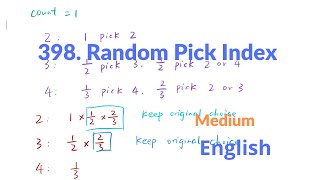



Cracking FAANG 15 mins
RANDOM PICK INDEX | LEETCODE # 398 | PYTHON RESERVOIR SAMPLING
happygirlzt 8 mins
LeetCode 398. Random Pick Index Explanation and Solution
Ren Zhang 17 mins
Leetcode 398 Random Pick Index
WorkWithGoogler 19 mins
Facebook Coding Interview Question | Leetcode 398 | Random Pick Index
Happy Coding 6 mins
LeetCode 398. Random Pick Index
5 videos
did my crawler come up with invalid videos ? drop me a line.
Similar Problems
- problem 382: Linked List Random Node
1 similar problem
Solved On The Same Day
2 easy
- problem 643: Maximum Average Subarray I
- problem 1431: Kids With the Greatest Number of Candies
- problem 310: Minimum Height Trees
- problem 334: Increasing Triplet Subsequence
- problem 355: Design Twitter
- problem 368: Largest Divisible Subset
- problem 382: Linked List Random Node
- problem 1004: Max Consecutive Ones III
- problem 1318: Minimum Flips to Make a OR b Equal to c
- problem 1679: Max Number of K-Sum Pairs
11 solutions
September 11, 2023
Extra
There are a few extra pages giving you some insights into my setup:
- Tech Stack - my development environment and tools
- AI - how AI helped me create this website (NOT solving the problems)
- Progress - progression over time
- Quality - code quality