C++ 0045.cpp
class Solution {
public:
    int jump(vector<int>& nums) {
        if (nums.size() == 1)
            return 0;

        vector<int> steps(nums.size() + 1, 999999);
        steps[0] = 0;

        for (auto i = 0; i < nums.size(); i++)
        {
            if (steps[i] == 999999)
                continue;

            for (auto j = 1; j <= nums[i]; j++)
            {
                if (i + j >= steps.size())
                    break;

                if (steps[i + j] > steps[i] + 1)
                    steps[i + j] = steps[i] + 1;
            }
        }

        return steps[nums.size()  - 1];
    }
};
Difficulty
This problem is ranked as
and has an acceptance rate of about 43% (5+ million submissions).
Typical patterns to solve this problem:
easy
medium
hard
and has an acceptance rate of about 43% (5+ million submissions).
Typical patterns to solve this problem:
- Array
- Dynamic Programming
- Greedy
I solved 663 easy, 1250 medium and 309 hard problems
AI Disclaimer
Every single line of code was written by me, 100% from scratch, between August 2023 and August 2024.
However, two years later I set up this website and used various AI tools to generate most of the walkthrough / explanations below.
See this dedicated page for more details.
However, two years later I set up this website and used various AI tools to generate most of the walkthrough / explanations below.
See this dedicated page for more details.
Code Walkthrough
Overview
The provided implementation solves the classic “minimum jumps to reach the end of an array” problem using a dynamic programming approach. It builds an auxiliary array that records the smallest number of jumps required to reach each position. The algorithm iterates through the input, propagating reachable states forward, and finally returns the value stored for the last index. The code handles the trivial case of a single-element array explicitly, returning zero jumps.
Key Steps
The method begins by checking whether the input vector contains only one element. In that situation the function returns 0 immediately, because no movement is needed.
if (nums.size() == 1)
    return 0;
Next, an auxiliary vector named steps is created. Its length is one greater than the input size, and each entry is initialized to a large sentinel value (999999). The first element is set to 0, indicating that the start position requires zero jumps.
vector<int> steps(nums.size() + 1, 999999);
steps[0] = 0;
The outer loop walks through each index i of the input array. If the current position has not been reached (its entry in steps still holds the sentinel), the loop skips further processing for that index.
for (auto i = 0; i < nums.size(); i++)
{
    if (steps[i] == 999999)
        continue;
    // inner loop follows
}
Inside the outer loop, an inner loop enumerates every possible jump length j from 1 up to the maximum distance allowed by nums[i]. For each candidate destination i + j, the code first checks whether the destination lies beyond the bounds of the steps vector; if so, the inner loop terminates early.
for (auto j = 1; j <= nums[i]; j++)
{
    if (i + j >= steps.size())
        break;
    // update step count follows
}
When a reachable destination is within bounds, the algorithm compares the existing recorded jump count for that destination with the count that would result from taking the current jump (steps[i] + 1). If the new count is smaller, the entry is updated.
if (steps[i + j] > steps[i] + 1)
    steps[i + j] = steps[i] + 1;
After all positions have been processed, the function returns the value stored for the last index of the original array, which represents the minimal number of jumps required to reach the end.
return steps[nums.size() - 1];Edge Cases
The explicit early return for a single-element input covers the edge case where the start is also the destination, ensuring the function does not perform unnecessary work. The sentinel value (999999) acts as a guard against unreachable positions; the outer loop’s continue statement skips any index that remains unreachable after previous iterations. The inner loop’s boundary check (i + j >= steps.size()) prevents out-of-range accesses when a jump would overshoot the end of the auxiliary array, effectively handling cases where the maximum jump length exceeds the remaining distance to the array’s end.
Performance Optimizations
The algorithm avoids redundant updates by only processing indices that have already been reached (steps[i] != 999999). This selective propagation reduces the number of inner-loop executions compared to a naïve approach that would iterate over every possible jump from every index regardless of reachability. The early break in the inner loop (if (i + j >= steps.size()) break;) stops further iteration as soon as the jump would exceed the array bounds, preventing unnecessary comparisons and assignments. By using a single auxiliary vector and updating it in place, the implementation minimizes memory allocations and leverages contiguous storage for fast access patterns. The use of simple integer comparisons and assignments keeps the inner operations lightweight, contributing to overall efficiency.
written by openai gpt
ELI5 - Simplified Explanation
Imagine you have a long row of numbered stepping stones leading to a treasure chest. You are standing on the first stone and you want to reach the last one by taking as few jumps as possible. Each stone has a magic number written on it that tells you how far you are allowed to leap forward.
To figure this out, this code keeps a little notebook where it writes down the smallest number of jumps needed to land on every stone. At the very beginning, it assumes every stone is super far away, almost impossible to reach. It starts the count at zero for the first stone because that is where you begin.
Then, it looks at each stone one by one. If it knows it can actually reach the current stone, it looks at the magic number written there. That number shows the range of how many spots you can hop ahead. It checks all those spots and writes in the notebook how many jumps it took to get there. If it finds a way to reach a stone in fewer jumps than it had written down before, it updates the notebook with the better, smaller number.
Finally, after looking at all the stones and all the possible hops, the notebook will have the smallest number of jumps needed to reach that final stone with the treasure.
written by google gemini
Code Quality
Several LLMs ranked my code quality on a scale from 1 (very poor) to 10 (outstanding):
n = 26
|
median = 6
|
μ = 5.50
|
σ = 1.08
Complexity Analysis
Time: polynomial
As a rule of thumb, the maximum input size for one second execution time is
As a rule of thumb, the maximum input size for one second execution time is
- factorial: up to 10 elements
- exponential: up to 20 elements
- polynomial: a few thousand elements
- loglinear: up to 100,000 elements
- linear: a few million elements
- logarithmic: a billion elements
- constant: practically unlimited
generated automatically
Other Solutions
I wrote a basic crawler to find other solutions to that problem.
Obviously, I did that after I solved the problem myself.
In general, AlgoMonster and WalkCCC solutions are high-quality and always worth a look.
I haven't checked most of the other solutions, but they might be helpful as well.
And of course, the LeetCode forum is always a good place (or even the best) to look for alternative approaches.
(click on a column header to sort the table)
| author | ||||||||||||
|---|---|---|---|---|---|---|---|---|---|---|---|---|
| author | solutions | |||||||||||
| www | AlgoMonster | C++ | Python | Java | TS | |||||||
| WalkCCC | C++ | Python | Java | |||||||||
| leetcode.ca | C++ | Python | Java | C# | Rust | Go | C | PHP | TS | |||
| LeetcodeHelp | C++ | Python | Java | |||||||||
| MemoryLimitExceeded | C++ | Python | ||||||||||
| Progiez | C++ | Python | Java | |||||||||
| github | aylei | Rust | ||||||||||
| begeekmyfriend | C | |||||||||||
| BigEggStudy | C# | |||||||||||
| black-shadows | Python | |||||||||||
| bujosa | Python | |||||||||||
| chandansgowda | Python | |||||||||||
| charles-wangkai | Java | |||||||||||
| chenyanzhe | C++ | |||||||||||
| everthis | JS | |||||||||||
| FelixFan1122 | C# | |||||||||||
| fengvyi | C++ | |||||||||||
| fpdjsns | C++ | |||||||||||
| gaosq0604 | Python | |||||||||||
| Garvit244 | Python | |||||||||||
| gouthampradhan | Java | |||||||||||
| halfrost | Go | |||||||||||
| JoshCrozier | JS | |||||||||||
| keineahnung2345 | C++ | |||||||||||
| lkwq007 | Python | |||||||||||
| luangong | C++ | |||||||||||
| MacJim | C++ | |||||||||||
| qiyuangong | Python | |||||||||||
| ruoru | Rust | |||||||||||
| Shamik07 | Dart | |||||||||||
| shreymehul | C# | |||||||||||
| sonugiri1043 | C++ | |||||||||||
| suxrobGM | C# | |||||||||||
| trung-hn | Python | |||||||||||
| varunu28 | Java | |||||||||||
| vthwang | Java | |||||||||||
| wisdompeak | C++ | |||||||||||
| XiaotaoGuo | C++ | |||||||||||
| zfang399 | C++ | |||||||||||
| AlgoMonster | C++, Python, Java, TypeScript | |||||||||||
| WalkCCC | C++, Python, Java | |||||||||||
| leetcode.ca | C, C++, C#, Go, Java, PHP, Python, Rust, TypeScript | |||||||||||
| LeetcodeHelp | C++, Java, Python | |||||||||||
| MemoryLimitExceeded | Python, C++ | |||||||||||
| Progiez | C++, Java, Python | |||||||||||
| aylei | Rust | |||||||||||
| begeekmyfriend | C | |||||||||||
| BigEggStudy | C# | |||||||||||
| black-shadows | Python, Python | |||||||||||
| bujosa | Python | |||||||||||
| chandansgowda | Python | |||||||||||
| charles-wangkai | Java | |||||||||||
| chenyanzhe | C++ | |||||||||||
| everthis | JavaScript | |||||||||||
| FelixFan1122 | C# | |||||||||||
| fengvyi | C++ | |||||||||||
| fpdjsns | C++ | |||||||||||
| gaosq0604 | Python | |||||||||||
| Garvit244 | Python | |||||||||||
| gouthampradhan | Java | |||||||||||
| halfrost | Go | |||||||||||
| JoshCrozier | JavaScript | |||||||||||
| keineahnung2345 | C++ | |||||||||||
| lkwq007 | Python | |||||||||||
| luangong | C++ | |||||||||||
| MacJim | C++ | |||||||||||
| qiyuangong | Python | |||||||||||
| ruoru | Rust | |||||||||||
| Shamik07 | Dart | |||||||||||
| shreymehul | C# | |||||||||||
| sonugiri1043 | C++ | |||||||||||
| suxrobGM | C# | |||||||||||
| trung-hn | Python | |||||||||||
| varunu28 | Java | |||||||||||
| vthwang | Java | |||||||||||
| wisdompeak | C++ | |||||||||||
| XiaotaoGuo | C++ | |||||||||||
| zfang399 | C++ |
57 links
|
39 authors
|
11 languages
Videos
These are a few popular YouTube videos for this problem:



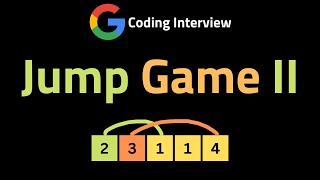









NeetCode 12 mins
Jump Game II - Greedy - Leetcode 45 - Python
Nikhil Lohia 20 mins
Jump Game 2 (LeetCode 45) | Minimum jumps to reach end of array | Explanation with Animations
Algorithms Made Easy 10 mins
Jump Game II | Live Coding with Explanation | Leetcode - 45
Greg Hogg 10 mins
Jump Game II - Leetcode 45 - Recursive Backtracking (Python)
One Code Man 6 mins
Jump Game II - LeetCode 45 - Greedy Algorithm - Coding Interview
AlgorithmHQ 13 mins
45. Jump Game II | Leetcode | Medium | Java | Greedy Algorithm | Striver's A to Z DSA Sheet/Course
LeetCodeWithMonu 12 mins
45. Jump Game II | JavaScript | Greedy | O(n) TC | LeetCode Daily Challenge
Code Scribbler 9 mins
LeetCode 45: Jump Game II | Java Solution | Dynamic Programming & Greedy Approach
Programming Live with Larry 26 mins
45. Jump Game II (Leetcode Hard)
Coding Decoded 13 mins
Jump Game II | Leetcode 45 | Live coding session | LC 45 | Day 5/30 May 2021 | jump game 2
CodeFreaks 11 mins
45 || Jump Game II || C++ || Leetcode Daily Challenge
Professor Oakes 6 mins
Jump Game II Python Solution - LeetCode #45
Programming Live with Larry 25 mins
Daily Leetcode #1044: Feb 08, 2023 - 45. Jump Game II
Happy Coding 16 mins
LeetCode 45. Jump Game II
Jeevan Kumar - Cracckify 4 mins
LeetCode 45. Jump Game II
Sleepy Cracker 6 mins
LeetCode 45 | Jump Game II | BFS | Java
Code With Zi 12 mins
LeetCode: 45. Jump Game II (Visualized)
Srk Codes 13 mins
Leetcode 45: Jump Game II in Telugu | Brute Force, Memo, Greedy | Python DSA | srkcodes
Software Interviews Prep 13 mins
Leetcode | Top Interview 150 | Medium | 45. Jump Game II | Time: O(N) | Javascript
Algorithms Casts 11 mins
Leetcode 45: Jump Game II
20 videos
did my crawler come up with invalid videos ? drop me a line.
Similar Problems
- problem 55: Jump Game
1 similar problem
Solved On The Same Day
19 easy
- problem 1: Two Sum
- problem 9: Palindrome Number
- problem 14: Longest Common Prefix
- problem 20: Valid Parentheses
- problem 26: Remove Duplicates from Sorted Array
- problem 27: Remove Element
- problem 83: Remove Duplicates from Sorted List
- problem 88: Merge Sorted Array
- problem 94: Binary Tree Inorder Traversal
- problem 100: Same Tree
- problem 104: Maximum Depth of Binary Tree
- problem 121: Best Time to Buy and Sell Stock
- problem 136: Single Number
- problem 141: Linked List Cycle
- problem 169: Majority Element
- problem 190: Reverse Bits
- problem 226: Invert Binary Tree
- problem 234: Palindrome Linked List
- problem 1114: Print in Order
- problem 3: Longest Substring Without Repeating Characters
- problem 7: Reverse Integer
- problem 8: String to Integer (atoi)
- problem 11: Container With Most Water
- problem 12: Integer to Roman
- problem 15: 3Sum
- problem 17: Letter Combinations of a Phone Number
- problem 22: Generate Parentheses
- problem 31: Next Permutation
- problem 36: Valid Sudoku
- problem 39: Combination Sum
- problem 40: Combination Sum II
- problem 46: Permutations
- problem 47: Permutations II
- problem 48: Rotate Image
- problem 49: Group Anagrams
- problem 55: Jump Game
- problem 59: Spiral Matrix II
- problem 75: Sort Colors
- problem 77: Combinations
- problem 91: Decode Ways
- problem 95: Unique Binary Search Trees II
- problem 96: Unique Binary Search Trees
- problem 134: Gas Station
- problem 164: Maximum Gap
- problem 189: Rotate Array
- problem 215: Kth Largest Element in an Array
- problem 238: Product of Array Except Self
- problem 287: Find the Duplicate Number
- problem 322: Coin Change
- problem 347: Top K Frequent Elements
- problem 377: Combination Sum IV
- problem 438: Find All Anagrams in a String
- problem 474: Ones and Zeroes
- problem 518: Coin Change II
- problem 526: Beautiful Arrangement
- problem 763: Partition Labels
- problem 983: Minimum Cost For Tickets
- problem 994: Rotting Oranges
- problem 1027: Longest Arithmetic Subsequence
- problem 2140: Solving Questions With Brainpower
- problem 2466: Count Ways To Build Good Strings
- problem 4: Median of Two Sorted Arrays
- problem 41: First Missing Positive
64 solutions
August 8, 2023
Extra
There are a few extra pages giving you some insights into my setup:
- Tech Stack - my development environment and tools
- AI - how AI helped me create this website (NOT solving the problems)
- Progress - progression over time
- Quality - code quality