Python 0581.py
class Solution:
    def findUnsortedSubarray(self, nums: List[int]) -> int:
        # O(nlogn), not O(n)
        n2 = sorted(nums.copy())

        left = right = None
        for i in range(len(nums)):
            if nums[i] != n2[i]:
                left  = i if left == None else left
                right = i

        return 0 if left == None else right - left + 1
12 lines
|
379 bytes
|
submitted September 23, 2023
|
GitHub
11% comment ratio
|
tab size 4
|
low complexity
Difficulty
This problem is ranked as
and has an acceptance rate of about 39% (1+ million submissions).
Typical patterns to solve this problem:
easy
medium
hard
and has an acceptance rate of about 39% (1+ million submissions).
Typical patterns to solve this problem:
- Array
- Greedy
- Monotonic Stack
- Sorting
- Stack
- Two Pointers
I solved 663 easy, 1250 medium and 309 hard problems
AI Disclaimer
Every single line of code was written by me, 100% from scratch, between August 2023 and August 2024.
However, two years later I set up this website and used various AI tools to generate most of the walkthrough / explanations below.
See this dedicated page for more details.
However, two years later I set up this website and used various AI tools to generate most of the walkthrough / explanations below.
See this dedicated page for more details.
Code Walkthrough
Overview
The provided implementation determines the length of the shortest continuous sub-array that, when sorted, makes the entire input array non-decreasing. It follows a straightforward strategy: create a sorted replica of the input, compare the two sequences element-by-element, and locate the first and last positions where they differ. The distance between those positions (inclusive) yields the required length. If no differences are found, the array is already sorted and the function returns zero.
Key Steps
Creating a sorted copy
n2 = sorted(nums.copy())A shallow copy of the original list is produced to preserve the caller’s data. The built-in sorted routine generates a new list ordered in non-decreasing fashion. This step supplies a reference ordering against which the original array is examined.
Initialising the boundary markers
left = right = NoneTwo variables, left and right, are set to None to indicate that no mismatching indices have been discovered yet. Using a single sentinel value for both markers simplifies later checks.
Scanning for mismatches
for i in range(len(nums)):
    if nums[i] != n2[i]:
        left  = i if left == None else left
        right = i
The loop iterates over every index of the input. Whenever the element at the current position differs from the element at the same position in the sorted copy, the algorithm records the index. The first mismatch encountered assigns left; subsequent mismatches only update right. This ensures that left marks the earliest out-of-order element while right marks the latest.
Computing the result
return 0 if left == None else right - left + 1If left remains None, the input was already sorted and the function returns zero. Otherwise, the length of the minimal sub-array is the inclusive distance between right and left.
Edge Cases Handled
When the input list is empty, the loop body never executes, leaving both markers as None. The final conditional therefore returns zero, correctly indicating that no sorting is required.
A single-element list follows the same path: the element trivially matches its sorted counterpart, so the function again yields zero.
Arrays that are already sorted but contain duplicate values also produce no mismatches, because each position matches the sorted copy exactly. The algorithm therefore returns zero for any already ordered sequence, regardless of repeated numbers.
If the entire array is in reverse order, every position will differ from the sorted copy. The first iteration sets left to zero, and each subsequent iteration updates right until it reaches the final index. The computed length then equals the full size of the array, which is the correct answer for a completely unsorted input.
Arrays with a mixture of sorted and unsorted segments, including cases where the unsorted region is at the beginning, middle, or end, are all captured because the scan records the earliest and latest mismatching indices, regardless of their location.
Performance Optimizations Observed
The implementation leverages Python’s built-in sorted function, which employs Timsort. Timsort adapts to existing order in the data, achieving faster sorting on partially sorted inputs without additional code.
By copying the list before sorting, the original data remains untouched, avoiding side effects that could force extra copying later in a larger program.
The conditional assignment for left (i if left == None else left) ensures that the left boundary is set only once, eliminating unnecessary writes during the scan.
The loop processes each element exactly once, and the final arithmetic operation to compute the length is constant-time. These choices keep the runtime overhead minimal given the overall algorithmic approach.
written by openai gpt
ELI5 - Simplified Explanation
Imagine a long row of building blocks that should be in order from the smallest to the tallest. Sometimes, someone might accidentally swap a few blocks around so they get out of line. This code acts like a tiny detective to find which part of the row is messy. First, it makes a secret list that is perfectly organized from smallest to biggest. Then it looks at the messy row and compares it to the perfect one, one block at a time. It keeps a sharp eye out for any spot where a block does not match the perfectly organized version. It marks the first spot where things look wrong and also the very last spot where things look wrong. Once the detective has looked at every block, it identifies the slice between that first messy spot and the last messy spot, which is the section that needs to be fixed to make the whole row perfect again.
written by google gemini
Code Quality
Several LLMs ranked my code quality on a scale from 1 (very poor) to 10 (outstanding):
n = 27
|
median = 6
|
μ = 5.70
|
σ = 1.46
Complexity Analysis
Time: loglinear
As a rule of thumb, the maximum input size for one second execution time is
As a rule of thumb, the maximum input size for one second execution time is
- factorial: up to 10 elements
- exponential: up to 20 elements
- polynomial: a few thousand elements
- loglinear: up to 100,000 elements
- linear: a few million elements
- logarithmic: a billion elements
- constant: practically unlimited
generated automatically
Other Solutions
I wrote a basic crawler to find other solutions to that problem.
Obviously, I did that after I solved the problem myself.
In general, AlgoMonster and WalkCCC solutions are high-quality and always worth a look.
I haven't checked most of the other solutions, but they might be helpful as well.
And of course, the LeetCode forum is always a good place (or even the best) to look for alternative approaches.
(click on a column header to sort the table)
| author | ||||||||||
|---|---|---|---|---|---|---|---|---|---|---|
| author | solutions | |||||||||
| www | AlgoMonster | C++ | Python | Java | TS | |||||
| WalkCCC | C++ | Python | Java | |||||||
| leetcode.ca | C++ | Python | Java | Rust | Go | TS | ||||
| LeetcodeHelp | C++ | Python | Java | |||||||
| Progiez | C++ | Python | Java | |||||||
| github | BigEggStudy | C# | ||||||||
| black-shadows | C++ | |||||||||
| charles-wangkai | Java | |||||||||
| everthis | JS | |||||||||
| fartem | Ruby | |||||||||
| FelixFan1122 | C# | |||||||||
| fpdjsns | C++ | |||||||||
| halfrost | Go | |||||||||
| haoel | Python | |||||||||
| JoshCrozier | JS | |||||||||
| keineahnung2345 | C++ | |||||||||
| linouk23 | C++ | |||||||||
| lkwq007 | Python | |||||||||
| qiyuangong | Java | |||||||||
| ruoru | Rust | |||||||||
| sonugiri1043 | C++ | |||||||||
| suxrobGM | C# | |||||||||
| trung-hn | Python | |||||||||
| varunu28 | Java | |||||||||
| wisdompeak | C++ | |||||||||
| YuriSpiridonov | Python | |||||||||
| zfang399 | C++ | |||||||||
| AlgoMonster | C++, Python, Java, TypeScript | |||||||||
| WalkCCC | C++, Python, Java | |||||||||
| leetcode.ca | C++, Go, Java, Python, Rust, TypeScript | |||||||||
| LeetcodeHelp | C++, Java, Python | |||||||||
| Progiez | C++, Java, Python | |||||||||
| BigEggStudy | C# | |||||||||
| black-shadows | C++, C++ | |||||||||
| charles-wangkai | Java | |||||||||
| everthis | JavaScript | |||||||||
| fartem | Ruby | |||||||||
| FelixFan1122 | C# | |||||||||
| fpdjsns | C++ | |||||||||
| halfrost | Go | |||||||||
| haoel | Python | |||||||||
| JoshCrozier | JavaScript | |||||||||
| keineahnung2345 | C++ | |||||||||
| linouk23 | C++ | |||||||||
| lkwq007 | Python | |||||||||
| qiyuangong | Java | |||||||||
| ruoru | Rust | |||||||||
| sonugiri1043 | C++ | |||||||||
| suxrobGM | C# | |||||||||
| trung-hn | Python | |||||||||
| varunu28 | Java | |||||||||
| wisdompeak | C++ | |||||||||
| YuriSpiridonov | Python | |||||||||
| zfang399 | C++ |
41 links
|
27 authors
|
9 languages
Videos
These are a few popular YouTube videos for this problem:


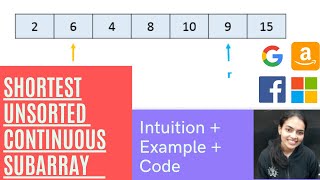


Nick White 9 mins
LeetCode 581. Shortest Unsorted Continuous Subarray (Algorithm Explained)
Pepcoding 9 mins
Shortest Unsorted Continuous Subarray || Leetcode
Code with Alisha 19 mins
Leetcode 581. Shortest Unsorted Continuous Subarray || Intuition + Example + Code
Algorithms Made Easy 11 mins
Shortest Unsorted Continuous Subarray | Live Coding with Explanation | Leetcode - 581
jayati tiwari 15 mins
Leetcode 581. Shortest Unsorted Continuous Subarray [ Solution + Code Explained]
Coding Decoded 15 mins
Shortest Unsorted Continuous Subarray | Leetcode 581 | Monotonic Stack | Live coding session
6 videos
did my crawler come up with invalid videos ? drop me a line.
Solved On The Same Day
1 easy
- problem 680: Valid Palindrome II
- problem 478: Generate Random Point in a Circle
- problem 497: Random Point in Non-overlapping Rectangles
- problem 519: Random Flip Matrix
- problem 659: Split Array into Consecutive Subsequences
- problem 738: Monotone Increasing Digits
- problem 743: Network Delay Time
- problem 769: Max Chunks To Make Sorted
- problem 985: Sum of Even Numbers After Queries
- problem 1048: Longest String Chain
- problem 1094: Car Pooling
- problem 1324: Print Words Vertically
- problem 1680: Concatenation of Consecutive Binary Numbers
- problem 1823: Find the Winner of the Circular Game
- problem 1860: Incremental Memory Leak
- problem 1922: Count Good Numbers
- problem 2487: Remove Nodes From Linked List
- problem 381: Insert Delete GetRandom O(1) - Duplicates allowed
- problem 517: Super Washing Machines
- problem 632: Smallest Range Covering Elements from K Lists
21 solutions
September 23, 2023
Extra
There are a few extra pages giving you some insights into my setup:
- Tech Stack - my development environment and tools
- AI - how AI helped me create this website (NOT solving the problems)
- Progress - progression over time
- Quality - code quality