Python 0006.py
class Solution:
    def convert(self, s: str, numRows: int) -> str:
        if numRows == 1:
            return s

        y = 0
        delta = +1

        rows = defaultdict(str)
        for c in s:
            rows[y] += c
            y += delta

            if y < 0 or y == numRows:
                y -= 2*delta
                delta = -delta

        return "".join(rows.values())
Difficulty
This problem is ranked as
and has an acceptance rate of about 55% (4+ million submissions).
Typical patterns to solve this problem:
easy
medium
hard
and has an acceptance rate of about 55% (4+ million submissions).
Typical patterns to solve this problem:
- String
I solved 663 easy, 1250 medium and 309 hard problems
AI Disclaimer
Every single line of code was written by me, 100% from scratch, between August 2023 and August 2024.
However, two years later I set up this website and used various AI tools to generate most of the walkthrough / explanations below.
See this dedicated page for more details.
However, two years later I set up this website and used various AI tools to generate most of the walkthrough / explanations below.
See this dedicated page for more details.
Code Walkthrough
Overview
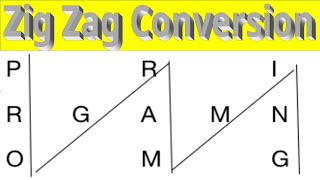
The provided Solution class implements a method that rearranges a given string into a zig-zag pattern with a specified number of rows and then reads the characters row by row to produce a new string. The algorithm processes the input in a single linear pass, dynamically tracking the current row and direction of movement, and accumulates characters for each row in a dictionary.
Core Logic
The method begins by handling the trivial situation where the number of rows equals one. In that case the zig-zag pattern collapses to a straight line, so the original string is returned unchanged.
if numRows == 1:
    return s
Two integer variables, y and delta, are introduced to represent the current row index and the step direction, respectively. y starts at the top row (index 0) and delta is initially set to +1, indicating a downward movement.
y = 0
delta = +1
A defaultdict of strings, named rows, is created to collect characters belonging to each row without needing explicit existence checks.
rows = defaultdict(str)The main loop iterates over each character c in the input string. For each character, the algorithm appends it to the string associated with the current row y. Afterwards, y is updated by adding delta, moving the cursor to the next row in the current direction.
for c in s:
    rows[y] += c
    y += delta
When the cursor steps beyond the top or bottom boundary (y < 0 or y == numRows), the direction must reverse. The code accomplishes this by moving the cursor back two steps in the opposite direction and flipping the sign of delta. This adjustment ensures that the next iteration places the character in the correct row after the turn.
    if y < 0 or y == numRows:
        y -= 2 * delta
        delta = -delta
After all characters have been placed, the rows are concatenated in order of their natural dictionary insertion (which follows the numeric row keys) to form the final transformed string.
return "".join(rows.values())Edge Cases
The implementation explicitly handles the case where numRows is one. In that scenario the zig-zag pattern degenerates to a single line, and the method returns the input string directly, avoiding unnecessary processing.
Another subtle edge condition occurs when the cursor reaches the limits of the row range. The conditional if y < 0 or y == numRows captures both the upper overflow (when moving upward past the first row) and the lower overflow (when moving downward past the last row). By subtracting 2 * delta from y, the algorithm steps back onto the last valid row before reversing direction, guaranteeing that no character is assigned to an invalid row index.
Performance Optimizations
The algorithm achieves high efficiency by performing a single traversal of the input string. Each character is processed exactly once, and the row accumulation uses in-place string concatenation within the defaultdict. This avoids the overhead of repeatedly checking for the existence of a row key, as the defaultdict automatically creates an empty string for any new row index.
Because the rows are stored as separate strings, the final concatenation step simply joins these pre-built substrings, which is faster than repeatedly inserting characters into a single mutable buffer. The use of integer arithmetic for direction changes (delta = -delta) and the compact boundary correction (y -= 2 * delta) eliminates the need for more complex conditional structures, keeping the inner loop tight and cache-friendly.
Overall, the design balances clarity with low-level efficiency, delivering a solution that scales well with the length of the input string and the number of rows.
written by openai gpt
ELI5 - Simplified Explanation
Imagine you have a long, colorful train of letters and you want to stack them up in a special shape to make a zigzag pattern that goes up and down a hill.
First, look at the number of rows. If the number is one, the train just stays in a single line, so there is nothing to move and the letters stay exactly as they were.
If there are more rows, imagine holding a magic crayon that draws a zigzag path. Start at the very top row and place a letter. Move down to the next row and place the next letter. Keep moving down row by row until the bottom is reached. Once the bottom is hit, it is time to bounce back up, just like a ball hitting the floor and hopping back toward the sky.
As the letters are placed, they are tucked into different piles based on which row they belong to. The crayon keeps track of whether it is heading down toward the bottom or climbing back up toward the top. If the path hits the bottom row or the very top, the direction changes, and the crayon starts moving the other way.
After every single letter from the original train has been placed into its new row, all the piles are lined up neatly side by side. The final result is a new string of letters that looks different from the start because they have been reordered by the zigzag path.
written by google gemini
Code Quality
Several LLMs ranked my code quality on a scale from 1 (very poor) to 10 (outstanding):
n = 29
|
median = 8
|
μ = 7.34
|
σ = 1.24
Complexity Analysis
not analyzed yet
Other Solutions
I wrote a basic crawler to find other solutions to that problem.
Obviously, I did that after I solved the problem myself.
In general, AlgoMonster and WalkCCC solutions are high-quality and always worth a look.
I haven't checked most of the other solutions, but they might be helpful as well.
And of course, the LeetCode forum is always a good place (or even the best) to look for alternative approaches.
(click on a column header to sort the table)
| author | |||||||||||||
|---|---|---|---|---|---|---|---|---|---|---|---|---|---|
| author | solutions | ||||||||||||
| www | AlgoMonster | C++ | Java | Python | TS | ||||||||
| WalkCCC | C++ | Java | Python | ||||||||||
| leetcode.ca | C++ | Java | Python | C | Rust | JS | C# | Go | PHP | TS | |||
| LeetcodeHelp | C++ | Java | Python | ||||||||||
| MemoryLimitExceeded | C++ | Python | |||||||||||
| Progiez | C++ | Java | Python | ||||||||||
| github | aylei | Rust | |||||||||||
| begeekmyfriend | C | ||||||||||||
| BigEggStudy | C# | ||||||||||||
| black-shadows | C++ | ||||||||||||
| charles-wangkai | Java | ||||||||||||
| chenyanzhe | C++ | ||||||||||||
| everthis | JS | ||||||||||||
| fengvyi | C++ | ||||||||||||
| fsq | C++ | ||||||||||||
| gaosq0604 | Python | ||||||||||||
| Garvit244 | Python | ||||||||||||
| gouthampradhan | Java | ||||||||||||
| halfrost | Go | ||||||||||||
| haoel | C++ | ||||||||||||
| JoshCrozier | JS | ||||||||||||
| keineahnung2345 | C++ | ||||||||||||
| Krazune | C++ | ||||||||||||
| lennylxx | C | ||||||||||||
| linouk23 | C++ | ||||||||||||
| lkwq007 | Python | ||||||||||||
| luangong | C++ | ||||||||||||
| martianoff | Scala | ||||||||||||
| qiyuangong | Java | ||||||||||||
| ruoru | Rust | ||||||||||||
| Shamik07 | Dart | ||||||||||||
| suxrobGM | C# | ||||||||||||
| varunu28 | Java | ||||||||||||
| vli02 | C | ||||||||||||
| vthwang | Java | ||||||||||||
| wisdompeak | C++ | ||||||||||||
| XiaotaoGuo | C++ | ||||||||||||
| zfang399 | C++ | ||||||||||||
| AlgoMonster | C++, Python, Java, TypeScript | ||||||||||||
| WalkCCC | C++, Python, Java | ||||||||||||
| leetcode.ca | C, C++, C#, Go, Java, JavaScript, PHP, Python, Rust, TypeScript | ||||||||||||
| LeetcodeHelp | C++, Java, Python | ||||||||||||
| MemoryLimitExceeded | Python, C++ | ||||||||||||
| Progiez | C++, Java, Python | ||||||||||||
| aylei | Rust | ||||||||||||
| begeekmyfriend | C | ||||||||||||
| BigEggStudy | C# | ||||||||||||
| black-shadows | C++, C++ | ||||||||||||
| charles-wangkai | Java | ||||||||||||
| chenyanzhe | C++ | ||||||||||||
| everthis | JavaScript | ||||||||||||
| fengvyi | C++ | ||||||||||||
| fsq | C++ | ||||||||||||
| gaosq0604 | Python | ||||||||||||
| Garvit244 | Python | ||||||||||||
| gouthampradhan | Java | ||||||||||||
| halfrost | Go | ||||||||||||
| haoel | C++ | ||||||||||||
| JoshCrozier | JavaScript | ||||||||||||
| keineahnung2345 | C++ | ||||||||||||
| Krazune | C++ | ||||||||||||
| lennylxx | C | ||||||||||||
| linouk23 | C++ | ||||||||||||
| lkwq007 | Python | ||||||||||||
| luangong | C++ | ||||||||||||
| martianoff | Scala | ||||||||||||
| qiyuangong | Java | ||||||||||||
| ruoru | Rust | ||||||||||||
| Shamik07 | Dart | ||||||||||||
| suxrobGM | C# | ||||||||||||
| varunu28 | Java | ||||||||||||
| vli02 | C | ||||||||||||
| vthwang | Java | ||||||||||||
| wisdompeak | C++ | ||||||||||||
| XiaotaoGuo | C++ | ||||||||||||
| zfang399 | C++ |
57 links
|
38 authors
|
12 languages
Videos
These are a few popular YouTube videos for this problem:















NeetCode 13 mins
ZigZag Conversion - Leetcode 6 - Python
AlgorithmHQ 9 mins
6. Zigzag Conversion | Leetcode | Medium | Java | String | Google
CodingNinja 14 mins
Zigzag Conversion - LeetCode #6 - Python, JavaScript, Java, C++
Eric Programming 7 mins
[Java] Leetcode 6. ZigZag Conversion [Array #7]
DataDaft 14 mins
Python Programming Practice: LeetCode #6 -- ZigZag Conversion
Pepcoding 18 mins
DSA Phir se with Sumeet | Leetcode 6 | Zigzag Conversion
One Code Man 5 mins
ZigZag Conversion - LeetCode 6 - LeetCode Daily Challenge
Priyanshi Porwal 13 mins
6. Zigzag Conversion | LeetCode Feb challenge | C++
AlgoJS 8 mins
Zigzag Conversion - LeetCode 6 - JavaScript
Jeevan Kumar - Cracckify 4 mins
LeetCode 6 Zigzag Conversion
Professor Oakes 5 mins
Zigzag Conversion Python Solution - LeetCode #6
LeetCodeWithMonu 15 mins
6. Zigzag Conversion | JavaScript | O(n) TC | LeetCode Daily Challenge
happygirlzt 8 mins
LeetCode 6. ZigZag Conversion Explanation and Solution
Programming Live with Larry 7 mins
Daily Leetcode #1039: Feb 03, 2023 - 6. Zigzag Conversion
Lit Code 9 mins
6. Zigzag Conversion - Litcode
Ghumman Tech 6 mins
Leetcode Question 6 "Zigzag Conversion" in Javascript
code Explainer 8 mins
6. Zigzag Conversion | LEETCODE MEDIUM
Code Scribbler 11 mins
LeetCode 6: Zigzag Conversion | Java Solution | String Manipulation
happygirlzt 11 mins
LeetCode 6. ZigZag Conversion Chinese Version 中文解释
Code Scribbler 11 mins
LeetCode 6: Zigzag Conversion | Python Solution | String Manipulation
20 videos
did my crawler come up with invalid videos ? drop me a line.
Solved On The Same Day
2 easy
- problem 476: Number Complement
- problem 496: Next Greater Element I
- problem 38: Count and Say
- problem 147: Insertion Sort List
- problem 148: Sort List
- problem 494: Target Sum
- problem 498: Diagonal Traverse
8 solutions
August 16, 2023
Extra
There are a few extra pages giving you some insights into my setup:
- Tech Stack - my development environment and tools
- AI - how AI helped me create this website (NOT solving the problems)
- Progress - progression over time
- Quality - code quality