Python 0717.py
lass Solution:
    def isOneBitCharacter(self, bits: List[int]) -> bool:
        bits.pop()

        size = 0
        while size < len(bits):
            size += 1 + bits[size]

        return size == len(bits)
Difficulty
This problem is ranked as
and has an acceptance rate of about 50% (500k+ submissions).
Typical patterns to solve this problem:
easy
medium
hard
and has an acceptance rate of about 50% (500k+ submissions).
Typical patterns to solve this problem:
- Array
I solved 663 easy, 1250 medium and 309 hard problems
AI Disclaimer
Every single line of code was written by me, 100% from scratch, between August 2023 and August 2024.
However, two years later I set up this website and used various AI tools to generate most of the walkthrough / explanations below.
See this dedicated page for more details.
Code Walkthrough
Overview
The implementation defines a class with a method that determines whether the final character in a binary array is a one-bit character. The algorithm works by discarding the known terminating zero, then scanning the remaining bits while interpreting each 0 as a single-bit symbol and each 1 as the start of a two-bit symbol. The method finally checks whether the scan ends exactly at the end of the shortened array, which indicates that the removed zero was indeed a one-bit character.
Key Steps
Removing the trailing zero
bits.pop()The last element of the input list is removed before processing. In the problem context the final bit is guaranteed to be 0, representing the character whose type we need to verify. By popping it, the algorithm can focus on parsing the preceding bits without special-casing the final element during the scan.
Scanning the bit sequence
size = 0
while size < len(bits):
    size += 1 + bits[size]
A pointer size starts at the beginning of the list. The loop continues while the pointer is within the bounds of the shortened array. For each iteration the pointer advances by 1 + bits[size]. When bits[size] is 0, the increment is 1, reflecting a one-bit character. When bits[size] is 1, the increment becomes 2, reflecting the two-bit character that starts with 1. This arithmetic eliminates the need for conditional branches or auxiliary state variables, keeping the scan tight and efficient.
Determining the result
return size == len(bits)After the loop terminates, the method compares the final pointer position with the length of the processed list. If they are equal, the scan consumed the entire array exactly, meaning the removed trailing zero was not part of a two-bit character and therefore is a one-bit character. If the pointer overshoots, the removed zero would have been the second half of a two-bit character, and the method would return False.
Edge Cases Handled
When the input consists of a single 0, the pop operation empties the list. The while loop condition size < len(bits) fails immediately because len(bits) is 0, leaving size at 0. The final comparison size == len(bits) evaluates to True, correctly identifying the lone 0 as a one-bit character.
If the array contains a pattern like [1, 0, 0], after popping the last 0 the list becomes [1, 0]. The loop starts with size = 0, reads bits[0] as 1, and increments size by 2, moving directly to the end of the list. The final equality holds, indicating that the original trailing 0 was a one-bit character.
When the sequence ends with a two-bit character such as [1, 1, 0], popping the final 0 yields [1, 1]. The loop processes bits[0] (1) and jumps size to 2, which equals the length of the list, so the method still returns True. However, in the original problem constraints the final bit is always 0, and the algorithm’s logic correctly distinguishes whether that 0 belongs to a preceding two-bit symbol or stands alone.
Performance Optimizations
The code operates directly on the input list without allocating additional containers, which minimizes memory overhead. The use of pop() modifies the list in place, avoiding the need for a separate slice or copy of the data. The loop’s increment expression 1 + bits[size] combines the decision of one- versus two-bit advancement into a single arithmetic operation, eliminating branching and reducing instruction count. The overall traversal touches each element at most once, providing a linear-time execution path with a minimal constant factor.
written by openai gpt
ELI5 - Simplified Explanation
Imagine a long train track made of blocks. Some blocks are small and take up only one space, but others are double-sized and need two spaces to fit. The computer looks at all these blocks lined up in a row.
First, the computer takes away the very last block to see what it is. Then, it starts walking from the beginning of the line to check the rest. Every time it finds a small block, it jumps forward one space. If it finds a double-sized block, it jumps forward two spaces to skip over it. The computer keeps jumping along until it reaches the end of the line. If it lands exactly at the spot where the last block used to be, it knows that the last block was just a tiny one-space piece.
written by google gemini
Code Quality
Several LLMs ranked my code quality on a scale from 1 (very poor) to 10 (outstanding):
n = 26
|
median = 4.5
|
μ = 4.81
|
σ = 2.25
Complexity Analysis
Time: linear
As a rule of thumb, the maximum input size for one second execution time is
As a rule of thumb, the maximum input size for one second execution time is
- factorial: up to 10 elements
- exponential: up to 20 elements
- polynomial: a few thousand elements
- loglinear: up to 100,000 elements
- linear: a few million elements
- logarithmic: a billion elements
- constant: practically unlimited
generated automatically
Other Solutions
I wrote a basic crawler to find other solutions to that problem.
Obviously, I did that after I solved the problem myself.
In general, AlgoMonster and WalkCCC solutions are high-quality and always worth a look.
I haven't checked most of the other solutions, but they might be helpful as well.
And of course, the LeetCode forum is always a good place (or even the best) to look for alternative approaches.
(click on a column header to sort the table)
| author | ||||||||||
|---|---|---|---|---|---|---|---|---|---|---|
| author | solutions | |||||||||
| www | AlgoMonster | C++ | Python | Java | TS | |||||
| WalkCCC | C++ | Python | Java | |||||||
| leetcode.ca | C++ | Python | JS | Java | Go | Rust | TS | |||
| LeetcodeHelp | C++ | Python | Java | |||||||
| Progiez | C++ | Python | Java | |||||||
| github | BigEggStudy | C# | ||||||||
| everthis | JS | |||||||||
| fartem | Ruby | |||||||||
| fengvyi | C++ | |||||||||
| halfrost | Go | |||||||||
| JoshCrozier | JS | |||||||||
| keineahnung2345 | C++ | |||||||||
| Krazune | C# | |||||||||
| lkwq007 | Python | |||||||||
| qiyuangong | Java | |||||||||
| shreymehul | C# | |||||||||
| suxrobGM | C# | |||||||||
| trung-hn | Python | |||||||||
| withaarzoo | C++ | |||||||||
| zfang399 | C++ | |||||||||
| AlgoMonster | C++, Python, Java, TypeScript | |||||||||
| WalkCCC | C++, Python, Java | |||||||||
| leetcode.ca | C++, Go, Java, JavaScript, Python, Rust, TypeScript | |||||||||
| LeetcodeHelp | C++, Java, Python | |||||||||
| Progiez | C++, Java, Python | |||||||||
| BigEggStudy | C# | |||||||||
| everthis | JavaScript | |||||||||
| fartem | Ruby | |||||||||
| fengvyi | C++ | |||||||||
| halfrost | Go | |||||||||
| JoshCrozier | JavaScript | |||||||||
| keineahnung2345 | C++ | |||||||||
| Krazune | C# | |||||||||
| lkwq007 | Python | |||||||||
| qiyuangong | Java | |||||||||
| shreymehul | C# | |||||||||
| suxrobGM | C# | |||||||||
| trung-hn | Python | |||||||||
| withaarzoo | C++ | |||||||||
| zfang399 | C++ |
35 links
|
20 authors
|
9 languages
Videos
These are a few popular YouTube videos for this problem:

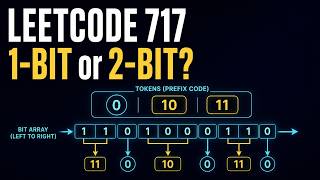


codestorywithMIK 17 mins
1-bit and 2-bit Characters | 2 Ways | Easy | Leetcode 717 | codestorywithMIK
NeetCodeIO 7 mins
1-bit and 2-bit Characters - Leetcode 717 - Python
Math Geeks 4 mins
Leetcode solving: 717. 1-bit and 2-bit Characters
Abdullah Arshed 3 mins
717. 1-bit and 2-bit Characters | Leetcode | Python
Sanyam IIT Guwahati 9 mins
1-bit and 2-bit Characters | LeetCode 717 | Complete Intuition Explained
Programming Live with Larry 5 mins
Daily Leetcode #2058: Nov 18, 2025 - 717. 1-bit and 2-bit Characters
Developer Coder 8 mins
1-bit and 2-bit Characters | LeetCode 717 | Java Code | Developer Coder
7 videos
did my crawler come up with invalid videos ? drop me a line.
Similar Problems
- problem 89: Gray Code
1 similar problem
Solved On The Same Day
4 easy
- problem 112: Path Sum
- problem 409: Longest Palindrome
- problem 645: Set Mismatch
- problem 2535: Difference Between Element Sum and Digit Sum of an Array
- problem 16: 3Sum Closest
- problem 24: Swap Nodes in Pairs
- problem 113: Path Sum II
- problem 114: Flatten Binary Tree to Linked List
- problem 116: Populating Next Right Pointers in Each Node
- problem 129: Sum Root to Leaf Numbers
- problem 131: Palindrome Partitioning
- problem 137: Single Number II
- problem 162: Find Peak Element
- problem 165: Compare Version Numbers
- problem 172: Factorial Trailing Zeroes
- problem 201: Bitwise AND of Numbers Range
- problem 204: Count Primes
- problem 402: Remove K Digits
- problem 430: Flatten a Multilevel Doubly Linked List
- problem 451: Sort Characters By Frequency
- problem 539: Minimum Time Difference
- problem 583: Delete Operation for Two Strings
- problem 633: Sum of Square Numbers
- problem 648: Replace Words
- problem 650: 2 Keys Keyboard
- problem 670: Maximum Swap
- problem 786: K-th Smallest Prime Fraction
- problem 2507: Smallest Value After Replacing With Sum of Prime Factors
- problem 2523: Closest Prime Numbers in Range
30 solutions
August 15, 2023
Extra
There are a few extra pages giving you some insights into my setup:
- Tech Stack - my development environment and tools
- AI - how AI helped me create this website (NOT solving the problems)
- Progress - progression over time
- Quality - code quality