Python 0721.py
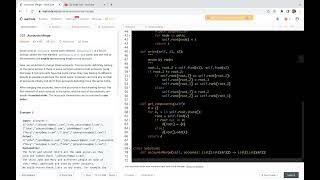
class Solution:
    def accountsMerge(self, accounts: List[List[str]]) -> List[List[str]]:
        # union-find
        def find(x):
            if parent[x] != x:
                parent[x] = find(parent[x]) # path compression
            return parent[x]

        def union(x, y):
            x = find(x)
            y = find(y)
            if x == y:
                return
            if x < y:
                parent[y] = x
            else:
                parent[x] = y

        mails  = {} # all address
        users  = [] # all names (duplicates allowed)
        parent = [] # ID of each user, union-find to merge accounts
        for i, a in enumerate(accounts):
            parent.append(i)
            users .append(a.pop(0))
            for address in a:
                if address in mails:
                    union(parent[i], mails[address]) # existing
                else:
                    mails[address] = find(parent[i]) # new address

        result = defaultdict(set) # ID => merged addresses
        for i, a in enumerate(accounts):
            for address in a:
                result[find(i)].add(address)

        for r in result: # convert to desired format
            yield [ users[r] ] + sorted(result[r])
37 lines
|
1276 bytes
|
submitted October 5, 2023
|
GitHub
28% comment ratio
|
tab size 4
|
low complexity
Difficulty
This problem is ranked as
and has an acceptance rate of about 62% (1+ million submissions).
Typical patterns to solve this problem:
easy
medium
hard
and has an acceptance rate of about 62% (1+ million submissions).
Typical patterns to solve this problem:
- Array
- Breadth First Search
- Depth First Search
- Hash Table
- Sorting
- String
- Union Find
I solved 663 easy, 1250 medium and 309 hard problems
AI Disclaimer
Every single line of code was written by me, 100% from scratch, between August 2023 and August 2024.
However, two years later I set up this website and used various AI tools to generate most of the walkthrough / explanations below.
See this dedicated page for more details.
However, two years later I set up this website and used various AI tools to generate most of the walkthrough / explanations below.
See this dedicated page for more details.
Code Walkthrough
Overview
The provided implementation solves the “accounts merge” problem by employing a union-find (disjoint set) data structure. Each account is initially treated as a separate component; email addresses that appear in multiple accounts trigger a union operation, collapsing the corresponding components. After all unions are performed, the algorithm gathers the emails belonging to each component, sorts them, and yields the merged account records.
Union-Find Initialization
parent = []                     # ID of each user, union-find to merge accounts
for i, a in enumerate(accounts):
    parent.append(i)            # each account starts as its own root
A list parent holds the representative (root) for each account index. The find function implements path compression, ensuring that subsequent look-ups reach the root directly.
def find(x):
    if parent[x] != x:
        parent[x] = find(parent[x])   # path compression
    return parent[x]
Merging Accounts
Two auxiliary structures are built while iterating over the input:
usersstores the name associated with each original account (the first element of each sub-list).mailsmaps an email address to the root identifier of the account that first introduced it.
users = []                      # all names (duplicates allowed)
mails = {}                      # all address
for i, a in enumerate(accounts):
    users.append(a.pop(0))      # extract name, keep remaining emails
    for address in a:
        if address in mails:
            union(parent[i], mails[address])   # existing address, merge sets
        else:
            mails[address] = find(parent[i])   # first occurrence, record root
The union routine attaches the higher-indexed root to the lower-indexed one, preserving a deterministic ordering of roots.
def union(x, y):
    x = find(x)
    y = find(y)
    if x == y:
        return
    if x < y:
        parent[y] = x
    else:
        parent[x] = y
Collecting Results
After all unions, a defaultdict(set) aggregates the email addresses belonging to each component. The second pass over accounts uses the final root of each account index to place emails into the appropriate bucket.
result = defaultdict(set)      # ID => merged addresses
for i, a in enumerate(accounts):
    for address in a:
        result[find(i)].add(address)
Finally, the algorithm yields each merged account. The name is taken from the users list using the component’s root index, and the email list is sorted to meet the required output format.
for r in result:               # convert to desired format
    yield [users[r]] + sorted(result[r])
Edge Cases Handled
The code gracefully handles accounts that contain a single email address, because the inner loop still processes that lone address and registers it in mails. When an email appears in multiple accounts, the union operation merges the corresponding components regardless of the order in which the accounts are read, thanks to the find calls that always retrieve the current root. Duplicate email entries within the same account are implicitly collapsed by the set used in result, preventing redundant entries in the final output. Accounts that share the same user name but have disjoint email sets remain separate components, as the union logic is driven solely by email overlap, not by name similarity.
Performance Optimizations
Path compression inside find dramatically reduces the depth of the union-find tree, making subsequent find operations near-constant time. The deterministic choice of the smaller index as the new root in union helps keep the tree shallow without requiring an explicit rank or size array. Storing the first occurrence of each email in the mails dictionary avoids repeated scans of previously seen addresses, turning the detection of overlapping emails into an O(1) hash-lookup per address. Using a defaultdict(set) for aggregation eliminates the need for explicit existence checks when inserting emails, and the final sorting step operates only on the distinct email set of each merged account, not on the entire input. These choices together ensure that the algorithm scales efficiently with the number of accounts and the total number of email addresses.
written by openai gpt
ELI5 - Simplified Explanation
Imagine having lots of treasure chests filled with mail addresses that belong to different people. Some people have their mail scattered across several different chests, and the goal is to make sure all the addresses that belong to the same person end up in one single, organized chest.
The computer starts by giving every chest a special number tag so it can keep track of them. When it looks at the mail inside, it acts like a detective. If it finds the same address in two different places, it realizes those two chests must belong to the same person. It then uses a trick called union to link those chest numbers together so they act like one big group.
The finding part of the code works like following a string back to the very first anchor point. This ensures that every piece of mail knows exactly which group it belongs to, even if it was linked through many different chests.
Once the sorting is done, the computer gathers all the addresses linked to the same master group together. It puts them in a nice list, puts the person's name at the very front, and makes sure all the addresses are tucked away in alphabetical order. Now all the mail is perfectly organized, with no duplicates and everything exactly where it should be.
written by google gemini
Code Quality
Several LLMs ranked my code quality on a scale from 1 (very poor) to 10 (outstanding):
n = 26
|
median = 7
|
μ = 6.88
|
σ = 1.42
Complexity Analysis
not analyzed yet
Other Solutions
I wrote a basic crawler to find other solutions to that problem.
Obviously, I did that after I solved the problem myself.
In general, AlgoMonster and WalkCCC solutions are high-quality and always worth a look.
I haven't checked most of the other solutions, but they might be helpful as well.
And of course, the LeetCode forum is always a good place (or even the best) to look for alternative approaches.
(click on a column header to sort the table)
| author | ||||||||||
|---|---|---|---|---|---|---|---|---|---|---|
| author | solutions | |||||||||
| www | AlgoMonster | C++ | Java | Python | TS | |||||
| WalkCCC | C++ | Java | ||||||||
| leetcode.ca | C++ | Java | Python | Go | TS | |||||
| LeetcodeHelp | C++ | Java | Python | |||||||
| Progiez | C++ | Java | Python | |||||||
| github | BigEggStudy | C# | ||||||||
| black-shadows | C++ | |||||||||
| charles-wangkai | Java | |||||||||
| everthis | JS | |||||||||
| FelixFan1122 | Java | |||||||||
| fpdjsns | C++ | |||||||||
| gouthampradhan | Java | |||||||||
| halfrost | Go | |||||||||
| haoel | C++ | |||||||||
| JoshCrozier | JS | |||||||||
| lkwq007 | Python | |||||||||
| ruoru | Rust | |||||||||
| sonugiri1043 | C++ | |||||||||
| suxrobGM | C# | |||||||||
| trung-hn | Python | |||||||||
| varunu28 | Java | |||||||||
| wisdompeak | C++ | |||||||||
| yuanliu666 | Kotlin | |||||||||
| zfang399 | C++ | |||||||||
| AlgoMonster | C++, Python, Java, TypeScript | |||||||||
| WalkCCC | C++, Java | |||||||||
| leetcode.ca | C++, Go, Java, Python, TypeScript | |||||||||
| LeetcodeHelp | C++, Java, Python | |||||||||
| Progiez | C++, Java, Python | |||||||||
| BigEggStudy | C# | |||||||||
| black-shadows | C++, C++ | |||||||||
| charles-wangkai | Java | |||||||||
| everthis | JavaScript | |||||||||
| FelixFan1122 | Java | |||||||||
| fpdjsns | C++ | |||||||||
| gouthampradhan | Java | |||||||||
| halfrost | Go | |||||||||
| haoel | C++ | |||||||||
| JoshCrozier | JavaScript | |||||||||
| lkwq007 | Python | |||||||||
| ruoru | Rust | |||||||||
| sonugiri1043 | C++ | |||||||||
| suxrobGM | C# | |||||||||
| trung-hn | Python | |||||||||
| varunu28 | Java | |||||||||
| wisdompeak | C++ | |||||||||
| yuanliu666 | Kotlin | |||||||||
| zfang399 | C++ |
36 links
|
24 authors
|
9 languages
Videos
These are a few popular YouTube videos for this problem:




NeetCodeIO 18 mins
Accounts Merge - Leetcode 721 - Python
Cracking FAANG 24 mins
ACCOUNTS MERGE | LEETCODE # 721 | PYTHON SOLUTION
Happy Coding 19 mins
LeetCode 721. Accounts Merge
WorkWithGoogler 34 mins
Google Coding Interview Question | Leetcode 721 | Accounts Merge
Code-Yao 20 mins
Leetcode 721. Accounts Merge - Disjoint Set / Union-Find
5 videos
did my crawler come up with invalid videos ? drop me a line.
Similar Problems
- problem 684: Redundant Connection
- problem 734: Sentence Similarity
- problem 737: Sentence Similarity II
3 similar problems
Solved On The Same Day
8 medium
- problem 417: Pacific Atlantic Water Flow
- problem 442: Find All Duplicates in an Array
- problem 457: Circular Array Loop
- problem 554: Brick Wall
- problem 565: Array Nesting
- problem 647: Palindromic Substrings
- problem 785: Is Graph Bipartite?
- problem 1061: Lexicographically Smallest Equivalent String
- problem 273: Integer to English Words
10 solutions
October 5, 2023
Extra
There are a few extra pages giving you some insights into my setup:
- Tech Stack - my development environment and tools
- AI - how AI helped me create this website (NOT solving the problems)
- Progress - progression over time
- Quality - code quality