Python 0777.py
class Solution:
    def canTransform(self, start: str, end: str) -> bool:
        # L and R must retain their order
        # verify it by removing any Xs
        if start.replace("X", "") != end.replace("X", ""):
            return False

        r1 = [ i for i, c in enumerate(start) if c == "R" ]
        r2 = [ i for i, c in enumerate(end)   if c == "R" ]
        l1 = [ i for i, c in enumerate(start) if c == "L" ]
        l2 = [ i for i, c in enumerate(end)   if c == "L" ]

        if len(r1) != len(r2):
            return False
        # now len(l1) == len(l2), too

        # "R" can't move left
        for a, b in zip(r1, r2):
            if a > b:
                return False

        # "L" can't move right
        for a, b in zip(l1, l2):
            if a < b:
                return False

        return True
27 lines
|
854 bytes
|
submitted May 8, 2024
|
GitHub
29% comment ratio
|
tab size 4
|
moderate complexity
Difficulty
This problem is ranked as
and has an acceptance rate of about 38% (200k+ submissions).
Typical patterns to solve this problem:
easy
medium
hard
and has an acceptance rate of about 38% (200k+ submissions).
Typical patterns to solve this problem:
- String
- Two Pointers
I solved 663 easy, 1250 medium and 309 hard problems
AI Disclaimer
Every single line of code was written by me, 100% from scratch, between August 2023 and August 2024.
However, two years later I set up this website and used various AI tools to generate most of the walkthrough / explanations below.
See this dedicated page for more details.
However, two years later I set up this website and used various AI tools to generate most of the walkthrough / explanations below.
See this dedicated page for more details.
Code Walkthrough
Overview
The provided implementation determines whether one string can be transformed into another under a set of movement rules for the characters L, R, and X. The transformation permits L to move only leftward, R to move only rightward, and X to act as an empty placeholder. The algorithm proceeds through a series of logical checks that enforce ordering constraints, verify matching counts, and ensure that each movable character respects its directional limits.
Order Preservation Check
The first logical gate removes all placeholder characters (X) from both strings and compares the resulting sequences. Because L and R cannot cross each other, their relative order must be identical in the source and target strings. The code snippet that performs this validation is:
if start.replace("X", "") != end.replace("X", ""):
    return False
If the stripped strings differ, the transformation is impossible, and the function exits early.
Index Collection
To enforce directional constraints, the algorithm records the positions of each R and L in both the start and end strings. This is achieved with list comprehensions that iterate over the enumerated characters:
r1 = [i for i, c in enumerate(start) if c == "R"]
r2 = [i for i, c in enumerate(end)   if c == "R"]
l1 = [i for i, c in enumerate(start) if c == "L"]
l2 = [i for i, c in enumerate(end)   if c == "L"]
These lists capture the exact indices where each movable character appears, enabling direct comparison of their allowed movement ranges.
Length Consistency
Before examining individual positions, the code confirms that the counts of R (and implicitly L) match between the two strings. A mismatch in the number of movable characters makes any transformation impossible:
if len(r1) != len(r2):
    return False
# now len(l1) == len(l2), too
The comment clarifies that the equality of L counts follows automatically from the earlier order preservation check.
Direction Constraints for R
The rule that R may only move rightward translates to a requirement that each R in the start string must not be positioned to the right of its counterpart in the end string. The algorithm iterates over paired indices and returns False if any R violates this constraint:
for a, b in zip(r1, r2):
    if a > b:
        return False
If all R positions satisfy a <= b, the rightward movement condition holds.
Direction Constraints for L
Similarly, L may only move leftward, which means each L in start must not be positioned to the left of its counterpart in end. The corresponding loop checks this condition:
for a, b in zip(l1, l2):
    if a < b:
        return False
A violation (a < b) indicates an illegal rightward shift for L, causing the function to reject the transformation.
Edge Cases Handled
The implementation gracefully handles several edge scenarios:
- Identical strings: The initial order check passes, the index lists are equal, and both directional loops find no violations, resulting in
True. - Strings composed solely of X: After stripping X, both become empty, satisfying the order check; the index lists are empty, and the loops are bypassed, yielding
True. - Strings where one contains extra L or R characters: The length consistency check detects the discrepancy and returns
False. - Situations where an R appears to the right of its target position or an L appears to the left of its target: The directional loops catch these cases and reject the transformation.
Performance Optimizations
The algorithm leverages early exits to avoid unnecessary work. The order preservation check and length consistency check are performed before any index traversal, allowing the function to terminate quickly for clearly invalid inputs. The use of list comprehensions to collect indices runs in linear time and produces compact data structures that are then iterated in lockstep using zip, which stops as soon as the shorter list ends. This approach minimizes the number of comparisons and avoids redundant scanning of the strings after the initial passes. The overall flow ensures that each character of the input strings is examined a constant number of times, leading to an efficient solution for the problem size.
written by openai gpt
ELI5 - Simplified Explanation
Imagine there is a toy box with three types of pieces: R, L, and X. X pieces are just empty spaces where other pieces can slide into. R pieces are little red cars that only like to move to the right side of the box. L pieces are little blue cars that only like to move to the left side of the box. Because R cars only go right and L cars only go left, they can never jump over each other.
The code first checks the box to make sure there is the same number of red cars and blue cars at the start and the end. Then it looks at all the red cars to make sure every one of them ends up in a spot that is the same or to the right of where it started. Finally, it looks at all the blue cars to make sure every one of them ends up in a spot that is the same or to the left of where it started. If all the red cars and blue cars follow their rules and end up in the right spots without jumping over each other, then the puzzle is solved.
written by google gemini
Code Quality
Several LLMs ranked my code quality on a scale from 1 (very poor) to 10 (outstanding):
n = 26
|
median = 8
|
μ = 7.88
|
σ = 1.09
Complexity Analysis
Time: linear
As a rule of thumb, the maximum input size for one second execution time is
As a rule of thumb, the maximum input size for one second execution time is
- factorial: up to 10 elements
- exponential: up to 20 elements
- polynomial: a few thousand elements
- loglinear: up to 100,000 elements
- linear: a few million elements
- logarithmic: a billion elements
- constant: practically unlimited
generated automatically
Other Solutions
I wrote a basic crawler to find other solutions to that problem.
Obviously, I did that after I solved the problem myself.
In general, AlgoMonster and WalkCCC solutions are high-quality and always worth a look.
I haven't checked most of the other solutions, but they might be helpful as well.
And of course, the LeetCode forum is always a good place (or even the best) to look for alternative approaches.
(click on a column header to sort the table)
| author | |||||||||||
|---|---|---|---|---|---|---|---|---|---|---|---|
| author | solutions | ||||||||||
| www | AlgoMonster | C++ | Python | Java | TS | ||||||
| WalkCCC | C++ | Python | Java | ||||||||
| leetcode.ca | C++ | Python | Java | Go | |||||||
| LeetcodeHelp | C++ | Python | Java | ||||||||
| Progiez | C++ | Python | Java | ||||||||
| github | BigEggStudy | C# | |||||||||
| black-shadows | C++ | ||||||||||
| charles-wangkai | Java | ||||||||||
| everthis | JS | ||||||||||
| fengvyi | C++ | ||||||||||
| JoshCrozier | JS | ||||||||||
| lkwq007 | Python | ||||||||||
| lzl124631x | C++ | ||||||||||
| martianoff | Scala | ||||||||||
| ruoru | Rust | ||||||||||
| suxrobGM | C# | ||||||||||
| vli02 | C | ||||||||||
| zfang399 | C++ | ||||||||||
| AlgoMonster | C++, Python, Java, TypeScript | ||||||||||
| WalkCCC | C++, Python, Java | ||||||||||
| leetcode.ca | C++, Go, Java, Python | ||||||||||
| LeetcodeHelp | C++, Java, Python | ||||||||||
| Progiez | C++, Java, Python | ||||||||||
| BigEggStudy | C# | ||||||||||
| black-shadows | C++, C++ | ||||||||||
| charles-wangkai | Java | ||||||||||
| everthis | JavaScript | ||||||||||
| fengvyi | C++ | ||||||||||
| JoshCrozier | JavaScript | ||||||||||
| lkwq007 | Python | ||||||||||
| lzl124631x | C++ | ||||||||||
| martianoff | Scala | ||||||||||
| ruoru | Rust | ||||||||||
| suxrobGM | C# | ||||||||||
| vli02 | C | ||||||||||
| zfang399 | C++ |
30 links
|
18 authors
|
10 languages
Videos
These are a few popular YouTube videos for this problem:
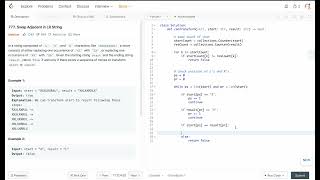
Simple Code - 단순코드 13 mins
777. Swap Adjacent in LR String | English | Medium
Code-Yao 7 mins
Leetcode 777. Swap Adjacent in LR String - simultaneous linear traversal
code Explainer 9 mins
777. Swap Adjacent in LR String | LEETCODE MEDIUM
Code Kage 13 mins
LeetCode 777 | Swap Adjacent in LR String | Explained in HINDI | Java
rotrA 12 mins
Leetcode 777 - Swap Adjacent in LR String - Python
5 videos
did my crawler come up with invalid videos ? drop me a line.
Similar Problems
- problem 2337: Move Pieces to Obtain a String
1 similar problem
Solved On The Same Day
1 medium
- problem 775: Global and Local Inversions
- problem 1157: Online Majority Element In Subarray
- problem 1163: Last Substring in Lexicographical Order
4 solutions
May 8, 2024
Extra
There are a few extra pages giving you some insights into my setup:
- Tech Stack - my development environment and tools
- AI - how AI helped me create this website (NOT solving the problems)
- Progress - progression over time
- Quality - code quality