Python 0788.py
class Solution:
    def rotatedDigits(self, n: int) -> int:
        def good(n): # 1 = True, 0 = False
            modified = 0
            for c in str(n):
                # cannot rotate
                if c in [ "3", "4", "7" ]:
                    return 0
                # at least one digit must alter the result
                if c in [ "2", "5", "6", "9" ]:
                    modified = 1

            return modified

        return sum(good(i) for i in range(1, n + 1))
15 lines
|
499 bytes
|
submitted October 6, 2023
|
GitHub
27% comment ratio
|
tab size 4
|
low complexity
Difficulty
This problem is ranked as
and has an acceptance rate of about 57% (200k+ submissions).
Typical patterns to solve this problem:
easy
medium
hard
and has an acceptance rate of about 57% (200k+ submissions).
Typical patterns to solve this problem:
- Dynamic Programming
- Math
I solved 663 easy, 1250 medium and 309 hard problems
AI Disclaimer
Every single line of code was written by me, 100% from scratch, between August 2023 and August 2024.
However, two years later I set up this website and used various AI tools to generate most of the walkthrough / explanations below.
See this dedicated page for more details.
However, two years later I set up this website and used various AI tools to generate most of the walkthrough / explanations below.
See this dedicated page for more details.
Code Walkthrough
Overview
The Solution class implements a method rotatedDigits that counts how many numbers from 1 up to a given limit n remain valid after each digit is rotated 180 degrees on a seven-segment display. A number is considered good if every digit can be rotated into another digit and at least one digit changes to a different value after rotation. The implementation follows a straightforward brute-force strategy: it iterates through the entire range, checks each integer with a helper function, and aggregates the results.
Core Logic
Helper Function good
The nested function good determines whether a single integer satisfies the rotation criteria.
def good(n):  # 1 = True, 0 = False
    modified = 0
    for c in str(n):
        # cannot rotate
        if c in ["3", "4", "7"]:
            return 0
        # at least one digit must alter the result
        if c in ["2", "5", "6", "9"]:
            modified = 1
    return modified
The function converts the integer to a string and examines each character. If any character belongs to the set {3,4,7}, the number cannot be rotated at all, and the function returns 0 immediately. For digits that change after rotation (2,5,6,9), a flag modified is set to 1. Digits 0 and 1 are neutral-they rotate to themselves and do not affect the flag. After processing all characters, the function returns the flag, which is 1 only when at least one mutable digit was encountered and no illegal digit appeared.
Main Loop
The public method rotatedDigits aggregates the results of good across the full interval.
return sum(good(i) for i in range(1, n + 1))A generator expression feeds each integer i to good, producing 1 for good numbers and 0 otherwise. The built-in sum then yields the total count.
Edge Cases Handled
The code explicitly handles numbers containing digits that are impossible to rotate (3, 4, 7). Encountering any of these digits triggers an early exit from good, ensuring that numbers such as 13 or 47 are correctly excluded.
Numbers composed solely of the neutral digits 0 and 1 (e.g., 10, 101) pass the illegal-digit test but never set the modified flag, so they are correctly classified as not good because no digit changes after rotation.
The lower bound of the range is 1, so the function never evaluates 0. This aligns with the problem definition, which typically excludes zero from the count.
When n is 1, the generator iterates over a single element, and good(1) returns 0, resulting in a final count of 0. This demonstrates correct handling of the minimal input size.
Performance Optimizations Present
Although the algorithm is conceptually simple, it incorporates a few micro-optimizations that reduce unnecessary work:
-
Early termination on illegal digits - The
return 0statement inside the loop stops further character inspection as soon as an illegal digit is found. This prevents the function from scanning the remaining digits of numbers that are already disqualified, saving cycles especially for longer numbers with early illegal digits. -
Flag reuse instead of list construction - The function uses a single integer variable
modifiedto track whether any mutable digit has been seen. This avoids building auxiliary data structures such as sets or lists, keeping memory usage minimal and reducing overhead from dynamic allocations. -
Generator expression for summation - By employing a generator expression inside
sum, the code avoids constructing an intermediate list of results. Each call togoodyields a value that is consumed immediately bysum, which is memory-efficient for large values ofn. -
String conversion per number - Converting the integer to a string once per number allows digit inspection via simple character comparison, which is faster than repeatedly extracting digits using arithmetic operations (
%and//). This choice leverages the highly optimized string handling in Python’s runtime.
These optimizations collectively keep the runtime modest for moderate input sizes, while the algorithm’s overall simplicity makes it easy to understand and maintain.
written by openai gpt
ELI5 - Simplified Explanation
Imagine you have a box of magic blocks that have numbers written on them. Some of these numbers look exactly the same if you flip them upside down, like zero, one, and eight. Other numbers turn into different numbers when you spin them around, like two, five, six, and nine. But there are a few grumpy numbers, like three, four, and seven, that just break if you try to flip them over.
The code works like a tiny robot that looks at every number from one up to a big number you pick. For each number, the robot checks all of its digits one by one. If it sees a three, four, or seven, it knows that number is broken and tosses it away. If it sees at least one number that changes into a different friend when flipped, it puts that number in a special prize pile because it counts as a good rotated digit. After checking every single number, the code counts how many magic numbers made it into the prize pile.
written by google gemini
Code Quality
Several LLMs ranked my code quality on a scale from 1 (very poor) to 10 (outstanding):
n = 27
|
median = 7
|
μ = 7.11
|
σ = 0.87
Complexity Analysis
Time: loglinear
As a rule of thumb, the maximum input size for one second execution time is
As a rule of thumb, the maximum input size for one second execution time is
- factorial: up to 10 elements
- exponential: up to 20 elements
- polynomial: a few thousand elements
- loglinear: up to 100,000 elements
- linear: a few million elements
- logarithmic: a billion elements
- constant: practically unlimited
generated automatically
Other Solutions
I wrote a basic crawler to find other solutions to that problem.
Obviously, I did that after I solved the problem myself.
In general, AlgoMonster and WalkCCC solutions are high-quality and always worth a look.
I haven't checked most of the other solutions, but they might be helpful as well.
And of course, the LeetCode forum is always a good place (or even the best) to look for alternative approaches.
(click on a column header to sort the table)
| author | ||||||||||
|---|---|---|---|---|---|---|---|---|---|---|
| author | solutions | |||||||||
| www | AlgoMonster | C++ | Java | Python | TS | |||||
| WalkCCC | C++ | Java | Python | |||||||
| leetcode.ca | C++ | Java | Python | Go | TS | |||||
| LeetcodeHelp | C++ | Java | Python | |||||||
| Progiez | C++ | Java | Python | |||||||
| github | BigEggStudy | C# | ||||||||
| black-shadows | C++ | |||||||||
| charles-wangkai | Java | |||||||||
| DimitrisJim | C | |||||||||
| everthis | JS | |||||||||
| JoshCrozier | JS | |||||||||
| keineahnung2345 | C++ | |||||||||
| Krazune | C | |||||||||
| lkwq007 | Python | |||||||||
| lzl124631x | C++ | |||||||||
| ruoru | Rust | |||||||||
| suxrobGM | C# | |||||||||
| varunu28 | Java | |||||||||
| withaarzoo | C++ | |||||||||
| zfang399 | C++ | |||||||||
| AlgoMonster | C++, Python, Java, TypeScript | |||||||||
| WalkCCC | C++, Python, Java | |||||||||
| leetcode.ca | C++, Go, Java, Python, TypeScript | |||||||||
| LeetcodeHelp | C++, Java, Python | |||||||||
| Progiez | C++, Java, Python | |||||||||
| BigEggStudy | C# | |||||||||
| black-shadows | C++, C++ | |||||||||
| charles-wangkai | Java | |||||||||
| DimitrisJim | C | |||||||||
| everthis | JavaScript | |||||||||
| JoshCrozier | JavaScript | |||||||||
| keineahnung2345 | C++ | |||||||||
| Krazune | C | |||||||||
| lkwq007 | Python | |||||||||
| lzl124631x | C++ | |||||||||
| ruoru | Rust | |||||||||
| suxrobGM | C# | |||||||||
| varunu28 | Java | |||||||||
| withaarzoo | C++ | |||||||||
| zfang399 | C++ |
33 links
|
20 authors
|
9 languages
Videos
These are a few popular YouTube videos for this problem:
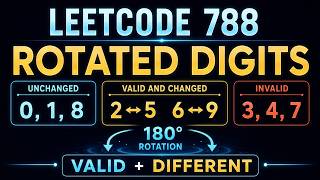

Programming Live with Larry 10 mins
788. Rotated Digits (Leetcode Easy)
Math Geeks 3 mins
Leetcode solving: 788. Rotated Digits
Sleepy Cracker 7 mins
LeetCode 788 | Rotated Digits | DP | Java
Aslam Coding 12 mins
LeetCode 788 | Rotated Digits | C++ Solution in Hindi | Amazon, Google, Flipkart 🔥
Muhammad Marenah 10 mins
788. Rotated Digits | LeetCode Using Python
5 videos
did my crawler come up with invalid videos ? drop me a line.
Solved On The Same Day
2 easy
- problem 783: Minimum Distance Between BST Nodes
- problem 796: Rotate String
- problem 393: UTF-8 Validation
- problem 787: Cheapest Flights Within K Stops
5 solutions
October 6, 2023
Extra
There are a few extra pages giving you some insights into my setup:
- Tech Stack - my development environment and tools
- AI - how AI helped me create this website (NOT solving the problems)
- Progress - progression over time
- Quality - code quality