Python 0808.py
class Solution:
    @cache
    def deeper(self, a, b):
        emptyA = a <= 0
        emptyB = b <= 0
        if emptyA and emptyB:
            return 0.5
        if emptyA:
            return 1
        if emptyB:
            return 0

        m = self.deeper(a - 4, b)
        n = self.deeper(a - 3, b - 1)
        o = self.deeper(a - 2, b - 2)
        p = self.deeper(a - 1, b - 3)
        return (m + n + o + p) / 4

    def soupServings(self, n: int) -> float:
        # result converges to 1
        if n > 4900:
            return 1

        # reduce state space, round up
        simpler = (n + 24) // 25
        return self.deeper(simpler, simpler)
26 lines
|
684 bytes
|
submitted May 18, 2024
|
GitHub
9% comment ratio
|
tab size 4
|
low complexity
Difficulty
This problem is ranked as
and has an acceptance rate of about 60% (200k+ submissions).
Typical patterns to solve this problem:
easy
medium
hard
and has an acceptance rate of about 60% (200k+ submissions).
Typical patterns to solve this problem:
- Dynamic Programming
- Math
- Probability And Statistics
I solved 663 easy, 1250 medium and 309 hard problems
AI Disclaimer
Every single line of code was written by me, 100% from scratch, between August 2023 and August 2024.
However, two years later I set up this website and used various AI tools to generate most of the walkthrough / explanations below.
See this dedicated page for more details.
However, two years later I set up this website and used various AI tools to generate most of the walkthrough / explanations below.
See this dedicated page for more details.
Code Walkthrough
Overview
The provided implementation computes a probability value based on two integer parameters that are progressively reduced through a recursive process. The public entry point is soupServings, which first checks for a threshold condition, then scales the input to a smaller domain before delegating the core computation to the helper method deeper. The helper method uses memoization to avoid redundant work and evaluates four possible transitions at each recursive step, ultimately returning a floating-point result.
Key Steps
Early termination for large inputs
if n > 4900:
    return 1
When the original argument exceeds a predefined bound, the function immediately returns the maximal probability value. This shortcut prevents the algorithm from exploring an excessively deep recursion tree for inputs that are known to converge to the limiting result.
Scaling the state space
simpler = (n + 24) // 25
return self.deeper(simpler, simpler)
The input n is transformed by rounding up to the nearest multiple of 25 and then dividing by 25. This reduction maps the original problem onto a much smaller integer lattice while preserving the relative proportions required for the recursive evaluation. The scaled value is used as both arguments to deeper, establishing a symmetric starting state.
Recursive probability calculation with memoization
@cache
def deeper(self, a, b):
    emptyA = a <= 0
    emptyB = b <= 0
    if emptyA and emptyB:
        return 0.5
    if emptyA:
        return 1
    if emptyB:
        return 0

    m = self.deeper(a - 4, b)
    n = self.deeper(a - 3, b - 1)
    o = self.deeper(a - 2, b - 2)
    p = self.deeper(a - 1, b - 3)
    return (m + n + o + p) / 4
The deeper method is decorated with @cache, which automatically stores the result of each unique (a, b) pair. This memoization ensures that each sub-problem is solved at most once, turning an exponential recursion into a tractable dynamic programming solution.
The method first determines whether either argument has reached a non-positive value. If both are non-positive, the function returns a neutral probability of 0.5. If only the first argument is non-positive, the result is 1, indicating a favorable outcome for that side; conversely, if only the second argument is non-positive, the result is 0.
When neither argument is exhausted, the function explores four possible reductions of the state: decreasing a by 4 while leaving b unchanged, decreasing a by 3 and b by 1, decreasing both by 2, and decreasing a by 1 while decreasing b by 3. The results of these four recursive calls are averaged, reflecting an equal probability of each transition occurring.
Edge Cases Handled
The base conditions explicitly address the scenario where both parameters have become non-positive simultaneously, returning a midpoint probability. The case where only the first parameter is non-positive yields the maximal probability, while the symmetric case for the second parameter yields the minimal probability. These conditions guarantee that the recursion terminates correctly even when the decrement steps overshoot the zero boundary.
The scaling step uses integer division with rounding up, ensuring that any positive n maps to at least one unit in the reduced domain. This prevents a degenerate situation where the scaled value could become zero before the recursion begins, which would otherwise trigger the base case prematurely.
The early return for n > 4900 handles extremely large inputs by recognizing that the probability converges to the upper bound, thereby avoiding unnecessary recursion depth and potential stack overflow.
Performance Optimizations
Memoization via the @cache decorator eliminates repeated evaluation of identical sub-problems, turning the naive exponential recursion into a polynomial-time computation over the reduced state space. The scaling of the input by a factor of 25 dramatically shrinks the number of distinct (a, b) pairs that need to be explored, reducing both the number of recursive calls and the size of the cache.
The explicit cutoff for inputs larger than 4900 provides a constant-time shortcut for a substantial portion of the input domain, bypassing the recursive machinery entirely. By rounding up during the scaling step, the implementation ensures that the reduced problem size is as small as possible while still preserving correctness, further limiting the depth of the recursion tree.
Collectively, these techniques produce a solution that runs efficiently even for inputs near the upper bound of the problem’s constraints, delivering the final probability with minimal computational overhead.
written by openai gpt
ELI5 - Simplified Explanation
Imagine there are two large bowls of delicious soup. Some bowls are almost empty and others are very full. The computer is trying to figure out what happens if you keep serving spoonfuls of soup until the bowls run out.
The first part of the code checks if there is any soup left. If both bowls become empty at the exact same time, it counts that as a tie. If the first bowl runs out before the second one, it declares a win for the first bowl. If the second bowl runs out first, it marks that as a loss for the first bowl.
When there is plenty of soup, the code pretends to be a little robot that keeps scooping out soup in four different ways. It takes a different amount from each bowl until there is nothing left to scoop. Because there are four different ways to scoop, it adds up the results and divides them by four to find the average.
Sometimes the bowls are so big that the first bowl will almost certainly run out first, no matter what happens. The code is smart enough to know that if the bowls are bigger than a certain size, it can stop guessing and just say the first bowl wins. It also makes the math easier by shrinking the big bowls down into smaller portions so the computer does not get tired while counting. It remembers the answers it already found so it does not have to do the same work again.
written by google gemini
Code Quality
Several LLMs ranked my code quality on a scale from 1 (very poor) to 10 (outstanding):
n = 27
|
median = 7
|
μ = 6.96
|
σ = 1.32
Complexity Analysis
not analyzed yet
Other Solutions
I wrote a basic crawler to find other solutions to that problem.
Obviously, I did that after I solved the problem myself.
In general, AlgoMonster and WalkCCC solutions are high-quality and always worth a look.
I haven't checked most of the other solutions, but they might be helpful as well.
And of course, the LeetCode forum is always a good place (or even the best) to look for alternative approaches.
(click on a column header to sort the table)
| author | |||||||||
|---|---|---|---|---|---|---|---|---|---|
| author | solutions | ||||||||
| www | AlgoMonster | C++ | Java | Python | TS | ||||
| WalkCCC | C++ | Java | Python | ||||||
| leetcode.ca | C++ | Rust | Java | C# | Go | Python | TS | ||
| LeetcodeHelp | C++ | Java | Python | ||||||
| Progiez | C++ | Java | Python | ||||||
| github | black-shadows | C++ | |||||||
| charles-wangkai | Java | ||||||||
| fsq | C++ | ||||||||
| JoshCrozier | JS | ||||||||
| keineahnung2345 | C++ | ||||||||
| ruoru | Rust | ||||||||
| suxrobGM | C# | ||||||||
| wisdompeak | C++ | ||||||||
| zfang399 | C++ | ||||||||
| AlgoMonster | C++, Python, Java, TypeScript | ||||||||
| WalkCCC | C++, Python, Java | ||||||||
| leetcode.ca | C++, C#, Go, Java, Python, Rust, TypeScript | ||||||||
| LeetcodeHelp | C++, Java, Python | ||||||||
| Progiez | C++, Java, Python | ||||||||
| black-shadows | C++, C++ | ||||||||
| charles-wangkai | Java | ||||||||
| fsq | C++ | ||||||||
| JoshCrozier | JavaScript | ||||||||
| keineahnung2345 | C++ | ||||||||
| ruoru | Rust | ||||||||
| suxrobGM | C# | ||||||||
| wisdompeak | C++ | ||||||||
| zfang399 | C++ |
29 links
|
14 authors
|
8 languages
Videos
These are a few popular YouTube videos for this problem:
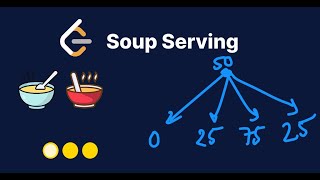



Codevery 12 mins
Leetcode 808 - soup servings
Study Placement 21 mins
Leetcode 808 🔥 Soup Servings | Optimal DP + Probability Explained
ExpertFunda 25 mins
Soup Servings | Leetcode 808 | Memoization Technique
impoldev 10 mins
Soup Servings | LeetCode 808 - Python
Developer Coder 46 mins
Soup Servings | LeetCode 808 | Dynamic Programming | 2 Approaches | Java Code | Developer Coder
5 videos
did my crawler come up with invalid videos ? drop me a line.
Solved On The Same Day
1 easy
- problem 3046: Split the Array
2 solutions
May 18, 2024
Extra
There are a few extra pages giving you some insights into my setup:
- Tech Stack - my development environment and tools
- AI - how AI helped me create this website (NOT solving the problems)
- Progress - progression over time
- Quality - code quality