Python 0827.py
class Solution:
    def largestIsland(self, grid: List[List[int]]) -> int:
        result = 0
        width  = len(grid[0])
        height = len(grid)

        # convert 1s to an ID and store the size of each island
        id      = 2   # start at 2 because 0 and 1 already used in grid
        islands = { } # size of each island, water has size 0 (simplifies code)
        for y in range(height):
            for x in range(width):
                if grid[y][x] == 1:
                    todo = [ (x, y) ]
                    have = set()
                    while todo:
                        tx, ty = todo.pop()
                        if (tx, ty) in have:
                            continue
                        have.add((tx, ty))
                        if tx > 0 and grid[ty][tx - 1] == 1:
                            todo.append(( tx - 1, ty ))
                        if ty > 0 and grid[ty - 1][tx] == 1:
                            todo.append(( tx, ty - 1 ))
                        if tx < width  - 1 and grid[ty][tx + 1] == 1:
                            todo.append(( tx + 1, ty ))
                        if ty < height - 1 and grid[ty + 1][tx] == 1:
                            todo.append(( tx, ty + 1 ))

                    # store size and ID
                    islands[id] = len(have)
                    for hx, hy in have:
                        grid[hy][hx] = id
                    id += 1

        # no islands yet => a new one will pop up with size 1
        if not islands:
            return 1
        if len(islands) == 1:
            # a single island, no bridges possible
            covered  = sum(islands.values())
            complete = width * height
            if covered == complete:
                return complete # cover the whole grid, don't change a cell
            else:
                return covered + 1

        result = 0
        for y in range(height):
            for x in range(width):
                if grid[y][x] == 0:
                    bridging = set() # be careful with connecting an island with itself !
                    if x > 0:
                        bridging.add(grid[y][x - 1])
                    if y > 0:
                        bridging.add(grid[y - 1][x])
                    if x < width  - 1:
                        bridging.add(grid[y][x + 1])
                    if y < height - 1:
                        bridging.add(grid[y + 1][x])

                    # ignore water
                    bridging.discard(0)

                    total = 1          # current cell turns from water to land, too
                    for b in bridging: # and all distinct islands next to it
                        total += islands[b]

                    result = max(result, total)

        return result
70 lines
|
2848 bytes
|
submitted December 20, 2023
|
GitHub
19% comment ratio
|
tab size 4
|
more than moderate complexity
Difficulty
This problem is ranked as
and has an acceptance rate of about 57% (700k+ submissions).
Typical patterns to solve this problem:
easy
medium
hard
and has an acceptance rate of about 57% (700k+ submissions).
Typical patterns to solve this problem:
- Array
- Breadth First Search
- Depth First Search
- Matrix
- Union Find
I solved 663 easy, 1250 medium and 309 hard problems
AI Disclaimer
Every single line of code was written by me, 100% from scratch, between August 2023 and August 2024.
However, two years later I set up this website and used various AI tools to generate most of the walkthrough / explanations below.
See this dedicated page for more details.
However, two years later I set up this website and used various AI tools to generate most of the walkthrough / explanations below.
See this dedicated page for more details.
Code Walkthrough
Overview
The provided implementation solves the problem of finding the largest possible island size after converting at most one water cell (value 0) into land (value 1). An island is defined as a group of orthogonally adjacent land cells. The algorithm proceeds in three conceptual phases: labeling existing islands with unique identifiers, handling special configurations where no or a single island exists, and evaluating each water cell as a potential bridge to merge neighboring islands.
Identifying Islands and Assigning IDs
The first phase scans the entire grid to replace each group of 1s with a distinct integer identifier starting from 2. This identifier doubles as a key in a dictionary that records the size of the corresponding island.
id      = 2
islands = {}
for y in range(height):
    for x in range(width):
        if grid[y][x] == 1:
            todo = [(x, y)]
            have = set()
            while todo:
                tx, ty = todo.pop()
                if (tx, ty) in have:
                    continue
                have.add((tx, ty))
                if tx > 0 and grid[ty][tx - 1] == 1:
                    todo.append((tx - 1, ty))
                if ty > 0 and grid[ty - 1][tx] == 1:
                    todo.append((tx, ty - 1))
                if tx < width - 1 and grid[ty][tx + 1] == 1:
                    todo.append((tx + 1, ty))
                if ty < height - 1 and grid[ty + 1][tx] == 1:
                    todo.append((tx, ty + 1))
            islands[id] = len(have)
            for hx, hy in have:
                grid[hy][hx] = id
            id += 1
The depth-first search uses an explicit stack (todo) and a set (have) to avoid revisiting cells. By overwriting the original grid with the island identifier, later phases can query the island belonging to any cell in constant time.
Handling Edge Cases
Two edge conditions are addressed before the main bridge evaluation loop.
- Empty island set - when the grid contains only water, the algorithm returns 1 because flipping any cell creates a single-cell island.
if not islands:
return 1- Single island scenario - when exactly one island exists, the code distinguishes between a completely filled grid and a grid with at least one water cell. If the grid is already full, the current island size is returned unchanged; otherwise, the size can be increased by one through a conversion.
if len(islands) == 1:
    covered  = sum(islands.values())
    complete = width * height
    if covered == complete:
        return complete
    else:
        return covered + 1
These branches guarantee correct results for degenerate inputs without entering the more expensive bridge-checking loop.
Evaluating Potential Bridges
The core of the algorithm iterates over every water cell, collects the identifiers of distinct neighboring islands, and computes the combined size that would result from turning the water cell into land.
result = 0
for y in range(height):
    for x in range(width):
        if grid[y][x] == 0:
            bridging = set()
            if x > 0:
                bridging.add(grid[y][x - 1])
            if y > 0:
                bridging.add(grid[y - 1][x])
            if x < width - 1:
                bridging.add(grid[y][x + 1])
            if y < height - 1:
                bridging.add(grid[y + 1][x])
            bridging.discard(0)
            total = 1
            for b in bridging:
                total += islands[b]
            result = max(result, total)
return result
Key aspects of this step include:
- The use of a
set(bridging) to automatically eliminate duplicate identifiers, preventing an island from being counted multiple times when it touches the water cell on more than one side. - The explicit removal of
0from the set, which represents water and should not contribute to the size calculation. - Adding
1to the total to account for the newly converted cell itself.
The maximum across all water cells yields the answer.
Performance Optimizations
Several design choices contribute to efficient execution:
- In-place labeling - By overwriting the original grid with island identifiers, the algorithm avoids allocating a separate structure for cell-to-island mapping, reducing memory pressure and improving cache locality.
- Early exits for trivial cases - The checks for an empty island set and a single island allow the function to return immediately for inputs that would otherwise trigger the full double loop over the grid.
- Set-based duplicate elimination - Using a
setto collect neighboring identifiers eliminates the need for explicit conditional checks for each direction, simplifying the code while still ensuring each island contributes its size only once. - Iterative DFS with a stack - The depth-first search avoids recursion, preventing stack overflow on large grids and allowing the interpreter to manage the call stack more efficiently.
- Minimal neighbor checks - Each cell examines at most four neighbors, and the boundary conditions are handled with simple index comparisons, keeping the inner loop lightweight.
These choices together enable the solution to handle large grids within reasonable time and memory constraints while maintaining clear and maintainable code structure.
written by openai gpt
ELI5 - Simplified Explanation
Imagine a giant map of the ocean made of square grid tiles. Some of these tiles are pieces of land, and some are water. When pieces of land are touching, they form a big island.
The first part of this code looks at the whole map to find these hidden islands. It goes square by square and, whenever it finds a piece of land that has not been labeled yet, it explores all the nearby land to see how big that island is. It marks all those connected squares with a special number so that it knows exactly which bits belong together. It even keeps a little notebook that remembers the number and the size of every island it finds.
After finishing the map and knowing the size of every island, the code looks for a way to make the biggest island possible. It looks for every spot that is currently water. It pretends to turn that one water square into land. When it does that, it checks if that square is touching any nearby islands. If it is, it adds the sizes of those neighboring islands onto the one square it just changed. It keeps track of the biggest total it can create by trying this at every single water spot on the map. It eventually figures out how to build the largest playground by connecting land in the best way possible.
written by google gemini
Code Quality
Several LLMs ranked my code quality on a scale from 1 (very poor) to 10 (outstanding):
n = 27
|
median = 7
|
μ = 7.22
|
σ = 1.23
Complexity Analysis
Time: polynomial
As a rule of thumb, the maximum input size for one second execution time is
As a rule of thumb, the maximum input size for one second execution time is
- factorial: up to 10 elements
- exponential: up to 20 elements
- polynomial: a few thousand elements
- loglinear: up to 100,000 elements
- linear: a few million elements
- logarithmic: a billion elements
- constant: practically unlimited
generated automatically
Other Solutions
I wrote a basic crawler to find other solutions to that problem.
Obviously, I did that after I solved the problem myself.
In general, AlgoMonster and WalkCCC solutions are high-quality and always worth a look.
I haven't checked most of the other solutions, but they might be helpful as well.
And of course, the LeetCode forum is always a good place (or even the best) to look for alternative approaches.
(click on a column header to sort the table)
| author | ||||||||||
|---|---|---|---|---|---|---|---|---|---|---|
| author | solutions | |||||||||
| www | AlgoMonster | C++ | Python | Java | TS | |||||
| WalkCCC | C++ | Java | ||||||||
| leetcode.ca | C++ | Python | Java | Rust | Go | TS | ||||
| LeetcodeHelp | C++ | Python | Java | |||||||
| Progiez | C++ | Python | Java | |||||||
| github | black-shadows | C++ | ||||||||
| charles-wangkai | Java | |||||||||
| everthis | JS | |||||||||
| fpdjsns | C++ | |||||||||
| JoshCrozier | JS | |||||||||
| lkwq007 | Python | |||||||||
| ruoru | Rust | |||||||||
| Shamik07 | Dart | |||||||||
| suxrobGM | C# | |||||||||
| trung-hn | Python | |||||||||
| varunu28 | Java | |||||||||
| zfang399 | C++ | |||||||||
| AlgoMonster | C++, Python, Java, TypeScript | |||||||||
| WalkCCC | C++, Java | |||||||||
| leetcode.ca | C++, Go, Java, Python, Rust, TypeScript | |||||||||
| LeetcodeHelp | C++, Java, Python | |||||||||
| Progiez | C++, Java, Python | |||||||||
| black-shadows | C++, C++ | |||||||||
| charles-wangkai | Java | |||||||||
| everthis | JavaScript | |||||||||
| fpdjsns | C++ | |||||||||
| JoshCrozier | JavaScript | |||||||||
| lkwq007 | Python | |||||||||
| ruoru | Rust | |||||||||
| Shamik07 | Dart | |||||||||
| suxrobGM | C# | |||||||||
| trung-hn | Python | |||||||||
| varunu28 | Java | |||||||||
| zfang399 | C++ |
30 links
|
17 authors
|
9 languages
Videos
These are a few popular YouTube videos for this problem:

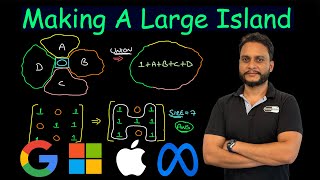


NeetCodeIO 27 mins
Making A Large Island - Leetcode 827 - Python
Techdose 26 mins
Making A Large Island | Leetcode 827
Happy Coding 25 mins
LeetCode 827. Making A Large Island
Programming Live with Larry 15 mins
Daily Leetcode #488: Aug 01, 2021 - 827. Making A Large Island
AlgorithmicIQ 28 mins
Leetcode 827 Making A Large Island - Understand Solution To This Hard Problem
5 videos
did my crawler come up with invalid videos ? drop me a line.
Solved On The Same Day
7 easy
- problem 1752: Check if Array Is Sorted and Rotated
- problem 1791: Find Center of Star Graph
- problem 1971: Find if Path Exists in Graph
- problem 1984: Minimum Difference Between Highest and Lowest of K Scores
- problem 2446: Determine if Two Events Have Conflict
- problem 2706: Buy Two Chocolates
- problem 2839: Check if Strings Can be Made Equal With Operations I
- problem 684: Redundant Connection
- problem 1008: Construct Binary Search Tree from Preorder Traversal
- problem 1026: Maximum Difference Between Node and Ancestor
- problem 1034: Coloring A Border
- problem 1625: Lexicographically Smallest String After Applying Operations
- problem 1765: Map of Highest Peak
- problem 2192: All Ancestors of a Node in a Directed Acyclic Graph
- problem 2477: Minimum Fuel Cost to Report to the Capital
- problem 2492: Minimum Score of a Path Between Two Cities
- problem 2596: Check Knight Tour Configuration
- problem 2658: Maximum Number of Fish in a Grid
- problem 1036: Escape a Large Maze
20 solutions
December 20, 2023
Extra
There are a few extra pages giving you some insights into my setup:
- Tech Stack - my development environment and tools
- AI - how AI helped me create this website (NOT solving the problems)
- Progress - progression over time
- Quality - code quality