Python 0828.py
class Solution:
    def uniqueLetterString(self, s: str) -> int:
        result = 0

        size = len(s)

        # positions when character was seen
        seen = defaultdict(list)
        for i, c in enumerate(s):
            seen[c].append(i)

        for c in seen:
            # padding to properly process begin and end
            have = [ -1 ] + seen[c] + [ size ]
            for prev, current, next in zip(have, have[1:], have[2:]):
                left  = current - prev
                right = next - current
                result += left * right

        return result
20 lines
|
606 bytes
|
submitted April 23, 2024
|
GitHub
14% comment ratio
|
tab size 4
|
low complexity
Difficulty
This problem is ranked as
and has an acceptance rate of about 54% (100k+ submissions).
Typical patterns to solve this problem:
easy
medium
hard
and has an acceptance rate of about 54% (100k+ submissions).
Typical patterns to solve this problem:
- Dynamic Programming
- Hash Table
- String
I solved 663 easy, 1250 medium and 309 hard problems
AI Disclaimer
Every single line of code was written by me, 100% from scratch, between August 2023 and August 2024.
However, two years later I set up this website and used various AI tools to generate most of the walkthrough / explanations below.
See this dedicated page for more details.
However, two years later I set up this website and used various AI tools to generate most of the walkthrough / explanations below.
See this dedicated page for more details.
Code Walkthrough
Overview
The provided implementation computes the total contribution of each distinct character in a string to the count of substrings that contain that character exactly once. It does this by first recording every index where each character appears, then for each occurrence it calculates how many substrings treat that occurrence as the unique appearance of the character. The final sum of all such contributions yields the answer.
Key Steps
The algorithm can be broken down into a sequence of logical phases, each reflected by a concise code fragment.
Collecting character positions
seen = defaultdict(list)
for i, c in enumerate(s):
    seen[c].append(i)
During this pass the code builds a mapping from each character to a list of its indices in the original string. The use of defaultdict(list) eliminates the need for explicit existence checks, allowing the list to be extended directly.
Preparing sentinel boundaries
have = [-1] + seen[c] + [size]For every character c, the list of its positions is padded with -1 at the front and size (the length of the string) at the end. These sentinel values simplify the handling of edge substrings that start before the first occurrence or end after the last occurrence.
Iterating over triples of consecutive positions
for prev, current, next in zip(have, have[1:], have[2:]):
    left  = current - prev
    right = next - current
    result += left * right
The zip construction walks through three aligned windows of the padded list: the previous index, the current index, and the next index. For each occurrence (current) the distance to the previous occurrence (left) and the distance to the next occurrence (right) are computed. Multiplying these distances gives the number of substrings where this particular occurrence is the sole appearance of the character. The product is accumulated into result.
Returning the accumulated total
return resultAfter all characters have been processed, the function returns the sum of contributions, which matches the required count of substrings with unique characters.
Edge Cases
The sentinel padding (-1 and size) ensures that characters appearing at the very beginning or end of the string are treated correctly. When a character occurs only once, the padded list becomes [-1, index, size]. The computed left equals index - (-1), i.e., index + 1, representing all possible start positions up to that character. The right equals size - index, representing all possible end positions from that character onward. Their product therefore counts every substring that includes the sole occurrence, which is precisely the expected contribution.
If the input string is empty, size is zero, the seen dictionary remains empty, and the outer loop over seen does not execute. Consequently, result stays at its initial value of zero, which is the correct answer for an empty input.
When a character repeats consecutively, such as "aa", the padded list for 'a' becomes [-1, 0, 1, 2]. The iteration over triples yields two contributions: one for the first 'a' with left = 1 and right = 1, and one for the second 'a' with the same values. Each contribution adds one, reflecting the two substrings "a" (at positions 0 and 1) that contain a unique 'a'. Substrings like "aa" are correctly excluded because neither occurrence is unique within that substring.
Performance Optimizations
The implementation avoids nested loops over the string length. By aggregating indices per character in a single pass and then processing each character’s list independently, the algorithm scales linearly with the total number of characters. The use of defaultdict(list) eliminates conditional checks during index collection, reducing overhead.
Padding each list with sentinel values removes the need for special-case logic when handling the first or last occurrence of a character. This uniform treatment allows the inner loop to use a simple zip over three slices, which is both concise and efficient in Python because it creates lightweight iterator objects rather than materializing intermediate lists.
Multiplication of the left and right distances directly yields the count of relevant substrings for a given occurrence, bypassing any explicit enumeration of substrings. This arithmetic shortcut eliminates combinatorial explosion and keeps the runtime proportional to the number of character occurrences rather than the number of possible substrings.
written by openai gpt
ELI5 - Simplified Explanation
Imagine that the letters in the word are standing in a long line, and each letter wants to count the special spots where it is the only one of its kind. The computer looks at every letter one by one to see where it lives in that line. It keeps a secret notebook to remember every place each letter appears.
Once the notebook is full, a special math game begins for every type of letter. The computer looks at the current place of a letter and checks how far it is from the neighbor on the left and how far it is from the neighbor on the right. By multiplying those two distances together, the computer learns exactly how many different groups of letters can be made where that specific character stays all by itself. It adds all those little puzzle pieces together until every spot for every letter has been counted.
written by google gemini
Code Quality
Several LLMs ranked my code quality on a scale from 1 (very poor) to 10 (outstanding):
n = 26
|
median = 8
|
μ = 8.12
|
σ = 0.97
Complexity Analysis
Time: linear
As a rule of thumb, the maximum input size for one second execution time is
As a rule of thumb, the maximum input size for one second execution time is
- factorial: up to 10 elements
- exponential: up to 20 elements
- polynomial: a few thousand elements
- loglinear: up to 100,000 elements
- linear: a few million elements
- logarithmic: a billion elements
- constant: practically unlimited
generated automatically
Other Solutions
I wrote a basic crawler to find other solutions to that problem.
Obviously, I did that after I solved the problem myself.
In general, AlgoMonster and WalkCCC solutions are high-quality and always worth a look.
I haven't checked most of the other solutions, but they might be helpful as well.
And of course, the LeetCode forum is always a good place (or even the best) to look for alternative approaches.
(click on a column header to sort the table)
| author | |||||||||
|---|---|---|---|---|---|---|---|---|---|
| author | solutions | ||||||||
| www | AlgoMonster | C++ | Python | Java | TS | ||||
| WalkCCC | C++ | Python | Java | ||||||
| leetcode.ca | C++ | Rust | Python | Go | Java | TS | |||
| LeetcodeHelp | C++ | Python | Java | ||||||
| Progiez | C++ | Python | Java | ||||||
| github | black-shadows | C++ | |||||||
| everthis | JS | ||||||||
| halfrost | Go | ||||||||
| JoshCrozier | JS | ||||||||
| lkwq007 | Python | ||||||||
| lzl124631x | C++ | ||||||||
| ruoru | Rust | ||||||||
| suxrobGM | C# | ||||||||
| wisdompeak | C++ | ||||||||
| AlgoMonster | C++, Python, Java, TypeScript | ||||||||
| WalkCCC | C++, Python, Java | ||||||||
| leetcode.ca | C++, Go, Java, Python, Rust, TypeScript | ||||||||
| LeetcodeHelp | C++, Java, Python | ||||||||
| Progiez | C++, Java, Python | ||||||||
| black-shadows | C++, C++ | ||||||||
| everthis | JavaScript | ||||||||
| halfrost | Go | ||||||||
| JoshCrozier | JavaScript | ||||||||
| lkwq007 | Python | ||||||||
| lzl124631x | C++ | ||||||||
| ruoru | Rust | ||||||||
| suxrobGM | C# | ||||||||
| wisdompeak | C++ |
28 links
|
14 authors
|
8 languages
Videos
These are a few popular YouTube videos for this problem:
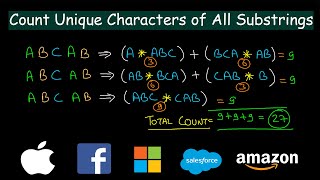

Techdose 23 mins
Count Unique Characters of All Substrings of a Given String | Leetcode 828
Kacy Codes 13 mins
WALKTHROUGH - LeetCode 828. Count Unique Characters of All Substrings of a Given String
Programming Live with Larry 28 mins
828. Count Unique Characters of All Substrings of a Given String (Leetcode Hard)
Infinity Solution's Concept Builder 31 mins
Leetcode 828: Count Unique Characters in all the substrings of a Given String | Easy Explanation
4 videos
did my crawler come up with invalid videos ? drop me a line.
Solved On The Same Day
1 hard
- problem 843: Guess the Word
2 solutions
April 23, 2024
Extra
There are a few extra pages giving you some insights into my setup:
- Tech Stack - my development environment and tools
- AI - how AI helped me create this website (NOT solving the problems)
- Progress - progression over time
- Quality - code quality