Python 0840.py
class Solution:
    def numMagicSquaresInside(self, grid: List[List[int]]) -> int:
        width  = len(grid[0])
        height = len(grid)

        def ismagic(x, y):
            # must be 9 distinct numbers
            unique = set()
            for j in range(3):
                for i in range(3):
                    unique.add(grid[y + j][x + i])
            # I got the next three checks from the discussion only, they are not obvious from the problem statement
            if len(unique) != 9:
                return False
            if min(unique) != 1:
                return False
            if max(unique) != 9:
                return False

            h1 = grid[y    ][x    ] + grid[y    ][x + 1] + grid[y    ][x + 2]
            h2 = grid[y + 1][x    ] + grid[y + 1][x + 1] + grid[y + 1][x + 2]
            h3 = grid[y + 2][x    ] + grid[y + 2][x + 1] + grid[y + 2][x + 2]
            v1 = grid[y    ][x    ] + grid[y + 1][x    ] + grid[y + 2][x    ]
            v2 = grid[y    ][x + 1] + grid[y + 1][x + 1] + grid[y + 2][x + 1]
            v3 = grid[y    ][x + 2] + grid[y + 1][x + 2] + grid[y + 2][x + 2]
            d1 = grid[y    ][x    ] + grid[y + 1][x + 1] + grid[y + 2][x + 2]
            d2 = grid[y    ][x + 2] + grid[y + 1][x + 1] + grid[y + 2][x    ]
            return h1 == h2 and h2 == h3 and h3 == v1 and v1 == v2 and v2 == v3 and v3 == d1 and d1 == d2

        result = 0
        for y in range(height - 2):
            for x in range(width - 2):
                if ismagic(x, y):
                    result += 1

        return result
36 lines
|
1606 bytes
|
submitted October 24, 2023
|
GitHub
6% comment ratio
|
tab size 4
|
low complexity
Difficulty
This problem is ranked as
and has an acceptance rate of about 55% (400k+ submissions).
Typical patterns to solve this problem:
easy
medium
hard
and has an acceptance rate of about 55% (400k+ submissions).
Typical patterns to solve this problem:
- Array
- Hash Table
- Math
- Matrix
I solved 663 easy, 1250 medium and 309 hard problems
AI Disclaimer
Every single line of code was written by me, 100% from scratch, between August 2023 and August 2024.
However, two years later I set up this website and used various AI tools to generate most of the walkthrough / explanations below.
See this dedicated page for more details.
However, two years later I set up this website and used various AI tools to generate most of the walkthrough / explanations below.
See this dedicated page for more details.
Code Walkthrough
Overview
The provided implementation defines a Solution class with a single method numMagicSquaresInside. The method receives a two-dimensional list grid and returns the count of 3 × 3 sub-grids that satisfy the definition of a magic square using the numbers 1 through 9 exactly once. The algorithm proceeds by iterating over every possible top-left coordinate of a 3 × 3 window, invoking a helper predicate to verify the magic-square property, and accumulating the total.
Core Logic
Dimension Extraction
width  = len(grid[0])
height = len(grid)
The code extracts the horizontal and vertical extents of the input matrix once, avoiding repeated length calculations inside the nested loops.
Magic-Square Predicate
The nested function ismagic(x, y) encapsulates all checks required for a candidate sub-grid whose top-left corner is at column x and row y.
Distinct-Number Verification
unique = set()
for j in range(3):
    for i in range(3):
        unique.add(grid[y + j][x + i])
if len(unique) != 9:
    return False
if min(unique) != 1:
    return False
if max(unique) != 9:
    return False
A set collects the nine values; the size test guarantees all entries are different. The subsequent min and max checks enforce that the values span exactly the range 1-9, which is a necessary condition for a 3 × 3 magic square using those digits.
Row, Column, and Diagonal Sums
h1 = grid[y    ][x    ] + grid[y    ][x + 1] + grid[y    ][x + 2]
h2 = grid[y + 1][x    ] + grid[y + 1][x + 1] + grid[y + 1][x + 2]
h3 = grid[y + 2][x    ] + grid[y + 2][x + 1] + grid[y + 2][x + 2]
v1 = grid[y    ][x    ] + grid[y + 1][x    ] + grid[y + 2][x    ]
v2 = grid[y    ][x + 1] + grid[y + 1][x + 1] + grid[y + 2][x + 1]
v3 = grid[y    ][x + 2] + grid[y + 1][x + 2] + grid[y + 2][x + 2]
d1 = grid[y    ][x    ] + grid[y + 1][x + 1] + grid[y + 2][x + 2]
d2 = grid[y    ][x + 2] + grid[y + 1][x + 1] + grid[y + 2][x    ]
return h1 == h2 and h2 == h3 and h3 == v1 and v1 == v2 and v2 == v3 and v3 == d1 and d1 == d2
The code computes the sum of each of the three rows (h1, h2, h3), three columns (v1, v2, v3), and the two diagonals (d1, d2). The final boolean expression ensures that all eight sums are equal, which is the defining property of a magic square.
Scanning the Grid
result = 0
for y in range(height - 2):
    for x in range(width - 2):
        if ismagic(x, y):
            result += 1
return result
The outer loops iterate only over positions where a full 3 × 3 window fits, i.e., up to height-2 rows and width-2 columns. For each candidate, the predicate is called; a true result increments the counter.
Edge Cases Handled
The implementation explicitly guards against several subtle conditions:
- Grids that are smaller than 3 × 3 are implicitly handled because the range limits (
height-2,width-2) become empty, resulting in a zero count without additional checks. - Sub-grids containing duplicate numbers are rejected by the
len(unique) != 9test. - Sub-grids that include numbers outside the 1-9 range are filtered out by the
minandmaxcomparisons. This prevents false positives where the distinctness condition holds but the values are not the required set. - The sum checks automatically reject any arrangement where rows, columns, or diagonals do not share the same total, covering cases such as rotated or reflected magic squares that still meet the numeric constraints.
Performance Optimizations
The code incorporates several practical optimizations that reduce unnecessary work:
- Single Pass Dimension Retrieval - Width and height are computed once before the loops, avoiding repeated attribute access.
- Early Rejection via Set Checks - By building the set of nine values first, the function can exit immediately when the distinctness or range conditions fail, bypassing the more expensive sum calculations for invalid candidates.
- Compact Loop Bounds - The iteration limits are calculated as
height - 2andwidth - 2, ensuring that the inner body never attempts to index outside the matrix, thus eliminating the need for boundary checks insideismagic. - Local Variable Access - All references to
grid,x, andyare captured from the enclosing scope, allowing the Python interpreter to resolve them quickly without repeated attribute lookups. - Straightforward Arithmetic - Row, column, and diagonal sums are expressed as direct additions of three elements each, avoiding function calls or list comprehensions that would add overhead.
These choices collectively keep the runtime proportional to the number of possible 3 × 3 windows, with constant-time work per window after the early exit checks.
Conclusion
The solution presents a clear, self-contained approach to counting magic squares within a matrix. It isolates the validation logic in a helper function, leverages set operations for distinctness, and performs explicit sum comparisons to enforce the magic-square property. The design handles edge conditions such as insufficient grid size and out-of-range values gracefully, while the early-exit strategy and tight loop bounds contribute to an efficient execution profile.
written by openai gpt
ELI5 - Simplified Explanation
Think of this code like playing a game of hide and seek with a special set of building blocks. Imagine there is a big tray filled with numbers arranged in a grid. The goal is to walk across the grid and look at every little three-by-three square hidden inside it.
When the code finds one of these small squares, it acts like a detective to see if it is a magic square. First, it looks at the numbers inside the box to make sure they are all different and that every number from one to nine is present. If even one number is missing or repeated, the detective knows it is not magic and moves on.
If the numbers are all correct, the detective starts adding them up. It adds the numbers in every row, every column, and even the two diagonal lines that cross through the middle. For a square to be truly magic, every single one of those sums must be the exact same number. If the row across the top equals the same as the column down the side and the diagonal line, then that square is a winner. The code keeps track of how many of these magic squares it finds, counting them up one by one until it has checked every corner of the tray.
written by google gemini
Code Quality
Several LLMs ranked my code quality on a scale from 1 (very poor) to 10 (outstanding):
n = 27
|
median = 7
|
μ = 6.85
|
σ = 1.15
Complexity Analysis
Time: polynomial
As a rule of thumb, the maximum input size for one second execution time is
As a rule of thumb, the maximum input size for one second execution time is
- factorial: up to 10 elements
- exponential: up to 20 elements
- polynomial: a few thousand elements
- loglinear: up to 100,000 elements
- linear: a few million elements
- logarithmic: a billion elements
- constant: practically unlimited
generated automatically
Other Solutions
I wrote a basic crawler to find other solutions to that problem.
Obviously, I did that after I solved the problem myself.
In general, AlgoMonster and WalkCCC solutions are high-quality and always worth a look.
I haven't checked most of the other solutions, but they might be helpful as well.
And of course, the LeetCode forum is always a good place (or even the best) to look for alternative approaches.
(click on a column header to sort the table)
| author | |||||||||
|---|---|---|---|---|---|---|---|---|---|
| author | solutions | ||||||||
| www | AlgoMonster | C++ | Java | Python | TS | ||||
| WalkCCC | C++ | Java | Python | ||||||
| leetcode.ca | C++ | Java | Rust | Python | JS | Go | TS | ||
| LeetcodeHelp | C++ | Java | Python | ||||||
| Progiez | C++ | Java | Python | ||||||
| github | BigEggStudy | C# | |||||||
| black-shadows | C++ | ||||||||
| charles-wangkai | Java | ||||||||
| fsq | C++ | ||||||||
| JoshCrozier | JS | ||||||||
| keineahnung2345 | C++ | ||||||||
| lkwq007 | Python | ||||||||
| lzl124631x | C++ | ||||||||
| ruoru | Rust | ||||||||
| suxrobGM | C# | ||||||||
| varunu28 | Java | ||||||||
| withaarzoo | C++ | ||||||||
| zfang399 | C++ | ||||||||
| AlgoMonster | C++, Python, Java, TypeScript | ||||||||
| WalkCCC | C++, Python, Java | ||||||||
| leetcode.ca | C++, Go, Java, JavaScript, Python, Rust, TypeScript | ||||||||
| LeetcodeHelp | C++, Java, Python | ||||||||
| Progiez | C++, Java, Python | ||||||||
| BigEggStudy | C# | ||||||||
| black-shadows | C++, C++ | ||||||||
| charles-wangkai | Java | ||||||||
| fsq | C++ | ||||||||
| JoshCrozier | JavaScript | ||||||||
| keineahnung2345 | C++ | ||||||||
| lkwq007 | Python | ||||||||
| lzl124631x | C++ | ||||||||
| ruoru | Rust | ||||||||
| suxrobGM | C# | ||||||||
| varunu28 | Java | ||||||||
| withaarzoo | C++ | ||||||||
| zfang399 | C++ |
33 links
|
18 authors
|
8 languages
Videos
These are a few popular YouTube videos for this problem:

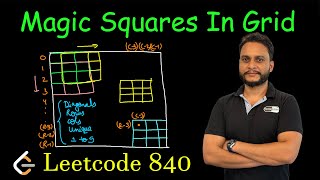




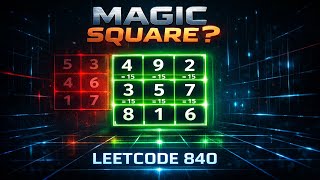
ShashCode 21 mins
840. Magic Squares In Grid | Leetcode Daily Challenge | DSA | Hindi
Techdose 12 mins
Magic Squares In Grid | Hashmap | Leetcode 840
Alpha-Code 14 mins
LeetCode 840 - Magic Squares In Grid - Java
Programming Live with Larry 12 mins
Daily Leetcode #2100: Dec 30, 2025 - 840. Magic Squares In Grid
Programming Live with Larry 15 mins
Daily Leetcode #1592: Aug 09, 2024 - 840. Magic Squares In Grid
Developer Coder 11 mins
Magic Squares In Grid | Leetcode 840 | Java Code | Developer Coder
Code Thoughts 12 mins
Magic Squares in Grid | Spiral | Daily Leetcode in Java | Leetcode 840 in Java | Must DO MAANG DSA
impoldev 10 mins
Magic Squares In Grid | LeetCode 840 - Python
ExpertFunda 19 mins
Magic Squares in Grid | LeetCode 840 Explained with Intuition, Diagrams & Java Solution
Code Scribbler 7 mins
LeetCode 840: Magic Squares In Grid | Java Solution | Matrix Traversal
Code Scribbler 7 mins
LeetCode 840: Magic Squares In Grid | CSharp Solution | Matrix Traversal
11 videos
did my crawler come up with invalid videos ? drop me a line.
Similar Problems
- problem 1895: Largest Magic Square
1 similar problem
Solved On The Same Day
1 easy
- problem 884: Uncommon Words from Two Sentences
- problem 781: Rabbits in Forest
- problem 789: Escape The Ghosts
- problem 817: Linked List Components
- problem 822: Card Flipping Game
- problem 861: Score After Flipping Matrix
- problem 870: Advantage Shuffle
- problem 904: Fruit Into Baskets
- problem 745: Prefix and Suffix Search
10 solutions
October 24, 2023
Extra
There are a few extra pages giving you some insights into my setup:
- Tech Stack - my development environment and tools
- AI - how AI helped me create this website (NOT solving the problems)
- Progress - progression over time
- Quality - code quality